Conductor and dancers
One micro:bit plays a tune and sends a cue as each phrase starts; robots dance the move for each cue, in time.
In a drone light show, hundreds of drones move together. They do not watch each other: each one waits for a signal, then does its part of the show.
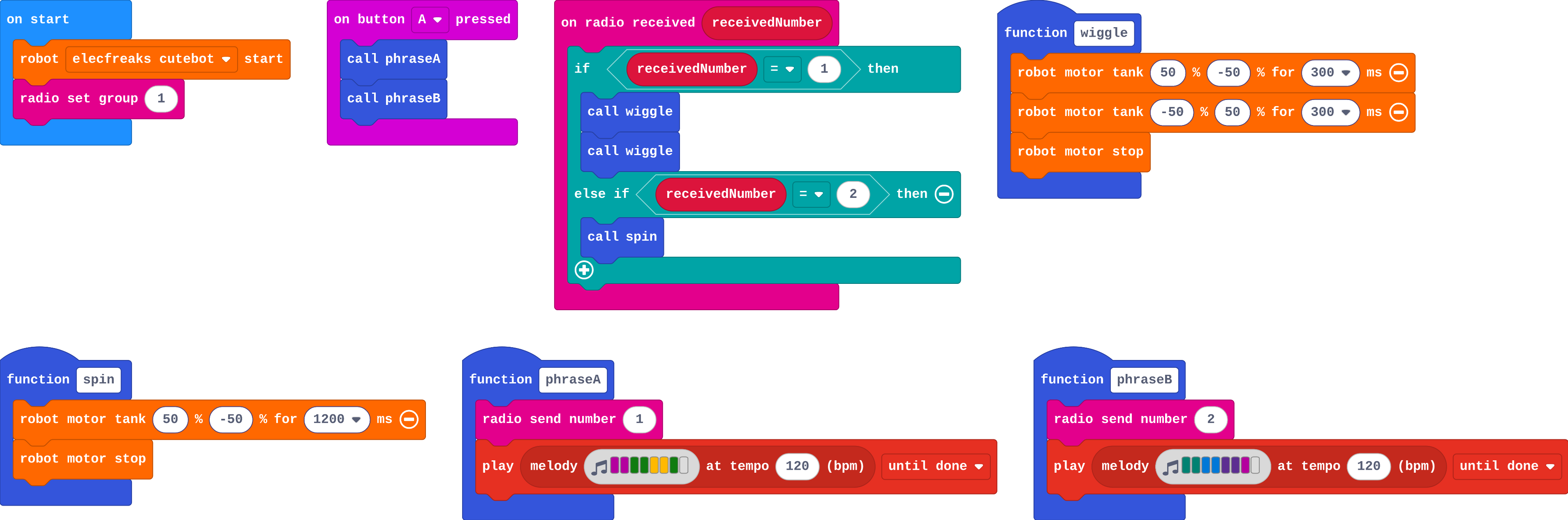
A conductor micro:bit plays a tune, one phrase at a time. As each phrase starts, it sends a cue by radio: 1 for the first phrase, 2 for the second. Every robot that hears a cue dances the move for it, so the robots keep in time with the music.
wiggle and spin are the dance moves from lesson 2. In the simulator, press A on one micro:bit: it conducts, and the other robot dances.
- Predict: Read the code and say what it will do before you run anything. A wrong guess is fine: it shows you what to look for.
- Run: Run it and compare the result with your prediction.
- Investigate: Trace how each line of code connects to what you see.
- Modify: Change the code on purpose and check the result.
- Make: Build something new using what you have learned. Expect a few tries; that is normal.
Make your prediction first. Help opens once you've locked it in.
Predict
Show as code
function wiggle () {
    robot.motorTank(50, -50, 300)
    robot.motorTank(-50, 50, 300)
    robot.motorStop()
}
function spin () {
    robot.motorTank(50, -50, 1200)
    robot.motorStop()
}
function phraseA () {
    radio.sendNumber(1)
    music.play(music.stringPlayable("C C G G A A G - ", 120), music.PlaybackMode.UntilDone)
}
function phraseB () {
    radio.sendNumber(2)
    music.play(music.stringPlayable("F F E E D D C - ", 120), music.PlaybackMode.UntilDone)
}
input.onButtonPressed(Button.A, function () {
    phraseA()
    phraseB()
})
radio.onReceivedNumber(function (receivedNumber) {
    if (receivedNumber == 1) {
        wiggle()
        wiggle()
    } else if (receivedNumber == 2) {
        spin()
    }
})
robot.elecfreaksCuteBot.start()
radio.setGroup(1)
Run
Press A on the first micro:bit. Listen to the tune (turn the sound on) and watch the second robot.
Show as code
function wiggle () {
    robot.motorTank(50, -50, 300)
    robot.motorTank(-50, 50, 300)
    robot.motorStop()
}
function spin () {
    robot.motorTank(50, -50, 1200)
    robot.motorStop()
}
function phraseA () {
    radio.sendNumber(1)
    music.play(music.stringPlayable("C C G G A A G - ", 120), music.PlaybackMode.UntilDone)
}
function phraseB () {
    radio.sendNumber(2)
    music.play(music.stringPlayable("F F E E D D C - ", 120), music.PlaybackMode.UntilDone)
}
input.onButtonPressed(Button.A, function () {
    phraseA()
    phraseB()
})
radio.onReceivedNumber(function (receivedNumber) {
    if (receivedNumber == 1) {
        wiggle()
        wiggle()
    } else if (receivedNumber == 2) {
        spin()
    }
})
robot.elecfreaksCuteBot.start()
radio.setGroup(1)
Investigate
Show as code
function wiggle () {
    robot.motorTank(50, -50, 300)
    robot.motorTank(-50, 50, 300)
    robot.motorStop()
}
function spin () {
    robot.motorTank(50, -50, 1200)
    robot.motorStop()
}
function phraseA () {
    radio.sendNumber(1)
    music.play(music.stringPlayable("C C G G A A G - ", 120), music.PlaybackMode.UntilDone)
}
function phraseB () {
    radio.sendNumber(2)
    music.play(music.stringPlayable("F F E E D D C - ", 120), music.PlaybackMode.UntilDone)
}
input.onButtonPressed(Button.A, function () {
    phraseA()
    phraseB()
})
radio.onReceivedNumber(function (receivedNumber) {
    if (receivedNumber == 1) {
        wiggle()
        wiggle()
    } else if (receivedNumber == 2) {
        spin()
    }
})
robot.elecfreaksCuteBot.start()
radio.setGroup(1)
Watch the first robot while the second one dances.
Lily's conductor:

Show as code
function phraseA () {
    radio.sendNumber(1)
    music.play(music.stringPlayable("C C G G A A G - ", 120), music.PlaybackMode.InBackground)
}
function phraseB () {
    radio.sendNumber(2)
    music.play(music.stringPlayable("F F E E D D C - ", 120), music.PlaybackMode.InBackground)
}
input.onButtonPressed(Button.A, function () {
    phraseA()
    phraseB()
})
Modify
Twinkle's third phrase is G G F F E E D - ("up above the world so high"). Add it as phraseC, with cue 3 and a new move for the robot.
Need a hint?
Duplicate phraseB and rename it phraseC. It sends 3 and plays G G F F E E D -.
Another hint
Call phraseC after phraseB on button A. Make a shuffle move (forward then back) and add else if receivedNumber = 3.
Make the robot's lights change colour with each cue, like a stage show.
Need a hint?
robot set color is in Robot. Put one at the top of each branch in on radio received, each a different colour.
Add the third phrase: it sends cue 3, and the robot does a new move for it.
This ticks by itself when your blocks do what is asked.
The robot's lights change colour with each cue.
This ticks by itself when your blocks do what is asked.
Make
Make your own robot show to a tune you know (or make one up):
- three phrases, each a function that sends a cue, then plays its notes until done
- A+B plays the whole tune
- each cue makes the robot do a different move
Ideas for notes: Mary Had a Little Lamb starts E D C D E E E -.
Need a hint?
Make phrase functions for your tune, each starting with send number and its own cue. Call them in order on A+B.
Another hint
Music notes: a letter for each note, - for a rest. Keep each phrase to about 8 notes. In on radio received, one branch per cue.
A show of your own: a tune in three phrases on A+B, each phrase sending its own cue to a different move.
This ticks by itself when your blocks do what is asked.
On a real robot
With real robots, one micro:bit (not in a robot) is the conductor and every robot in the same radio group dances. Things to notice:
- Every robot hears the cue at the same moment, so a whole class of robots can dance together.
- Real robots on different floors move different distances, so dancers drift apart over a long show. Short moves that end with a stop keep them together.
- A loud room drowns out a micro:bit speaker; a micro:bit plugged into a speaker helps.
For teachers
Students make a conductor micro:bit that plays a tune phrase by phrase and sends a radio cue as each phrase starts; robots dance the move for each cue, so the dance keeps in time with the music. About 50 minutes.
Open the teacher guide: answers, solutions, slides and a worksheet.
Students will be able to
- I can send a radio cue at the moment a phrase of music starts.
- I can make a robot do a different move for each cue it receives.
- I can explain why playing music until done keeps the cues in time.
Before class
This is the performance strand: lesson 2's dance moves (functions) plus lesson 7's radio. Each phrase is a function that sends its cue, then plays its notes until done. Because the music waits, the next phrase (and its cue) only starts when the last one ends, so cues arrive in time with the tune. Dancers decide what each cue means in on radio received.
Lily's show is the key slip: in background starts the music and moves on at once, so all the cues are sent together. In the simulator, two micro:bits and two robots appear (radio); pressing A on one makes the other robot dance, because a micro:bit never hears its own messages. Students need sound on (or headphones, which are not always available: the moves still show the timing).
Notes are written as letters with - for a rest, at 120 beats per minute. With real hardware, one bare micro:bit can conduct a whole class of robots in one group. Untested on real hardware: whether the robot start block errors on a micro:bit that is not in a robot (if so, the conductor's copy leaves it out). MOVE Motor classes can dance with Kitronik blocks in the same functions.
Running the lesson
- Predict: the key is that cue 2 waits for phrase A's music to end.
- Run: sound on if possible. Watch the second robot, and notice the first one stays still.
- Investigate: Lily's show is the background-music slip. Ask: what does 'until done' make the program wait for?
- Modify: phraseC is a copy of phraseB with new notes and cue 3; the dancer needs a branch for 3.
- Make: let students choose any tune; keep phrases short (about 8 notes) so the moves fit.
- Real robot (optional): one conductor, many dancers, one radio group: a class performance.
The hard part (on purpose)
Timing cues by playing each phrase until done. When moves happen at once, ask whether the music plays until done or in the background.
When students get stuck
- The robot does every move at once. Ask: Is the music playing until done or in the background? Fix: Use play … until done, so the next cue waits for the phrase to finish.
- Nothing dances. Ask: Which micro:bit did you press A on, and which robot are you watching? Fix: Watch the other robot; check both use the same radio group.
- A move runs on the wrong phrase. Ask: Does each phrase send its own number, and does the dancer check that number? Fix: Match the cue in each phrase to the branch in on radio received.
Stretch and support
Stretch: Give each robot its own part: robots with a role variable (lead or backup) do different moves for the same cue.
Support: Give phraseC complete; students add the dancer's branch and the new move.
Where it leads
Next: the robot talks back, sending an alert to a base station. Real-world links: drone light shows, stage lighting cues, a conductor and an orchestra, synchronised swimming.
What each step is for
- Investigate: A cue is sent at the moment a phrase starts, and the robot acts when it arrives. Playing each phrase until done is what spaces the cues out in time.
- Modify: Each new part of the show is a phrase with its own cue on the conductor, and a branch with its own move on the dancers.
- Send a radio cue at the moment a phrase of music starts.
- Make a robot do a different move for each cue it receives.
- Explain why playing music until done keeps the cues in time.