A shared code
Send a place number that stands for a word in a list both micro:bits share.
Morse code, flag signals and the numbers a fast-food counter calls out all work because both sides agree what each code means.
Last lesson, 1 meant "left" and 2 meant "right" because you decided so. A list makes that agreement clear: if both micro:bits have the same list of words, sending a place number is enough. The receiver looks up the word at that place.
- Predict: Read the code and say what it will do before you run anything. A wrong guess is fine: it shows you what to look for.
- Run: Run it and compare the result with your prediction.
- Investigate: Trace how each line of code connects to what you see.
- Modify: Change the code on purpose and check the result.
- Make: Build something new using what you have learned. Expect a few tries; that is normal.
Make your prediction first. Help opens once you've locked it in.
Predict
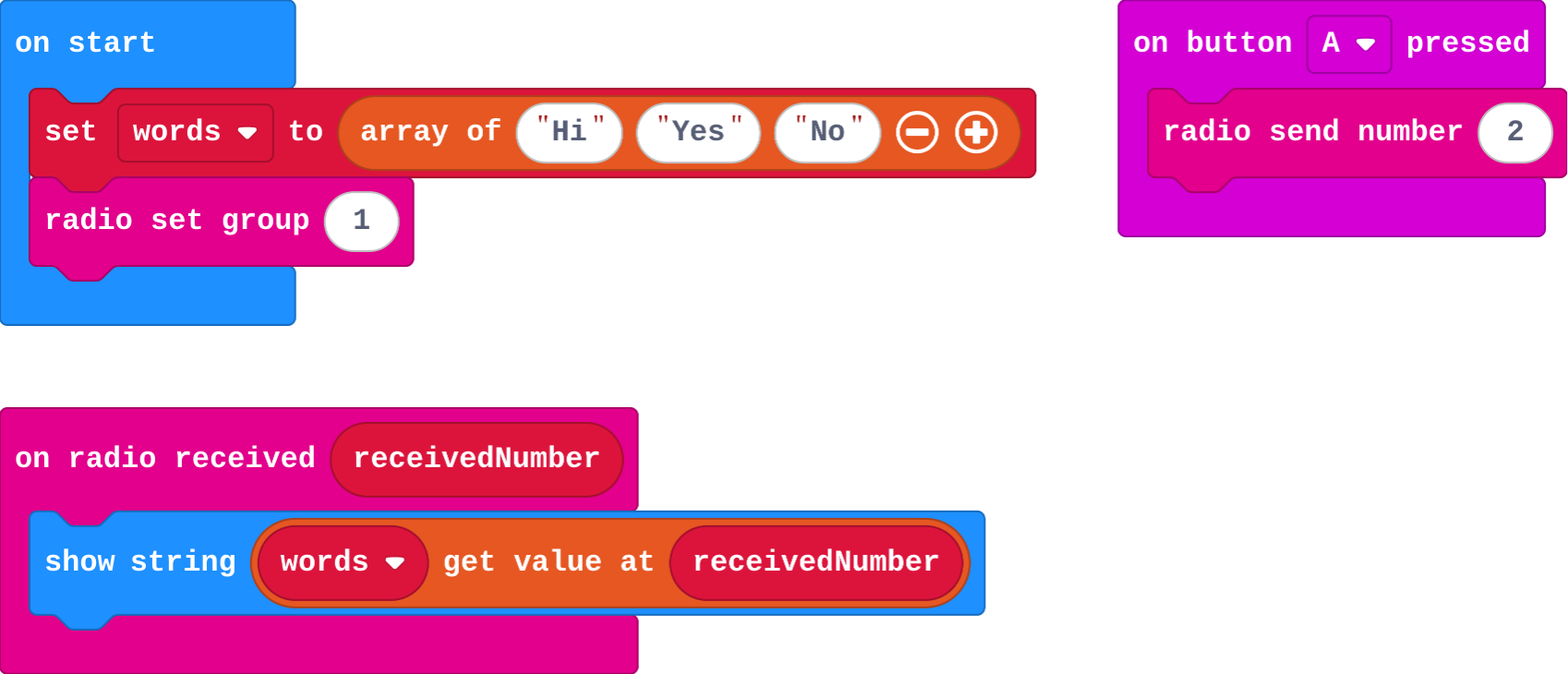
Show as code
let words = ["Hi", "Yes", "No"]
radio.setGroup(1)
radio.onReceivedNumber(function (receivedNumber) {
basic.showString(words[receivedNumber])
})
input.onButtonPressed(Button.A, function () {
radio.sendNumber(2)
})
The receiver shows get value at receivedNumber: the word at the place that arrived.
Run
Press A on one micro:bit and read the word on the other.
Show as code
let words = ["Hi", "Yes", "No"]
radio.setGroup(1)
radio.onReceivedNumber(function (receivedNumber) {
basic.showString(words[receivedNumber])
})
input.onButtonPressed(Button.A, function () {
radio.sendNumber(2)
})
Investigate
A steps through the list; B sends the place number of the chosen word.
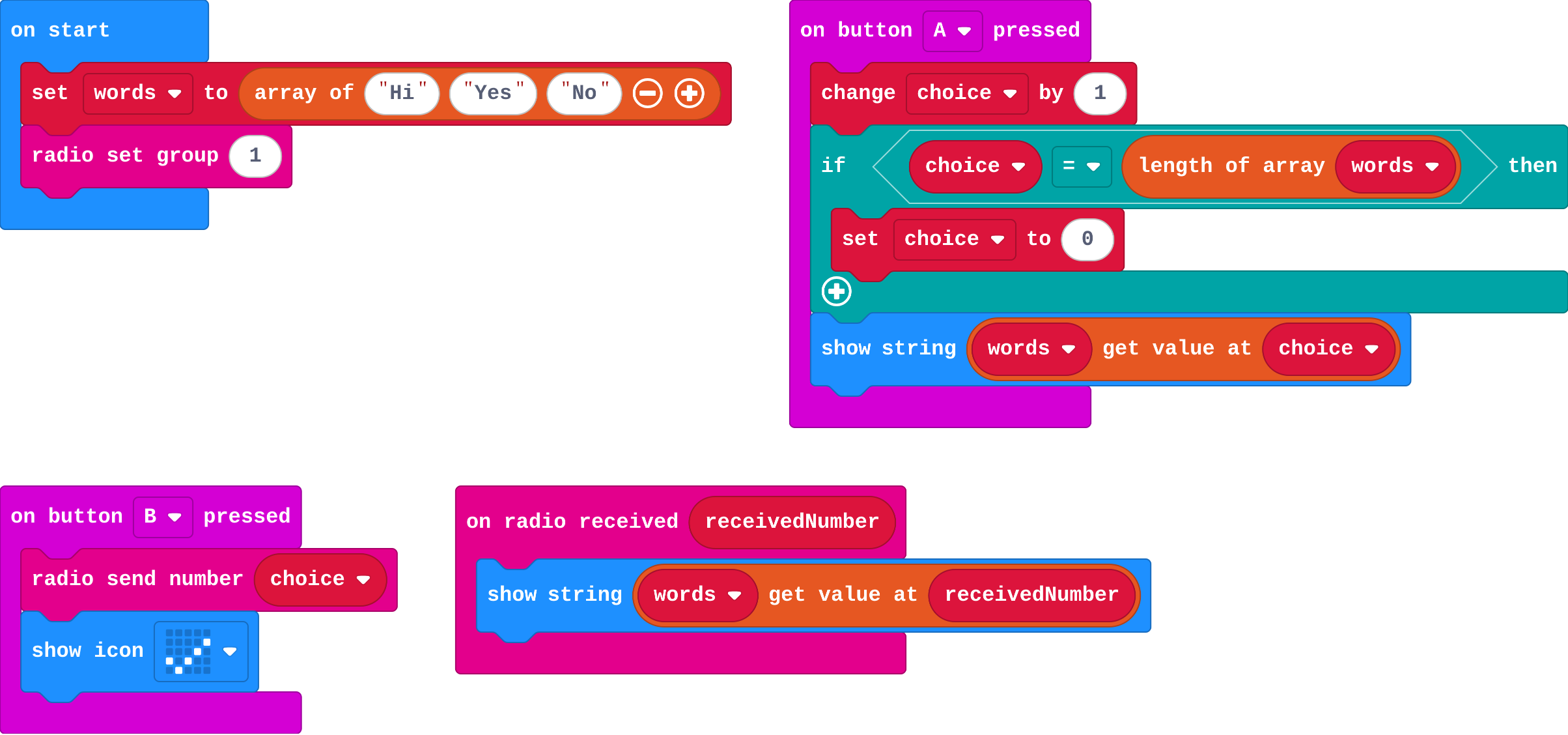
Show as code
let words = ["Hi", "Yes", "No"]
let choice = 0
radio.setGroup(1)
input.onButtonPressed(Button.A, function () {
    choice += 1
    if (choice == words.length) {
        choice = 0
    }
    basic.showString(words[choice])
})
input.onButtonPressed(Button.B, function () {
    radio.sendNumber(choice)
    basic.showIcon(IconNames.Yes)
})
radio.onReceivedNumber(function (receivedNumber) {
    basic.showString(words[receivedNumber])
})
Ella's list:
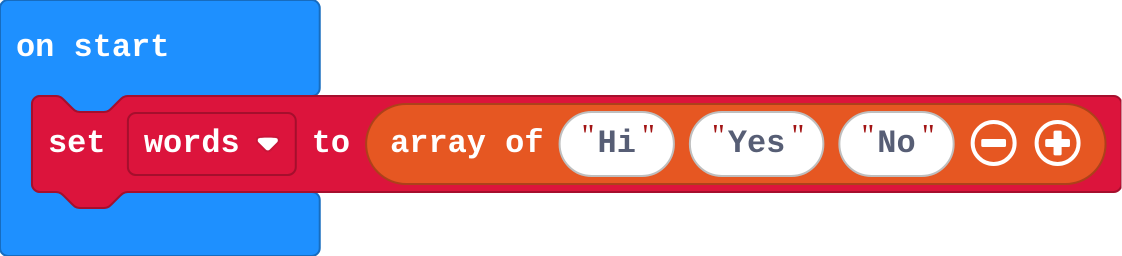
Show as code
let words = ["Hi", "Yes", "No"]
Tom's list:
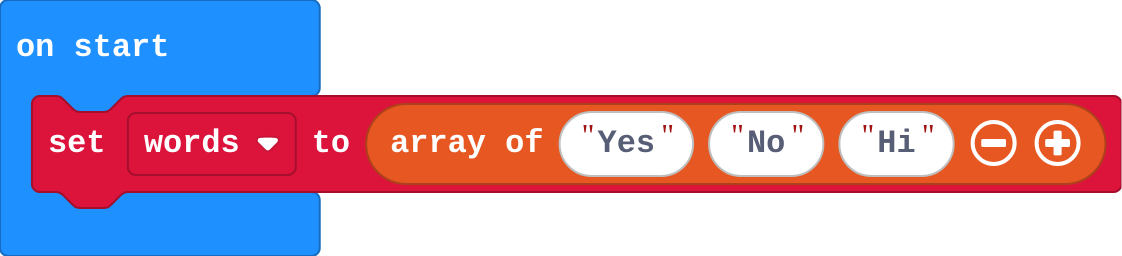
Show as code
let words = ["Yes", "No", "Hi"]
In Python, the receiver is one line: basic.show_string(words[receivedNumber]). The square brackets mean "the item at this place", just like get value at.
This messenger lets you choose a word with A, then send it with B. Fill in choice after each press of A.
| press | choice after | word shown |
|---|---|---|
| (start) | 0 | |
| A | ||
| A | ||
| A |
Modify
Add a fourth word. Did you need to change anything else? Why not?
Need a hint?
Click + on the list block. Both micro:bits run the same program, so one change updates both lists.
Make the receiver reply: when a word arrives, it sends back 99, and the sender shows a tick when 99 arrives. Real messaging apps do this to show "delivered".
Need a hint?
In on radio received: if receivedNumber = 99, show a tick; else show the word and send 99.
Another hint
Ask about 99 first, because 99 is not a place in the list.
Add a fourth word to the list.
This ticks by itself when your blocks do what is asked.
Reply with 99 when a message arrives, and show a tick when 99 comes back.
This ticks by itself when your blocks do what is asked.
Mix it up

Show as code
radio.setGroup(1)
radio.onReceivedNumber(function (receivedNumber) {
    if (receivedNumber > 3) {
        basic.showIcon(IconNames.No)
    } else if (receivedNumber > 1) {
        basic.showIcon(IconNames.Sad)
    } else {
        basic.showIcon(IconNames.Happy)
    }
})
What does this receiver show for each number that arrives?
| receivedNumber | shows |
|---|---|
| 1 | |
| 2 | |
| 5 |
Make
Make a mood check-in for the start of class. Each student's micro:bit has a list of moods (at least three). A steps through them, B sends the chosen one, and the teacher's micro:bit shows it.
Need a hint?
Make a list of moods and a variable mood. A changes mood by 1 and goes back to 0 at the end of the list.
Another hint
B sends mood. on radio received shows get value at receivedNumber.
A mood check-in: A chooses a mood from a list, B sends its place, and the other micro:bit shows the mood.
This ticks by itself when your blocks do what is asked.
Change a quiz buzzer
This buzzer lets you pick an answer, A, B or C, and send it to the quiz master. Add a fourth answer, D, then make the quiz master's micro:bit show a tick after each answer arrives.
For teachers
Students send a place number that stands for a word in a list both micro:bits share, and see that a message is a code both sides must agree on. About 45 minutes.
Open the teacher guide: answers, solutions, slides and a worksheet.
Students will be able to
- I can send a place number and look up the word it stands for.
- I can explain why both micro:bits need the same list in the same order.
- I can step through a list with a button and loop back to the start.
Before class
This lesson joins earlier ideas: lists (places from 0), variables (the chosen place) and radio. Both micro:bits hold the same list of words. Instead of sending a word, the sender sends its place number; the receiver shows the word at that place (get value at receivedNumber). That shared list is a code, and both sides must agree on it exactly: same words, same order. Stepping through a list uses a variable that goes up by 1 and goes back to 0 when it reaches the length. A reply (such as 99 for "got it") is just another agreed number that is not a place in the list.
Running the lesson
- Predict: many say 2. Ask what the receiver does with the number (looks it up).
- Run: it shows No. Say it plainly: the number is a code for a word both sides know.
- Investigate: the trace shows the loop back to 0. Ella and Tom is this lesson's misconception: a code only works if both sides share it.
- Modify: adding a word needs nothing else changed, because of the length. The reply task is how real apps show 'delivered'.
- Mix it up: else if over receivedNumber, where the order of the questions matters.
- Make: a mood check-in. With real micro:bits, the teacher's micro:bit can sit at the front.
The hard part (on purpose)
Both sides must share the same list in the same order. When the wrong word shows, ask them to compare the two lists item by item.
When students get stuck
- The wrong word shows. Ask: Are both lists the same, in the same order? Fix: Make the lists match exactly on both micro:bits.
- Pressing A past the end shows nothing or an error. Ask: What happens when choice reaches the length of the list? Fix: Add if choice = length of words, set choice to 0.
- The tick shows instead of the word, or the word shows instead of the tick. Ask: Which number means 'got it', and is it checked first? Fix: Check receivedNumber = 99 first; else show the word.
Stretch and support
Stretch: Send two numbers in one message: the sender's player number times 10, plus the word's place (so 23 means player 2 said word 3). Decode it on the receiver.
Support: Give students the mood list and the A stepping blocks, and ask them to add the sending and receiving.
Where it leads
Next unit: time. The micro:bit can measure how long something takes. Class ideas: a class emoji vote; a secret code where groups invent their own word lists and swap them.
What each step is for
- Investigate: A message is a code both sides must share: the same list, in the same order. Sending the place number keeps the message small.
- Modify: Adding to the shared list needs no other change, because the loop back to 0 uses the list's length. A reply is just another agreed number.
- Mix it up: The first true question wins, so the order of the questions about receivedNumber decides what each number does.
- Send a place number and look up the word it stands for.
- Explain why both micro:bits need the same list in the same order.
- Step through a list with a button and loop back to the start.