Radio duel
Turn the reaction timer into a two-player race over radio. First to press after the heart wins.
Quiz shows use buzzers that lock out everyone else the moment one player presses. That is a few radio messages and a true/false variable.
Two players, two micro:bits. Either player presses B to start a round. After a random wait, the heart appears on both; the first to press A wins the round. Both micro:bits run the same program, and they agree on a code: 0 means get ready, 1 means go, 2 means I pressed first.
In the simulator, the second micro:bit appears because the program uses radio. Press B on one, then race yourself by pressing A on either.
- Predict: Read the code and say what it will do before you run anything. A wrong guess is fine: it shows you what to look for.
- Run: Run it and compare the result with your prediction.
- Investigate: Trace how each line of code connects to what you see.
- Modify: Change the code on purpose and check the result.
- Make: Build something new using what you have learned. Expect a few tries; that is normal.
Make your prediction first. Help opens once you've locked it in.
Predict
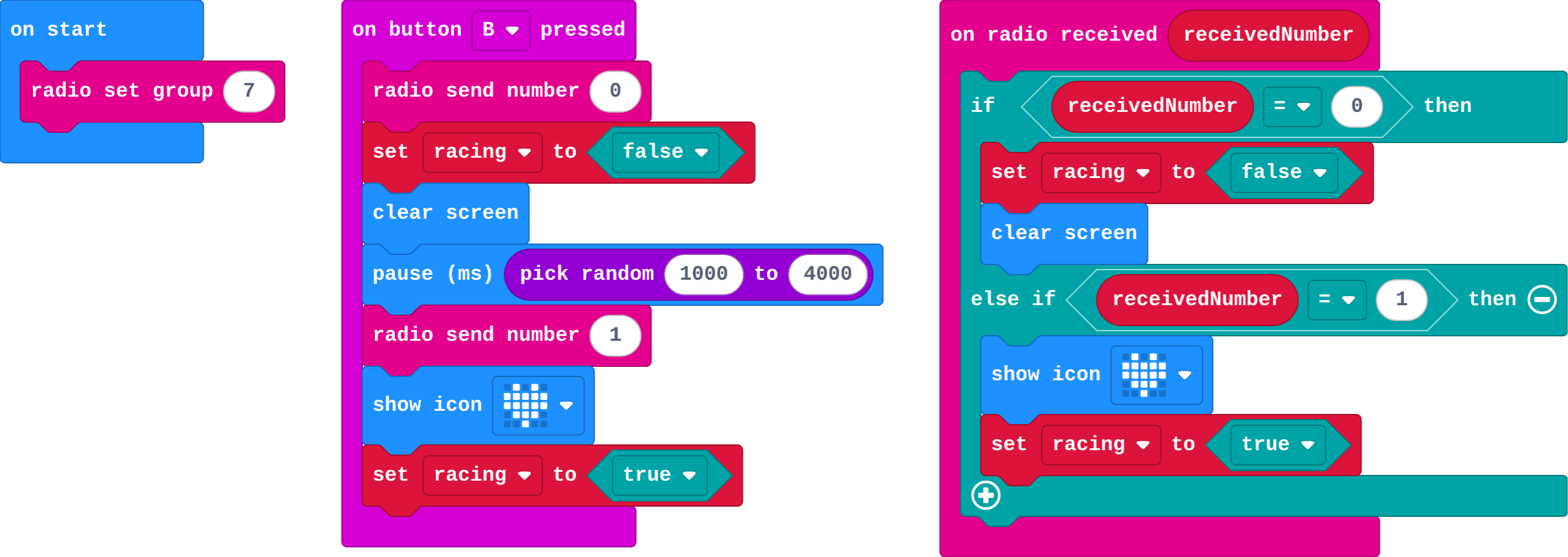
Show as code
let racing = false
radio.setGroup(7)
input.onButtonPressed(Button.B, function () {
    radio.sendNumber(0)
    racing = false
    basic.clearScreen()
    basic.pause(randint(1000, 4000))
    radio.sendNumber(1)
    basic.showIcon(IconNames.Heart)
    racing = true
})
radio.onReceivedNumber(function (receivedNumber) {
    if (receivedNumber == 0) {
        racing = false
        basic.clearScreen()
    } else if (receivedNumber == 1) {
        basic.showIcon(IconNames.Heart)
        racing = true
    }
})
Run
Press B on either micro:bit and watch both.
Show as code
let racing = false
radio.setGroup(7)
input.onButtonPressed(Button.B, function () {
    radio.sendNumber(0)
    racing = false
    basic.clearScreen()
    basic.pause(randint(1000, 4000))
    radio.sendNumber(1)
    basic.showIcon(IconNames.Heart)
    racing = true
})
radio.onReceivedNumber(function (receivedNumber) {
    if (receivedNumber == 0) {
        racing = false
        basic.clearScreen()
    } else if (receivedNumber == 1) {
        basic.showIcon(IconNames.Heart)
        racing = true
    }
})
Investigate
Show as code
let racing = false
radio.setGroup(7)
input.onButtonPressed(Button.B, function () {
    radio.sendNumber(0)
    racing = false
    basic.clearScreen()
    basic.pause(randint(1000, 4000))
    radio.sendNumber(1)
    basic.showIcon(IconNames.Heart)
    racing = true
})
radio.onReceivedNumber(function (receivedNumber) {
    if (receivedNumber == 0) {
        racing = false
        basic.clearScreen()
    } else if (receivedNumber == 1) {
        basic.showIcon(IconNames.Heart)
        racing = true
    }
})
Match each message with its meaning.
Look for blocks that appear twice.
def on_received_number(receivedNumber):
global racing
if receivedNumber == 0:
racing = False
basic.clear_screen()
elif receivedNumber == 1:
basic.show_icon(IconNames.HEART)
racing = True
radio.on_received_number(on_received_number)
elif is Python's short way to write else if.
Match each message with what it means in the duel.
The receiving part in Python. Match each line with what it does.
Milestone 1: one go function
Make a function go that shows the heart and sets racing to true. Call it in both places, so there is one copy to change.
Need a hint?
Make a Function called go, and drag show heart and set racing to true into it.
Another hint
Put call go in both places where those blocks were.
Make a function go for the heart and racing, and call it from both places.
This ticks by itself when your blocks do what is asked.
Milestone 2: first press wins
- When A is pressed while racing: stop racing, send 2, show a happy face.
- When 2 arrives while racing: stop racing, show a sad face.
Need a hint?
In A: if racing, set racing to false, send 2 and show a happy face.
Another hint
In on radio received, add else if receivedNumber = 2: if racing, set racing to false and show a sad face.
The first press after the heart sends 2 and wins; the other player sees they lost.
This ticks by itself when your blocks do what is asked.
Milestone 3: first to three
Make it a match: the first player to win three rounds wins.
- Count your round wins; A+B shows them.
- At three wins, send 3 and show a trophy.
- When 3 arrives, show game over.
Need a hint?
A variable wins goes up by 1 each time you win a round. A+B shows it.
Another hint
When wins reaches 3, send 3 and show a trophy (a picture). When 3 arrives, the other player shows game over.
Count wins, and the first to three wins the match: send 3, and the other shows game over.
This ticks by itself when your blocks do what is asked.
Fair play
Play a match against a partner. Agree a group number of your own before you start.
Show as code
let racing = false
radio.setGroup(7)
input.onButtonPressed(Button.B, function () {
    radio.sendNumber(0)
    racing = false
    basic.clearScreen()
    basic.pause(randint(1000, 4000))
    radio.sendNumber(1)
    basic.showIcon(IconNames.Heart)
    racing = true
})
radio.onReceivedNumber(function (receivedNumber) {
    if (receivedNumber == 0) {
        racing = false
        basic.clearScreen()
    } else if (receivedNumber == 1) {
        basic.showIcon(IconNames.Heart)
        racing = true
    }
})
For teachers
Students turn the reaction game into a two-player race over radio, using a shared message code, a function to remove copied blocks, a true/false variable and a score. About 60 minutes.
Open the teacher guide: answers, solutions, slides and a worksheet.
Students will be able to
- I can keep two micro:bits in step with an agreed code of messages.
- I can replace copied blocks with a function.
- I can make only the first press count, using a true/false variable.
Before class
Both micro:bits run the same program. The players agree a code: 0 = get ready, 1 = go, 2 = I pressed first (and 3 = I won the match, in Milestone 3). Whoever presses B sends 0, waits, sends 1 and shows its own heart; the other shows its heart when 1 arrives. racing is true only while a round is on, so only the first press counts, and a late press after receiving 2 does nothing. Milestone 1 is a refactor: the starter shows the heart and sets racing in two places (a design fault: copies must be kept the same by hand), and students fold them into one function. In the simulator, two micro:bits appear; one student can play both sides to test.
Running the lesson
- Predict: the heart shows on both. Ask how the second micro:bit knows when (message 1).
- Investigate: the match names the code. The two-copies question is why Milestone 1 exists.
- Milestone 1: defs 1 and calls 2 is the check. Ask: if you change the heart now, how many places change?
- Milestone 2: read the A event aloud: 'if we are racing, stop, tell the other player, celebrate'.
- Milestone 3: a score variable and message 3. Give pairs real micro:bits for this if you have them: it is far more fun.
- Fair play: in a room of micro:bits, each pair needs its own group.
The hard part (on purpose)
Keeping two micro:bits in step with a code of messages. Ask them to trace one round on paper: who sends what, and who checks it.
When students get stuck
- The heart only shows on one micro:bit. Ask: Is message 1 sent, and does the receiver check for 1? Fix: Send 1 before calling go, and in on radio received call go when receivedNumber = 1.
- Both players see a happy face. Ask: Do you check racing before counting a press? Fix: In A, only act if racing; set racing to false straight away.
- The check for Milestone 1 does not tick. Ask: How many call go blocks are there? Fix: Call go in both places: after sending 1, and when 1 arrives.
Stretch and support
Stretch: Add an early-press penalty: pressing A before the heart sends 4, and the other player wins the round.
Support: Run Milestone 3 in pairs: one student builds the winner side (counting and sending 3), the other the loser side (receiving 3).
Where it leads
Two optional lessons go further: Fake-outs and levels (one player, harder rules) and Tournament (a scoreboard list and a round function). Class ideas: a class knockout tournament; a quiz buzzer for real class quizzes.
What each step is for
- Investigate: Two micro:bits stay in step by agreeing on a code of messages. The same blocks written twice must be kept the same by hand, which is a reason for a function.
- Milestone 1: one go function: A function removes the copy: both places call one job, so a change happens everywhere at once.
- Milestone 2: first press wins: One message tells the other player the result, and racing makes sure only the first press counts.
- Milestone 3: first to three: A match adds a score variable and one more agreed message, without changing how a round works.
- Keep two micro:bits in step with an agreed code of messages.
- Replace copied blocks with a function.
- Make only the first press count, using a true/false variable.