Score and lives
Give the player lives, make a hit cost one, and let the engine end the game.
Three hearts in the corner and a game that can end: that is what turns moving sprites into a game you can win or lose.
Last lesson the score went up and down, but the game never ended. Arcade's Info blocks keep a score and lives (hearts) at the top of the screen, and they end the game by themselves.
- Predict: Read the code and say what it will do before you run anything. A wrong guess is fine: it shows you what to look for.
- Run: Run it and compare the result with your prediction.
- Investigate: Trace how each line of code connects to what you see.
- Modify: Change the code on purpose and check the result.
- Make: Build something new using what you have learned. Expect a few tries; that is normal.
Make your prediction first. Help opens once you've locked it in.
Predict
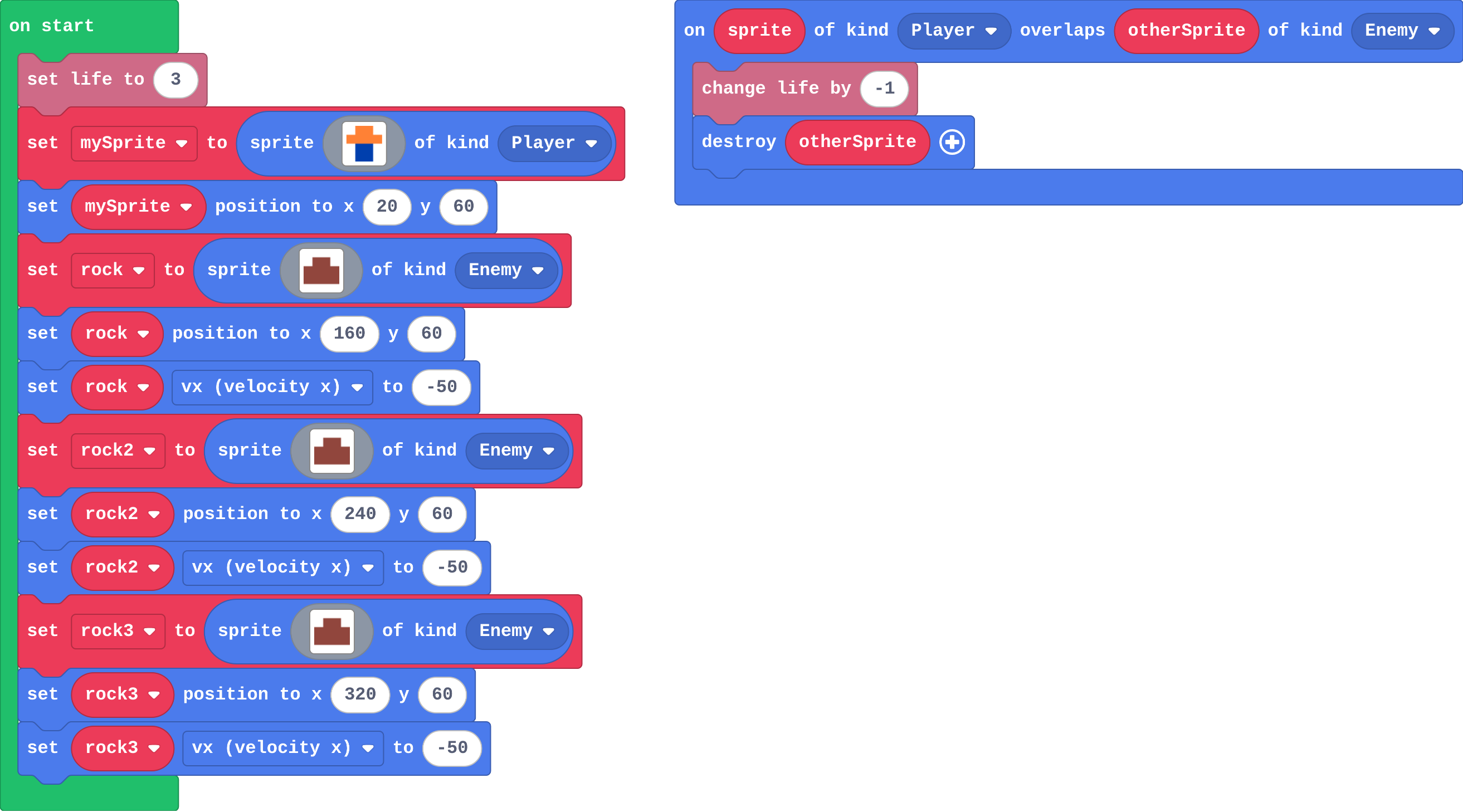
Show as code
info.setLife(3)
let mySprite = sprites.create(img`
. 4 4 .
4 4 4 4
. 8 8 .
. 8 8 .
`, SpriteKind.Player)
mySprite.setPosition(20, 60)
let rock = sprites.create(img`
. e e .
e e e e
e e e e
`, SpriteKind.Enemy)
rock.setPosition(160, 60)
rock.vx = -50
let rock2 = sprites.create(img`
. e e .
e e e e
e e e e
`, SpriteKind.Enemy)
rock2.setPosition(240, 60)
rock2.vx = -50
let rock3 = sprites.create(img`
. e e .
e e e e
e e e e
`, SpriteKind.Enemy)
rock3.setPosition(320, 60)
rock3.vx = -50
sprites.onOverlap(SpriteKind.Player, SpriteKind.Enemy, function (sprite, otherSprite) {
info.changeLifeBy(-1)
otherSprite.destroy()
})
There is no game over block in this program. Lock in what you think happens.
Run
Watch the hearts at the top of the screen. Use the restart button under the simulator to play again.
Show as code
info.setLife(3)
let mySprite = sprites.create(img`
. 4 4 .
4 4 4 4
. 8 8 .
. 8 8 .
`, SpriteKind.Player)
mySprite.setPosition(20, 60)
let rock = sprites.create(img`
. e e .
e e e e
e e e e
`, SpriteKind.Enemy)
rock.setPosition(160, 60)
rock.vx = -50
let rock2 = sprites.create(img`
. e e .
e e e e
e e e e
`, SpriteKind.Enemy)
rock2.setPosition(240, 60)
rock2.vx = -50
let rock3 = sprites.create(img`
. e e .
e e e e
e e e e
`, SpriteKind.Enemy)
rock3.setPosition(320, 60)
rock3.vx = -50
sprites.onOverlap(SpriteKind.Player, SpriteKind.Enemy, function (sprite, otherSprite) {
info.changeLifeBy(-1)
otherSprite.destroy()
})
Investigate
Dodge the rocks with the arrow keys and collect the heart. Lose on purpose once, too.
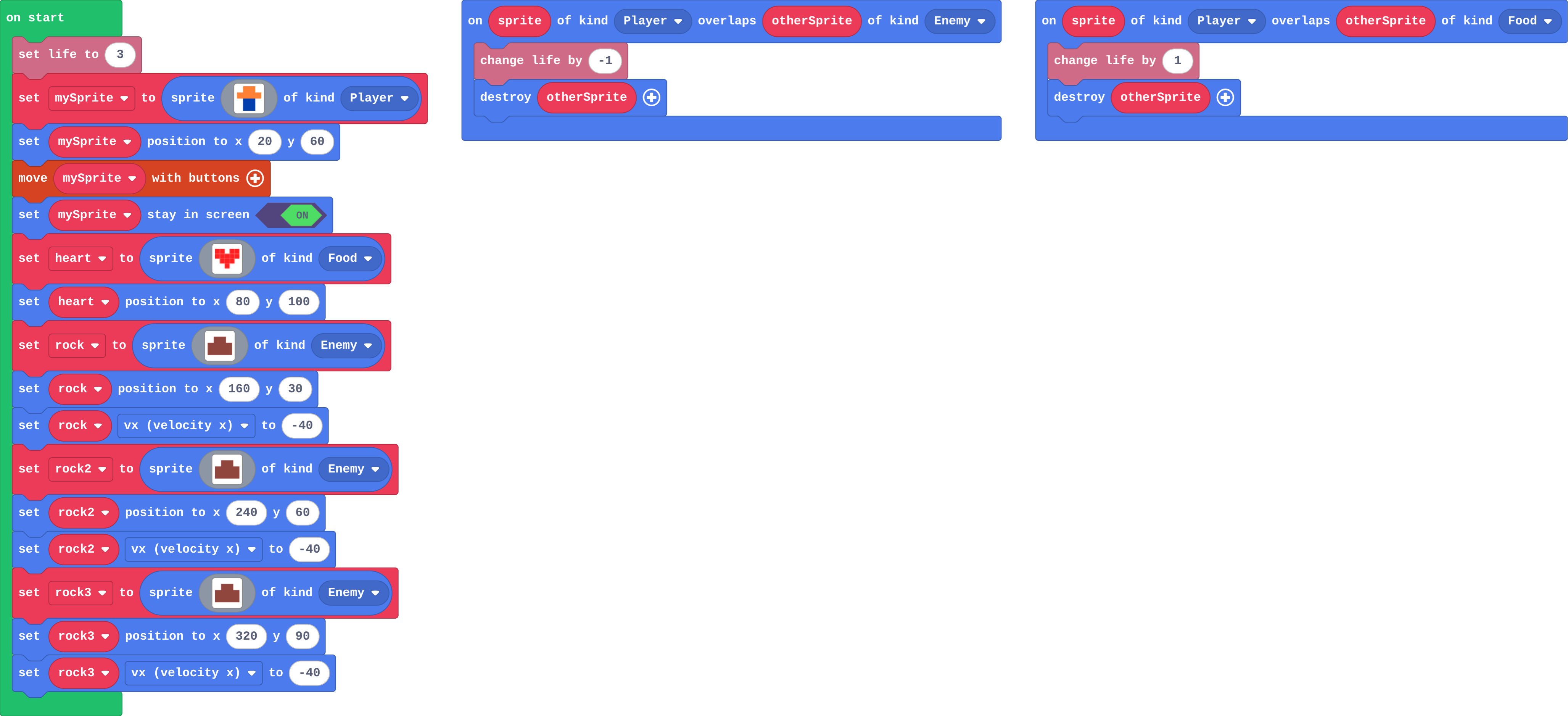
Show as code
info.setLife(3)
let mySprite = sprites.create(img`
    . 4 4 .
    4 4 4 4
    . 8 8 .
    . 8 8 .
    `, SpriteKind.Player)
mySprite.setPosition(20, 60)
controller.moveSprite(mySprite)
mySprite.setStayInScreen(true)
let heart = sprites.create(img`
    2 2 . 2 2
    2 2 2 2 2
    . 2 2 2 .
    . . 2 . .
    `, SpriteKind.Food)
heart.setPosition(80, 100)
let rock = sprites.create(img`
    . e e .
    e e e e
    e e e e
    `, SpriteKind.Enemy)
rock.setPosition(160, 30)
rock.vx = -40
let rock2 = sprites.create(img`
    . e e .
    e e e e
    e e e e
    `, SpriteKind.Enemy)
rock2.setPosition(240, 60)
rock2.vx = -40
let rock3 = sprites.create(img`
    . e e .
    e e e e
    e e e e
    `, SpriteKind.Enemy)
rock3.setPosition(320, 90)
rock3.vx = -40
sprites.onOverlap(SpriteKind.Player, SpriteKind.Enemy, function (sprite, otherSprite) {
    info.changeLifeBy(-1)
    otherSprite.destroy()
})
sprites.onOverlap(SpriteKind.Player, SpriteKind.Food, function (sprite, otherSprite) {
    info.changeLifeBy(1)
    otherSprite.destroy()
})
Sam's overlap event:

Show as code
sprites.onOverlap(SpriteKind.Player, SpriteKind.Enemy, function (sprite, otherSprite) {
    info.changeLifeBy(-1)
})
Play this game in your head. Fill in the lives after each thing happens.
| what happens | lives after |
|---|---|
| (start) | 3 |
| a rock hits the player | |
| a rock flies past | |
| the player collects the heart | |
| a rock hits the player |
Modify
Start the player with 5 lives.
Need a hint?
Change the 3 in set life.
Make the heart give a point as well as a life.
Need a hint?
Inside the Player–Food event, add change score by 1 (Info) next to change life by 1.
Start the player with 5 lives.
This ticks by itself when your blocks do what is asked.
Collecting the heart also scores a point.
This ticks by itself when your blocks do what is asked.
Mix it up
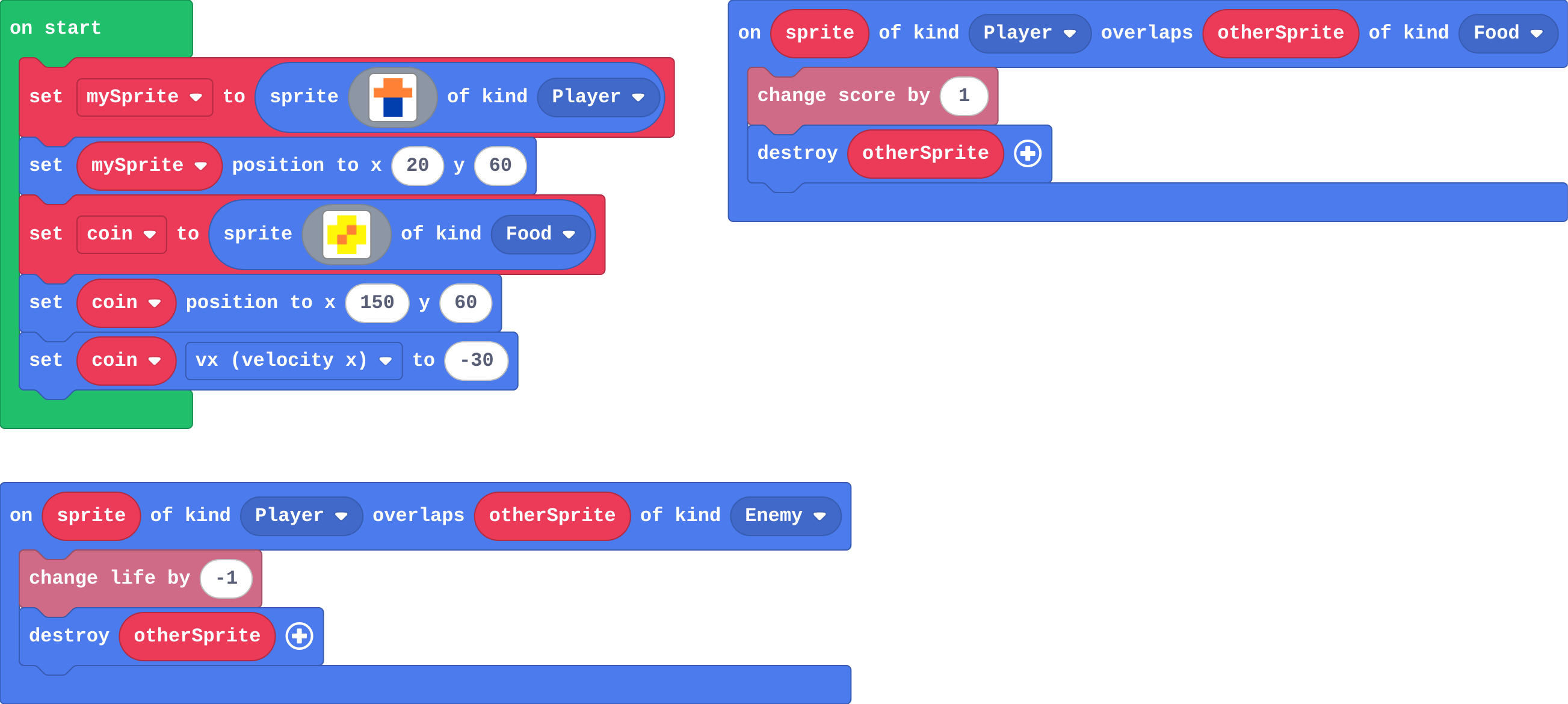
Show as code
let mySprite = sprites.create(img`
    . 4 4 .
    4 4 4 4
    . 8 8 .
    . 8 8 .
    `, SpriteKind.Player)
mySprite.setPosition(20, 60)
let coin = sprites.create(img`
    . 5 5 .
    5 5 4 5
    5 4 5 5
    . 5 5 .
    `, SpriteKind.Food)
coin.setPosition(150, 60)
coin.vx = -30
sprites.onOverlap(SpriteKind.Player, SpriteKind.Food, function (sprite, otherSprite) {
    info.changeScoreBy(1)
    otherSprite.destroy()
})
sprites.onOverlap(SpriteKind.Player, SpriteKind.Enemy, function (sprite, otherSprite) {
    info.changeLifeBy(-1)
    otherSprite.destroy()
})
Make
The rocks fly already. Make it a game:
- the player starts with 3 lives
- each rock that hits takes one life, and is destroyed
Need a hint?
In on start: set life to 3 (Info).
Another hint
Add an on overlap for Player and Enemy. Inside: change life by -1, then destroy otherSprite.
A dodge game: 3 lives, and a rock that hits takes one life and is destroyed.
This ticks by itself when your blocks do what is asked.
Change a dodgeball game
Balls bounce around the court; each hit costs a life. Add a fourth ball, give the player 5 lives, and make the balls a little faster.
For teachers
Students give the player lives, make a hit cost one life, and see that the engine ends the game at 0 lives and that an overlap runs every frame while sprites touch. About 40 minutes.
Open the teacher guide: answers, solutions, slides and a worksheet.
Students will be able to
- I can give the player lives and let the game end by itself.
- I can make a hit cost exactly one life.
- I can explain why an enemy must be destroyed (or moved) when it hits the player.
Before class
Info blocks keep a score and lives (hearts) at the top of the screen. When the lives reach 0, Arcade ends the game by itself. One important fact: an overlap event runs every frame (about 30 times a second) while the two sprites still touch. If the enemy is not destroyed, one touch takes life after life, and the game ends at once. Timers (a new enemy every second) are next lesson; here the rocks are made at the start and flown in with a velocity.
Running the lesson
- Predict: many students expect lives to go below 0, or that a game over block is needed. The engine does it. Ask the 'no game over block' group to run it and watch.
- Run: count the hearts aloud as they go.
- Investigate: Sam's dodger is the lesson's key bug: an overlap runs every frame while sprites touch.
- Mix it up: kinds and velocity, from earlier lessons.
- Make: students who forget destroy lose all three lives at once: let them find it.
The hard part (on purpose)
An overlap runs every frame while sprites touch, so one hit takes every life. Ask what happens to the enemy after it touches the player.
When students get stuck
- One touch ends the game. Ask: What happens to the enemy after it touches the player? Fix: Nothing, so the overlap runs again next frame. Add destroy otherSprite inside the overlap event.
- No hearts at the top of the screen. Ask: Is there a set life block in on start? Fix: Add set life to 3 (Info). Lives appear only once they are set.
- Touching a rock does nothing. Ask: What kind are the rocks, and what kinds does the overlap name? Fix: The rocks are Enemy; the event must be Player with Enemy.
Stretch and support
Stretch: Add a coin worth points, so there is something to chase as well as dodge.
Support: Give students the overlap event already placed, and ask them to fill in the two blocks inside.
Where it leads
Next lesson: a timer that sends a new rock every second, for as long as the game lasts.
What each step is for
- Investigate: Info keeps lives and ends the game at 0. An overlap runs every frame while two sprites touch, so destroying the enemy makes one touch cost one life.
- Modify: set life sets how many hearts the player starts with, and each kind of touch needs its own overlap event.
- Mix it up: The engine moves a sprite with a velocity; its kind decides which overlap runs when it arrives.
- Give the player lives and let the game end by itself.
- Make a hit cost exactly one life.
- Explain why an enemy must be destroyed (or moved) when it hits the player.