Scrambling is not a secret
A scrambling method works only while nobody knows the method. A real code has a public method and a secret key.
A message written backwards looks secret for about ten seconds. The question is what makes a code truly hard to read, and the answer is not hiding the method.
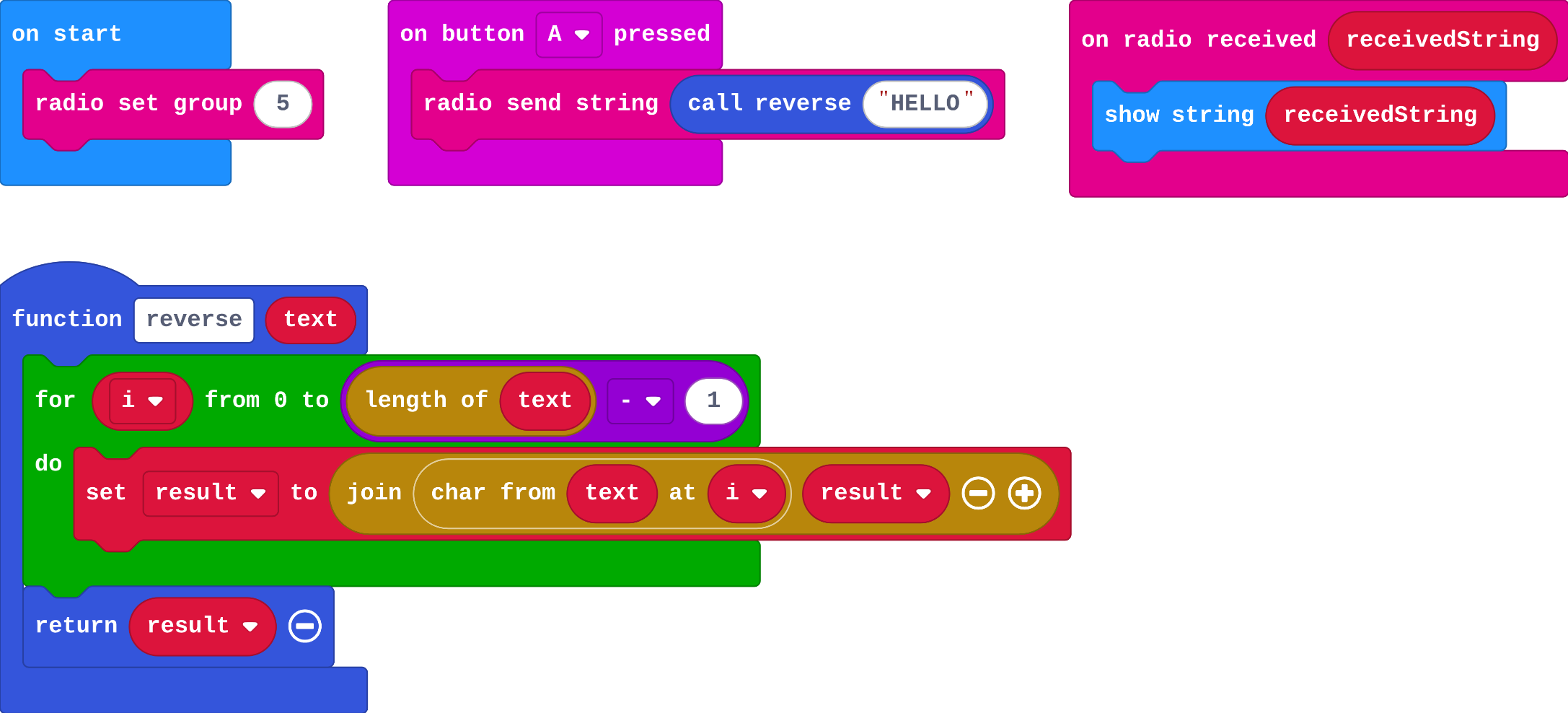
A first idea for privacy is to scramble the message before sending it. The micro:bit below reverses the text with a function (a named job, from micro:bit Foundations). HELLO goes out as OLLEH.
Behind the code: in micro:bit Foundations a function was a named job. This one, reverse, also takes a value in and hands one back:
reverse("HELLO")hands"HELLO"to the function, which calls ittext. A value handed in like this is a parameter.- return hands the answer back, so
reverse("HELLO")can go anywhere a text can, such as inside send string.
Inside, a for index loop (in Loops) visits each place in the text, from 0 up to its length − 1. text.charAt(i) is the letter at place i, counted from 0 like a list. result starts empty, and each time round the next letter is joined on at the front, so the text comes out backwards. Every cipher in this course is built this way: a function that walks through a message letter by letter and returns a new one.
- Predict: Read the code and say what it will do before you run anything. A wrong guess is fine: it shows you what to look for.
- Run: Run it and compare the result with your prediction.
- Investigate: Trace how each line of code connects to what you see.
- Modify: Change the code on purpose and check the result.
- Make: Build something new using what you have learned. Expect a few tries; that is normal.
Make your prediction first. Help opens once you've locked it in.
Predict
Show as code
function reverse(text: string): string {
    let result = ""
    for (let i = 0; i < text.length; i++) {
        result = text.charAt(i) + result
    }
    return result
}
radio.setGroup(5)
input.onButtonPressed(Button.A, function () {
    radio.sendString(reverse("HELLO"))
})
radio.onReceivedString(function (receivedString) {
    basic.showString(receivedString)
})
Run
Show as code
function reverse(text: string): string {
    let result = ""
    for (let i = 0; i < text.length; i++) {
        result = text.charAt(i) + result
    }
    return result
}
radio.setGroup(5)
input.onButtonPressed(Button.A, function () {
    radio.sendString(reverse("HELLO"))
})
radio.onReceivedString(function (receivedString) {
    basic.showString(receivedString)
})
Investigate
Show as code
function reverse(text: string): string {
    let result = ""
    for (let i = 0; i < text.length; i++) {
        result = text.charAt(i) + result
    }
    return result
}
radio.setGroup(5)
input.onButtonPressed(Button.A, function () {
    radio.sendString(reverse("HELLO"))
})
radio.onReceivedString(function (receivedString) {
    basic.showString(receivedString)
})
The loop runs once for each place in HELLO: i is 0, 1, 2, 3, then 4.
Match each part of a code with its job.
Modify
Make the receiver show HELLO again.
Need a hint?
In on radio received string, show reverse(received string).
The receiver reverses the text back before showing it.
This ticks by itself when your blocks do what is asked.
Make
Invent a scrambling method of your own as two functions, scramble and unscramble, and send a message through them. Then ask a partner to guess your method from the scrambled text alone. Would it still work once they know it?
Need a hint?
scramble: start with an empty result, and loop through the places like reverse does. Join each letter and then an X onto the end (MEET becomes MXEXEXTX). Return the result.
Another hint
unscramble: the real letters sit at places 0, 2, 4 and so on. Loop i from 0 up to half the length, and join on the letter at place i × 2.
Your own scrambler and unscrambler as two functions: A sends the scrambled text and the receiver shows the unscrambled text.
This ticks by itself when your blocks do what is asked.
For teachers
Students send a reversed message, see that anyone who knows the method can undo it, and meet the idea of a public method with a secret key. About 40 minutes.
Open the teacher guide: answers, solutions, slides and a worksheet.
Students will be able to
- I can write a function that scrambles text and one that unscrambles it.
- I can explain why a secret method is not enough.
- I can name the parts of a code: method, key, plain text and cipher text.
Before class
The idea: a cipher is a method for scrambling a message. If the method is the only secret, everything is lost the moment someone learns it. Real ciphers have a public method and a secret key; Caesar's cipher, next, is the smallest example.
Vocabulary: plain text (before), cipher text (after), method (steps), key (the secret value). Use them every time from now on.
Code: this lesson teaches the code every later cipher is built from. Foundations functions were named jobs with nothing in or out; reverse(text) takes a parameter and returns a text. The for index loop visits each place 0 to length − 1, and text.charAt(i) is the letter at place i (counted from 0, like a list). The Investigate trace task (result after i = 0 and 1) checks students can follow it; spend time here, because Caesar, Checksum and the CTF reuse the same shape.
Running the lesson
- Predict: students expect HELLO. Ask: where in the program is the reversing undone?
- Make: let pairs swap and guess. The point is that a guess at the method is cheap.
The hard part (on purpose)
A method everyone knows hides nothing. Ask what a listener who knows the method would need to read the message.
When students get stuck
- The receiver shows OLLEH. Ask: Where does the receiver undo the reversing? Fix: Show reverse(received string) instead of received string.
- The text comes out shorter or longer than expected in unscramble. Ask: Which letters does unscramble keep? Fix: Loop i up to half the length, and join the letter at place i × 2.
Stretch and support
Stretch: Make the scrambler swap each pair of letters (HELLO → EHLLO).
Support: Give scramble complete and ask only for unscramble.
Where it leads
Next: a code with a key, the Caesar cipher.
What each step is for
- Investigate: Scrambling with a method everyone knows hides nothing from someone who knows the method. A code needs a secret, and the secret must be separate from the method.
- Modify: The receiver must undo the sender's scrambling, using the same function.
- Write a function that scrambles text and one that unscrambles it.
- Explain why a secret method is not enough.
- Name the parts of a code: method, key, plain text and cipher text.