The Caesar cipher
Shift every letter along the alphabet by a secret number. The method is public; the number is the key.
Julius Caesar is said to have shifted each letter of his orders three places along the alphabet. Anyone who did not know the shift saw nonsense.
Builds on: Text as numbers (Digital systems › Data representation)
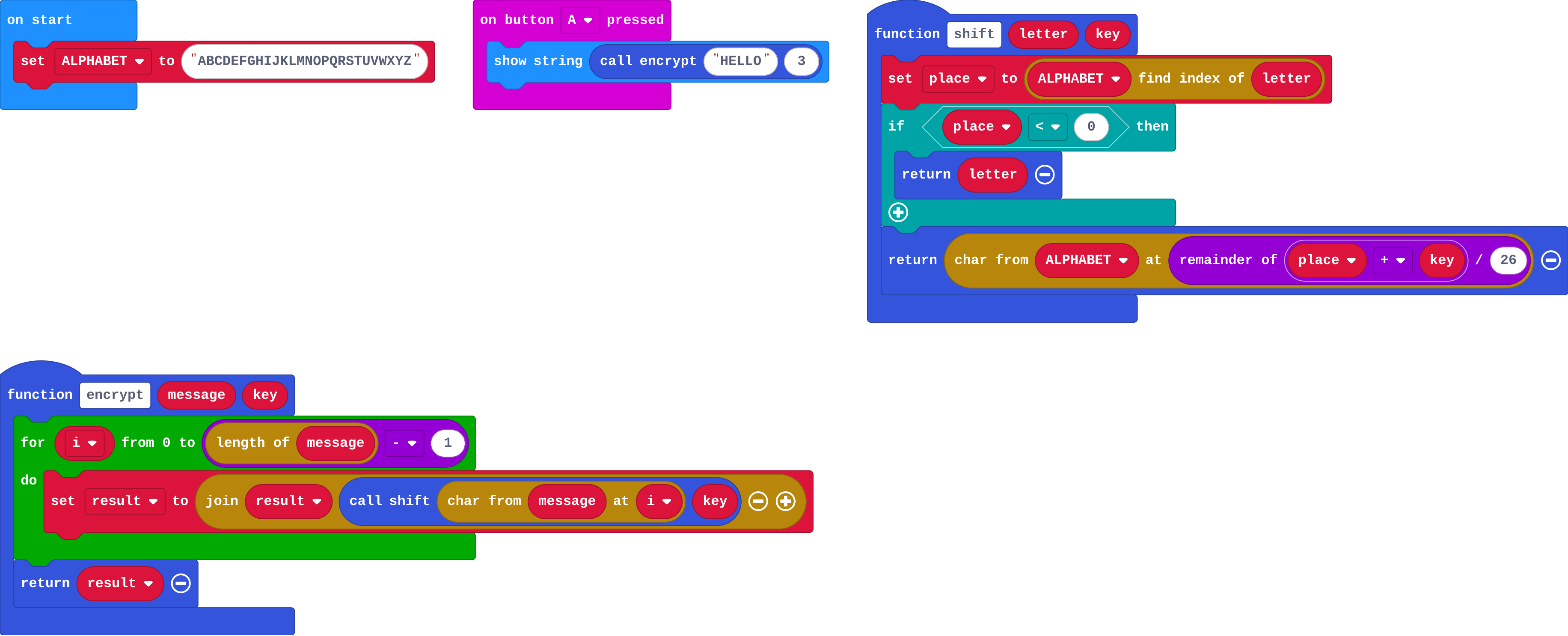
The Caesar cipher shifts every letter along the alphabet by the key. With key 3, A becomes D, B becomes E, and Z wraps round to C. The function shift moves one letter; encrypt shifts every letter of a message. Spaces and numbers pass through unchanged.
Two things are new: ALPHABET.indexOf(letter) finds a letter's place in the alphabet (A is 0), and % 26 ("remainder after dividing by 26") wraps the end of the alphabet back to the start.
- Predict: Read the code and say what it will do before you run anything. A wrong guess is fine: it shows you what to look for.
- Run: Run it and compare the result with your prediction.
- Investigate: Trace how each line of code connects to what you see.
- Modify: Change the code on purpose and check the result.
- Make: Build something new using what you have learned. Expect a few tries; that is normal.
Make your prediction first. Help opens once you've locked it in.
Predict
Show as code
let ALPHABET = "ABCDEFGHIJKLMNOPQRSTUVWXYZ"
function shift(letter: string, key: number): string {
    let place = ALPHABET.indexOf(letter)
    if (place < 0) {
        return letter
    }
    return ALPHABET.charAt((place + key) % 26)
}
function encrypt(message: string, key: number): string {
    let result = ""
    for (let i = 0; i < message.length; i++) {
        result = result + shift(message.charAt(i), key)
    }
    return result
}
input.onButtonPressed(Button.A, function () {
    basic.showString(encrypt("HELLO", 3))
})
Run
Show as code
let ALPHABET = "ABCDEFGHIJKLMNOPQRSTUVWXYZ"
function shift(letter: string, key: number): string {
    let place = ALPHABET.indexOf(letter)
    if (place < 0) {
        return letter
    }
    return ALPHABET.charAt((place + key) % 26)
}
function encrypt(message: string, key: number): string {
    let result = ""
    for (let i = 0; i < message.length; i++) {
        result = result + shift(message.charAt(i), key)
    }
    return result
}
input.onButtonPressed(Button.A, function () {
    basic.showString(encrypt("HELLO", 3))
})
Investigate
Show as code
let ALPHABET = "ABCDEFGHIJKLMNOPQRSTUVWXYZ"
function shift(letter: string, key: number): string {
    let place = ALPHABET.indexOf(letter)
    if (place < 0) {
        return letter
    }
    return ALPHABET.charAt((place + key) % 26)
}
function encrypt(message: string, key: number): string {
    let result = ""
    for (let i = 0; i < message.length; i++) {
        result = result + shift(message.charAt(i), key)
    }
    return result
}
input.onButtonPressed(Button.A, function () {
    basic.showString(encrypt("HELLO", 3))
})
With key 3, which place does Z (place 25) move to? (A is 0.)
Modify
Add a decrypt function and test it by encrypting and decrypting HELLO.
Need a hint?
Make a function decrypt(message, key) that returns encrypt(message, 26 − key). Then show decrypt(encrypt("HELLO", 3), 3).
A decrypt function that undoes encrypt, so the micro:bit shows HELLO again.
This ticks by itself when your blocks do what is asked.
Make
Make a secret messenger. A sends an encrypted message by radio and the receiver decrypts it with the same key; B adds one to the key on this micro:bit. Try it with both micro:bits using the same key, then with different keys. What does the receiver show?
Need a hint?
A variable key starts at 3. B adds one to key and shows it.
Another hint
A sends encrypt(MEET AT 3, key) by radio; the receiver shows decrypt(received string, key).
A sends an encrypted message by radio; the receiver decrypts it with the same key; B changes the key.
This ticks by itself when your blocks do what is asked.
For teachers
Students build the Caesar cipher, decrypt with it, and send encrypted messages by radio with a shared key. About 50 minutes.
Open the teacher guide: answers, solutions, slides and a worksheet.
Students will be able to
- I can explain what the key of a Caesar cipher is.
- I can encrypt and decrypt a message with the same key.
- I can explain why a receiver with the wrong key shows nonsense.
Before class
The idea: every letter moves along the alphabet by the key. The method (shift) is public; the key (the number) is the secret. Both people need the same key.
New code: ALPHABET.indexOf(letter) is the letter's place in the alphabet (A is 0, and −1 if it is not found, which is why spaces pass through). % 26 wraps: 28 % 26 = 2. Treat these as recipes; the Investigate step makes the wrap visible.
A pattern worth naming: decrypting is encrypting with the rest of the circle, 26 − key. Students often expect a separate "undo" method.
Honesty about strength: this code is easy to break, as the next lesson shows. Say so now; the lesson after turns it into the point.
Running the lesson
- Investigate: the Z → C question is the whole idea. Give time to do it by hand.
- Make: when keys differ, the receiver shows plausible-looking nonsense. Ask: does the receiver know it is wrong?
The hard part (on purpose)
Wrapping round the alphabet with % 26, and undoing a shift. Ask them to shift one letter by hand, including one near Z, before testing.
When students get stuck
- Spaces or numbers come out as letters. Ask: What does indexOf return for a space? Fix: indexOf gives −1 for a character that is not a letter; shift returns it unchanged.
- decrypt does not give back the message. Ask: How far round the alphabet is encrypt plus decrypt? Fix: The two keys must add to 26: decrypt uses 26 − key.
Stretch and support
Stretch: Add a numeric key menu: B counts up and A sends, and the key resets to 1 after 25.
Support: Give encrypt and decrypt complete; students wire up the buttons and radio.
Where it leads
Next: how long does it take to break this?
What each step is for
- Investigate: The key is the number of places to shift; % 26 wraps the end of the alphabet; to undo a shift you shift the rest of the way round.
- Modify: Decrypting is encrypting with the rest of the circle.
- Explain what the key of a Caesar cipher is.
- Encrypt and decrypt a message with the same key.
- Explain why a receiver with the wrong key shows nonsense.