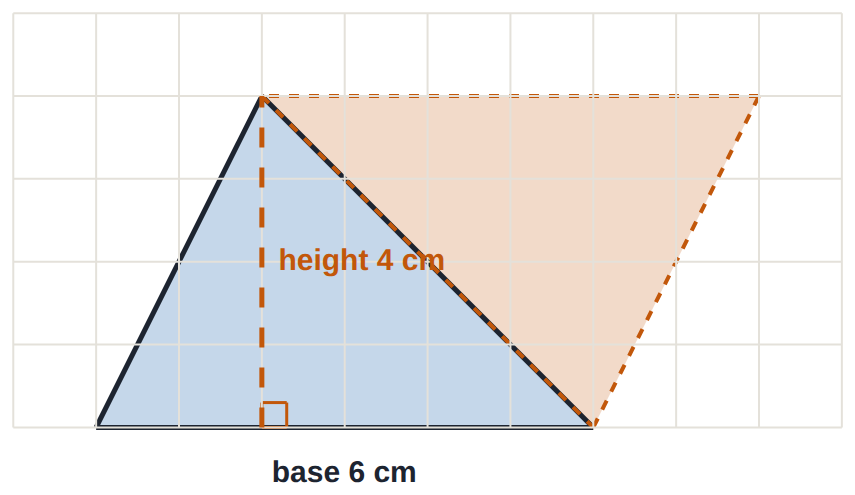
perpendicular height
The distance from the base to the opposite side or corner, at a right angle (∟) to the base. A slanted side is longer, and is not the height.
Area, volume, circles and Pythagoras · The words and methods from the lessons, with an example of each.
The distance from the base to the opposite side or corner, at a right angle (∟) to the base. A slanted side is longer, and is not the height.
Two copies make a parallelogram with the same base and height; the triangle is half.
Area counts squares: cm², m². A 1 m square is 100 cm by 100 cm.
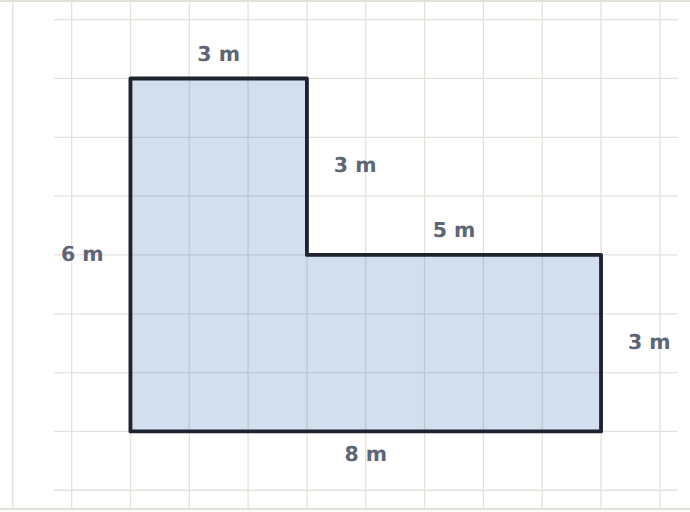
Cut the shape into pieces you know and add their areas, or take the missing pieces away from a big rectangle. Each piece uses its own lengths.
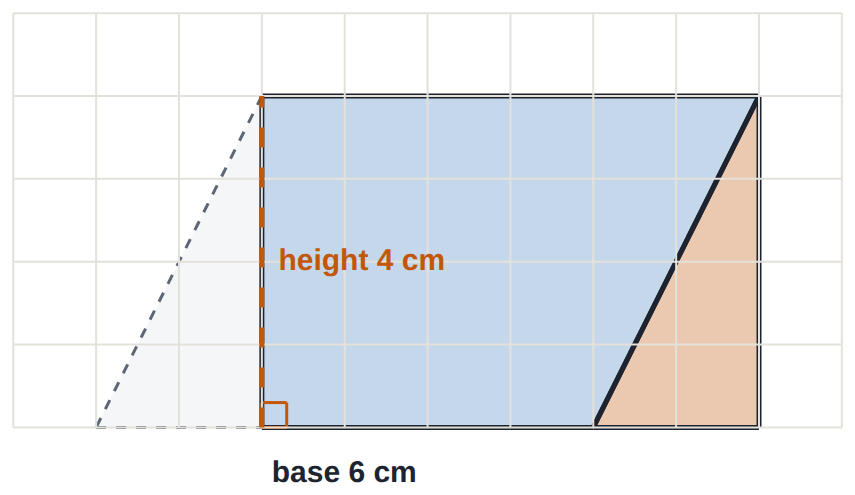
Cut the triangle off one end and move it: a rectangle with the same base and height.
Split the shape into rectangles and triangles and add the parts, or subtract a missing part from a bigger shape. Put every length in the same unit first.
Count the full squares, add half the part squares, multiply by the area of one square. A finer grid gives a closer estimate.
Each layer is the base (the cross-section); the height counts the layers. For a box, .
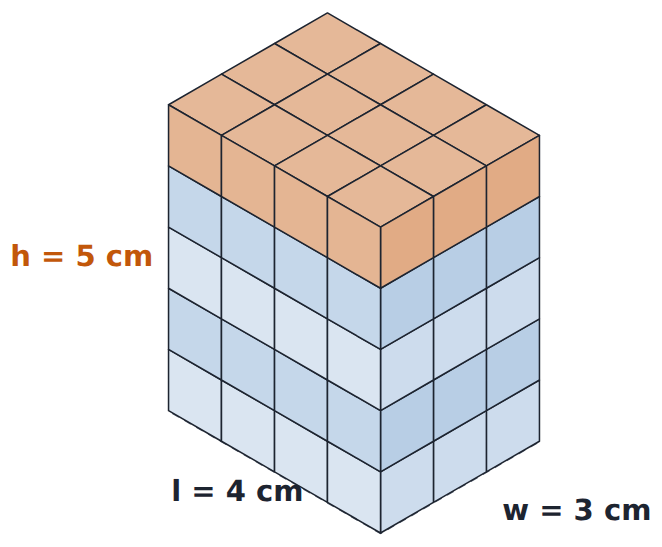
A cubic metre is 100 × 100 × 100 = 1 000 000 cm³: convert each of the three lengths.
The shape that is the same all the way along a prism, like a slice of bread. A triangular prism's cross-section is a triangle: halve first.

How much a container holds. A 10 cm cube holds 1 litre.
The area of the end times the length, for any right prism. Divide to find a missing length.
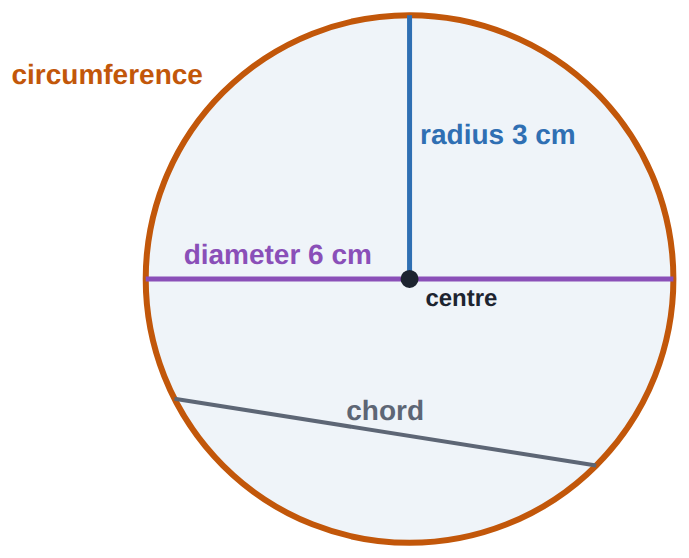
The radius goes from the centre to the edge; the diameter right across through the centre. A chord joins any two points; the diameter is the longest.
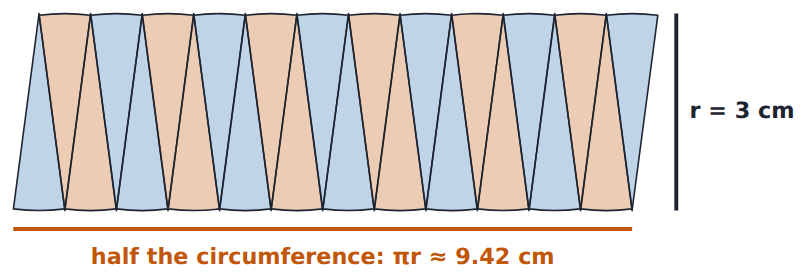
Slices of a circle make a near-rectangle πr long and r high. The area is between 2r² and 4r². Do not mix it up with C = 2πr.
The circumference divided by the diameter: the same for every circle. 3.14 and 22/7 are approximations.
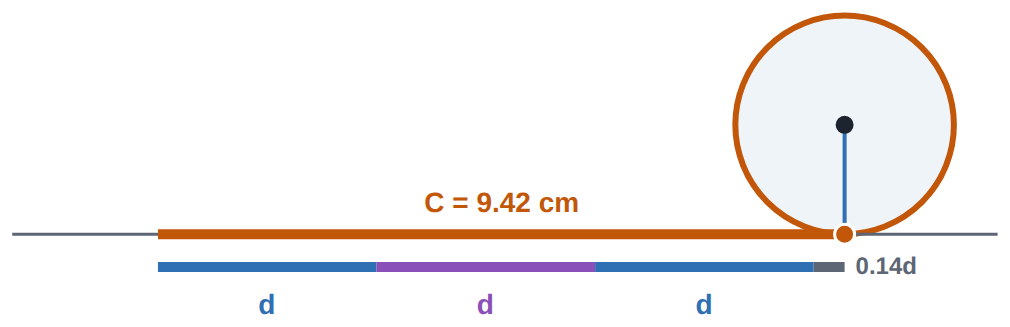
Use the diameter, or double the radius. Backwards: . Exact answers keep π: cm.
Divide by π, then take the square root. A semicircle is half the area; its perimeter is half the circumference plus the diameter.
In a right-angled triangle, the squares on the two shorter sides add to the square on the hypotenuse c, the side opposite the right angle.
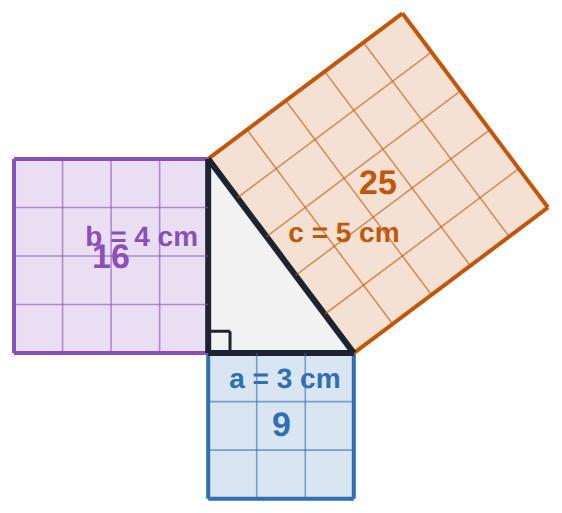
Add the squares for the hypotenuse; subtract for a shorter side. Check: the hypotenuse is the longest.
With c the longest side: equal, right-angled; a² + b² smaller, obtuse; bigger, acute. Pythagorean triples: 3-4-5, 5-12-13, 8-15-17 and multiples.
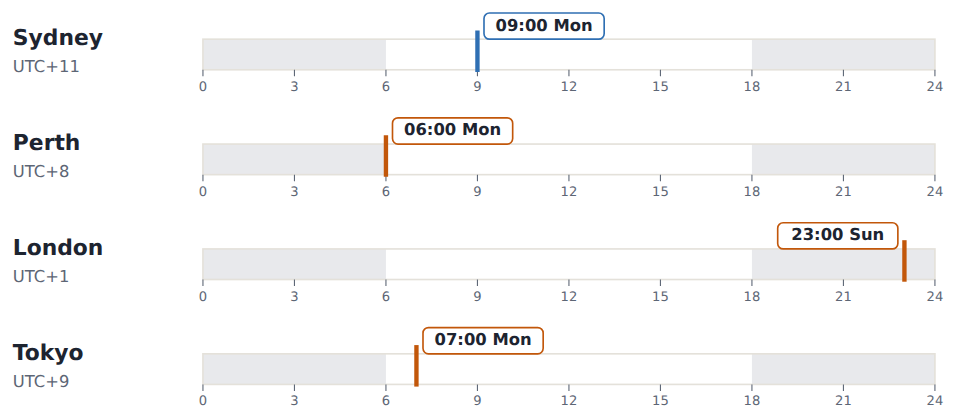
Find the difference between the UTC offsets, add or take it away, and change the day if you cross midnight. For a flight, add the flight time in the departure zone, then change zones.