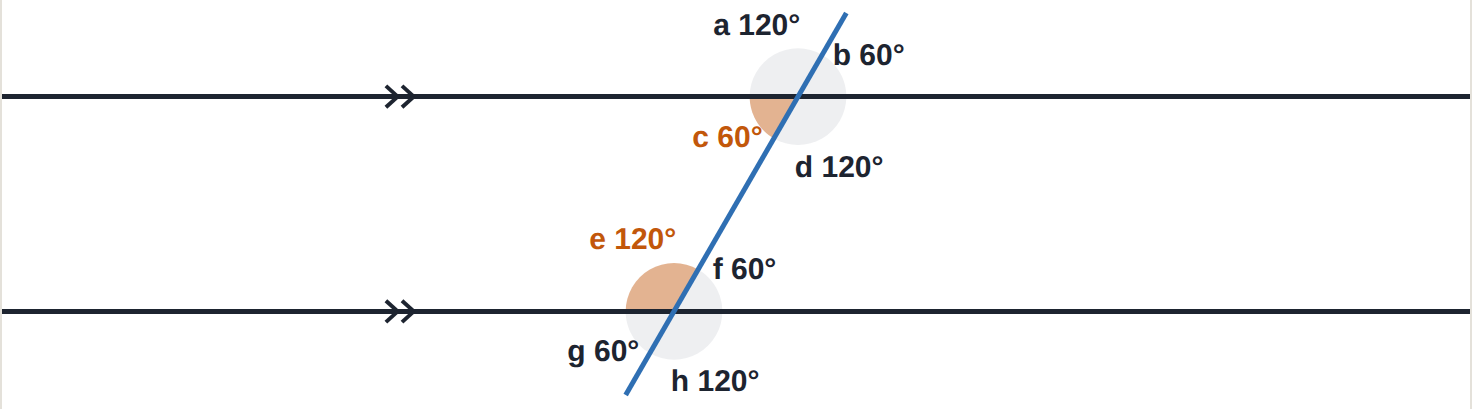
transversal
Parallel lines go the same way and never meet; arrows (>>) mark them. A transversal crosses both, making eight angles.
Angles and shapes · The words and methods from the lessons, with an example of each.
Parallel lines go the same way and never meet; arrows (>>) mark them. A transversal crosses both, making eight angles.
Between the parallel lines, on opposite sides of the transversal (a Z shape). With parallel lines they are equal.
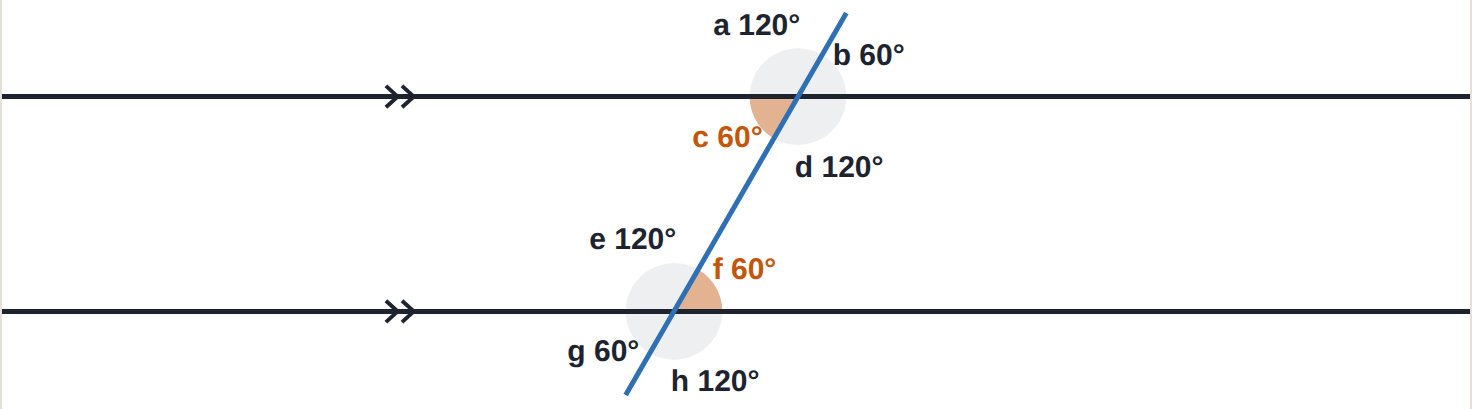
Opposite each other at one crossing: always equal, parallel lines or not. Not one of the parallel-line pairs.
For each angle you find, name the rule: corresponding or alternate angles are equal; co-interior angles add to ; angles on a straight line add to .
The same place at each crossing (an F shape). With parallel lines they are equal.

Between the parallel lines, on the same side (a C shape). With parallel lines they add to : they are not equal unless both are .