← Angles and shapes

Maths reference: Angles and shapes

The words and methods from Angles and shapes, each with an example and, where it helps, a picture of the board.

Print a cheat sheet (the whole course or one unit, with board pictures)

Parallel lines

parallel lines≫ crossed by a transversal\text{parallel lines} \gg \text{ crossed by a transversal}
transversal

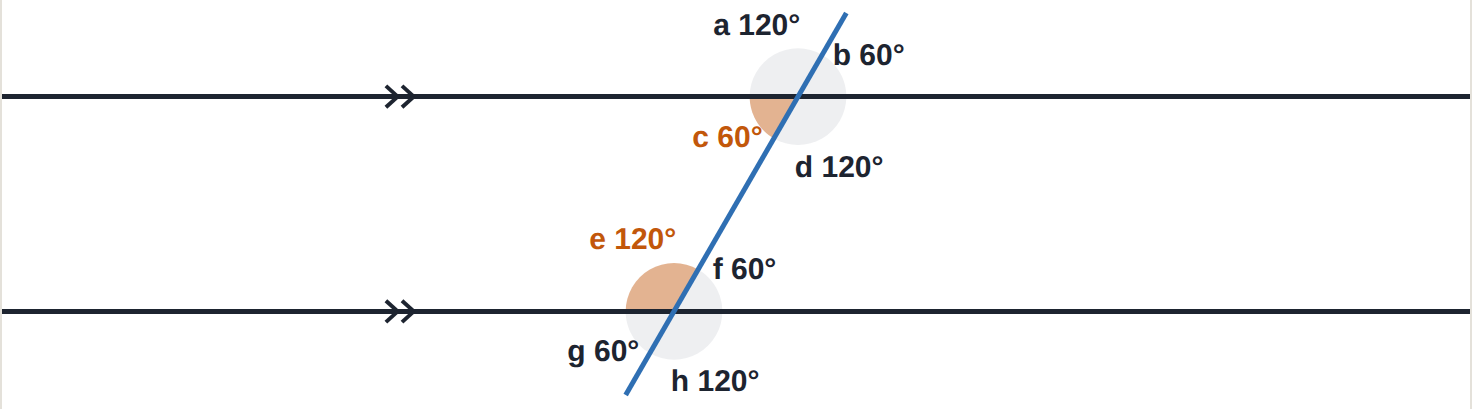
Parallel lines go the same way and never meet; arrows (>>) mark them. A transversal crosses both, making eight angles.

a=ea = e
corresponding angles

The same place at each crossing (an F shape). With parallel lines they are equal.

a and e: the same place at each crossing, both 120°
c=fc = f
alternate angles

Between the parallel lines, on opposite sides of the transversal (a Z shape). With parallel lines they are equal.
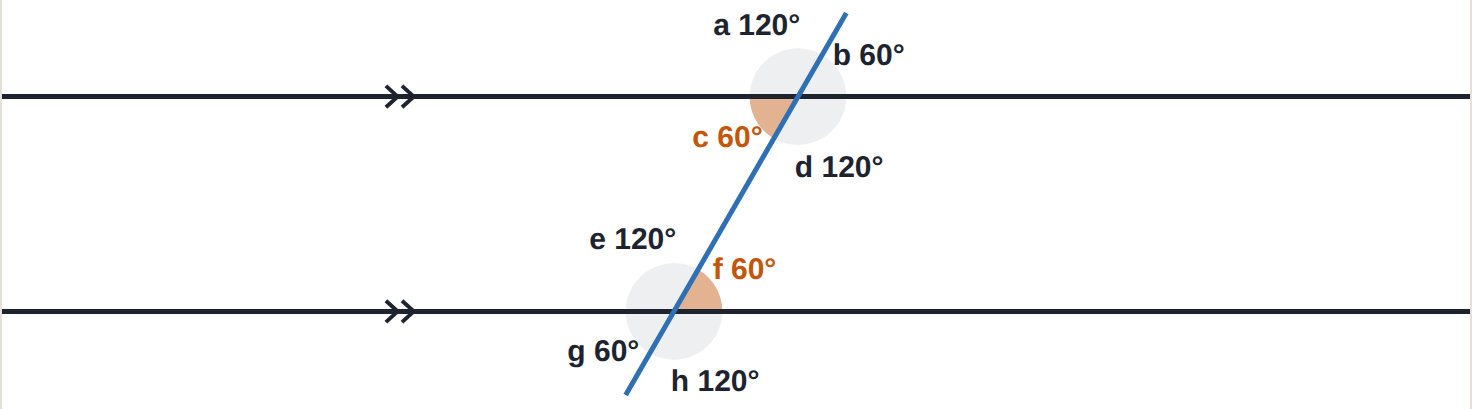
c and f: between the lines, opposite sides, both 60°
c+e=180∘c + e = 180^\circ
co-interior angles

Between the parallel lines, on the same side (a C shape). With parallel lines they add to 180∘180^\circ: they are not equal unless both are 90∘90^\circ.

c and e: between the lines, same side, 60° + 120° = 180°
b=cb = c
vertically opposite angles

Opposite each other at one crossing: always equal, parallel lines or not. Not one of the parallel-line pairs.

f=70∘  (corresponding to b)f = 70^\circ \;\text{(corresponding to } b\text{)}
give a reason

For each angle you find, name the rule: corresponding or alternate angles are equal; co-interior angles add to 180∘180^\circ; angles on a straight line add to 180∘180^\circ.

Words

∠A\angle A
interior angle

An angle inside a shape, at one of its corners.

n sides,  n cornersn \text{ sides}, \; n \text{ corners}
polygon

A closed shape with straight sides: triangle (3), quadrilateral (4), pentagon (5), hexagon (6), octagon (8).

each angle=(n−2)×180∘n\text{each angle} = \dfrac{(n - 2) \times 180^\circ}{n}
regular polygon

All sides and all angles are equal, so each angle is the angle sum shared equally: a regular hexagon has angles of 120∘120^\circ.

Rules

a+b+c=180∘a + b + c = 180^\circ
angle sum of a triangle

True for every triangle, whatever its shape or size: tear off the corners and they fill a straight line.
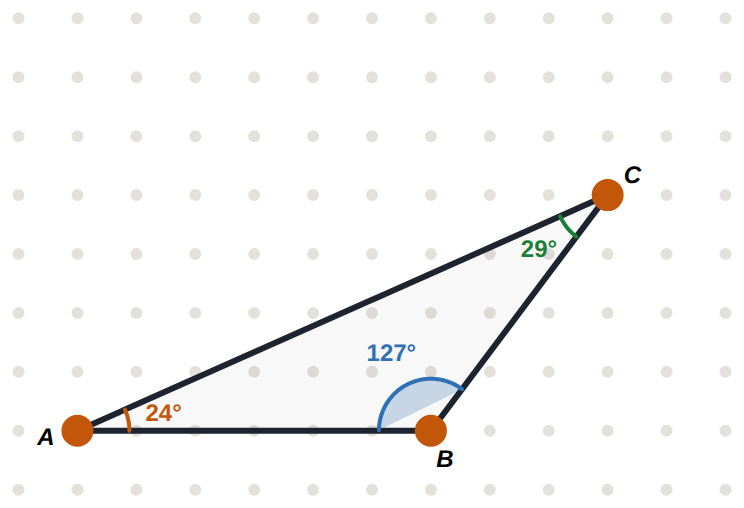
An obtuse triangle: 24° + 127° + 29° = 180°
(n−2)×180∘(n - 2) \times 180^\circ
angle sum of a polygon

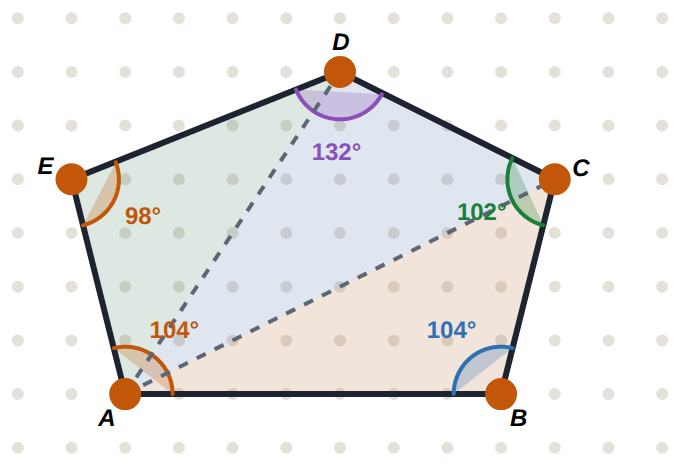
Split it into triangles from one corner: a shape with nn sides makes n−2n - 2 triangles. A pentagon: 3×180∘=540∘3 \times 180^\circ = 540^\circ.

A pentagon splits into 3 triangles from A: 540°

Shapes

scalene, isosceles, equilateral    acute, right-angled, obtuse\text{scalene, isosceles, equilateral} \;\; \text{acute, right-angled, obtuse}
triangles by sides and angles

Give two names: one for the sides (how many are equal) and one for the biggest angle. Equal sides sit opposite equal angles.
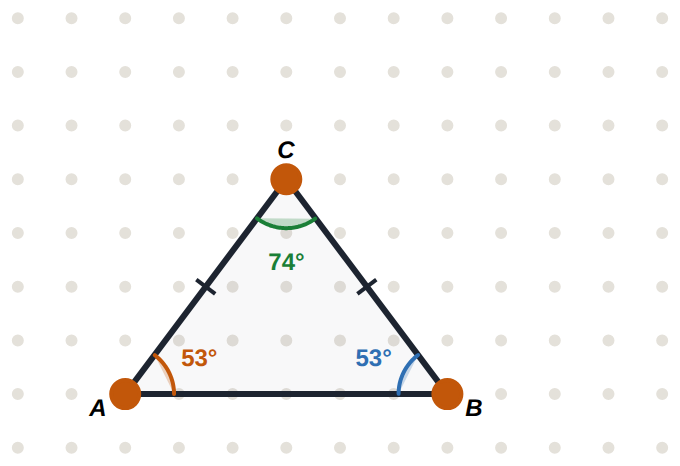
An isosceles acute triangle, its equal sides ticked
every square is a rectangle; every rectangle is a parallelogram\text{every square is a rectangle; every rectangle is a parallelogram}
quadrilateral family

Trapezium: at least one pair of parallel sides. Parallelogram: two. Rhombus: four equal sides. Rectangle: four right angles. Square: both. Kite: two pairs of equal neighbouring sides. A square is also a rectangle and a rhombus.
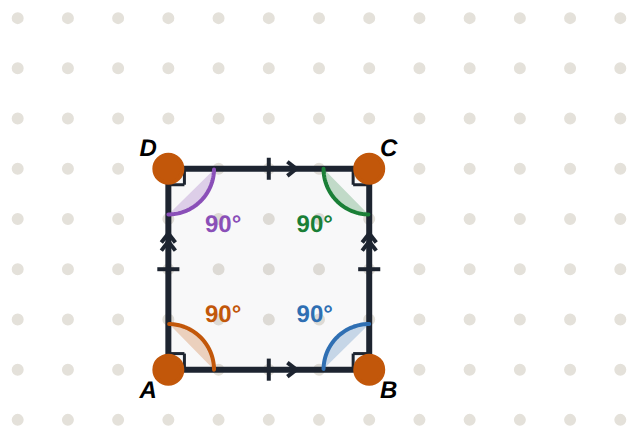
A square with equal sides, parallel sides and right angles marked
equal sides  and  equal angles\text{equal sides} \;\text{and}\; \text{equal angles}
regular polygon

Both are needed: a rhombus has equal sides but is not regular. Names: pentagon 5, hexagon 6, heptagon 7, octagon 8, nonagon 9, decagon 10.

concave: an angle>180∘\text{concave: an angle} > 180^\circ
convex and concave

Convex: every corner points out. Concave: at least one corner points in.
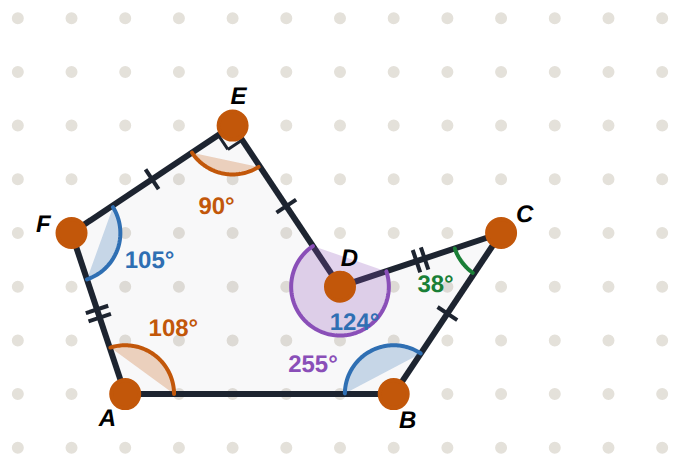
A concave hexagon with one corner pointing in

Solids, transformations and algorithms

cube: 6 squares on 6 different faces\text{cube: 6 squares on 6 different faces}
net

A net is a solid unfolded flat. Fold it, or roll a cube over it, to check that every face is covered once. Six squares is not enough.
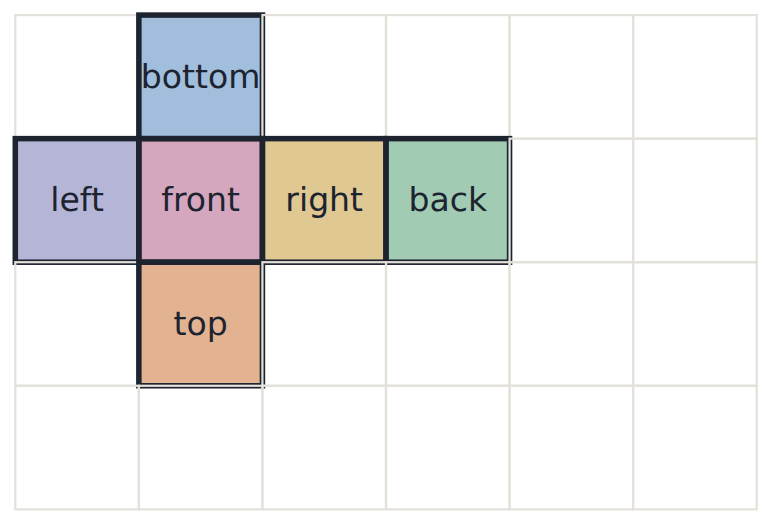
A cross of six squares that folds into a cube
A=2×triangle+length×(a+b+c)A = 2 \times \text{triangle} + \text{length} \times (a + b + c)
prism net area

A triangular prism has two triangles and three rectangles. The net's area is the surface area.

front=tallest pile in each column\text{front} = \text{tallest pile in each column}
top, front and side views

A view shows what you can see from one side; hidden cubes do not show. The top view with heights shows every cube.
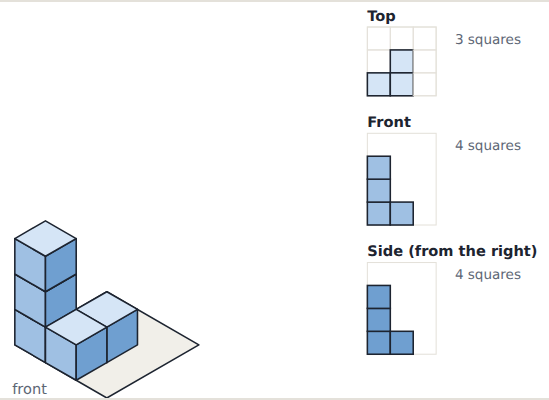
Three drawings of the same cubes
(x,y)→(x+a, y+b)(x, y) \to (x + a, \, y + b)
translation

Every point slides the same way. Right and up add; left and down take away.
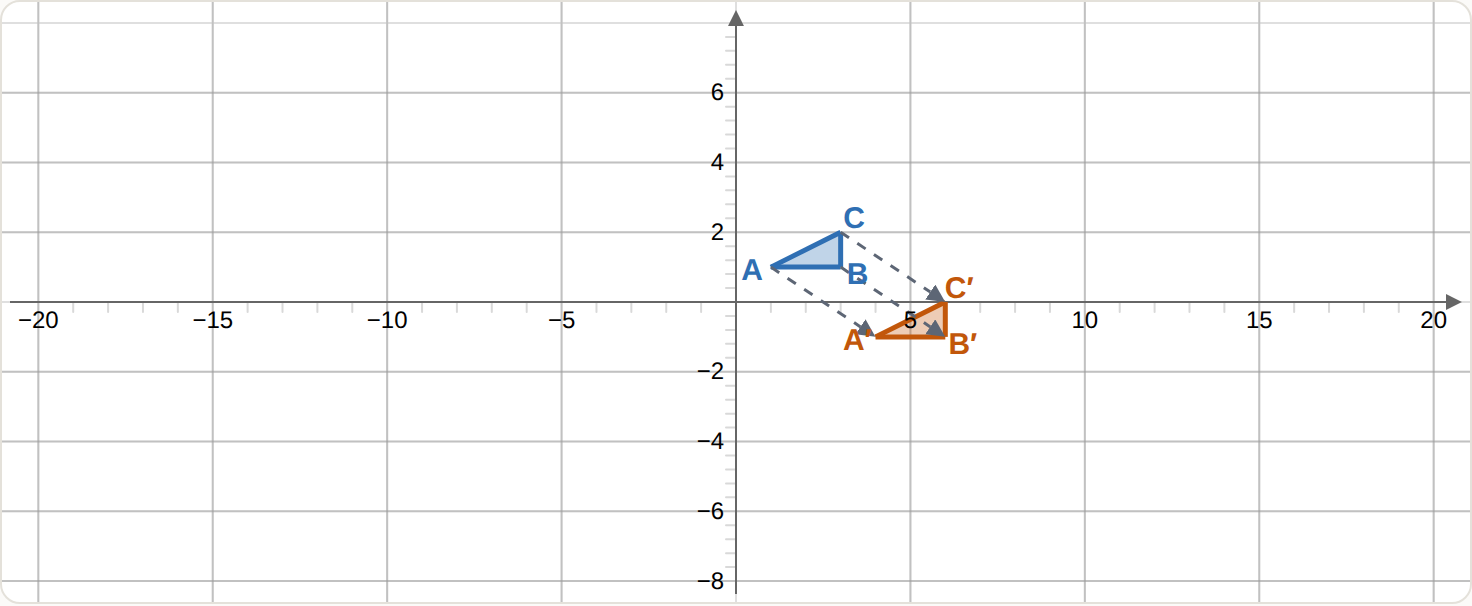
A triangle moved 3 right and 2 down
x-axis: (x,y)→(x,−y)y-axis: (x,y)→(−x,y)x\text{-axis: } (x, y) \to (x, -y) \qquad y\text{-axis: } (x, y) \to (-x, y)
reflection

Each point and its image are the same distance from the mirror, on opposite sides.

A triangle reflected in the y-axis
90∘ anticlockwise: (x,y)→(−y,x)90^\circ \text{ anticlockwise: } (x, y) \to (-y, x)
rotation

Give the centre, the angle and the direction. A half turn: (x, y) to (−x, −y). 90° clockwise is 270° anticlockwise.
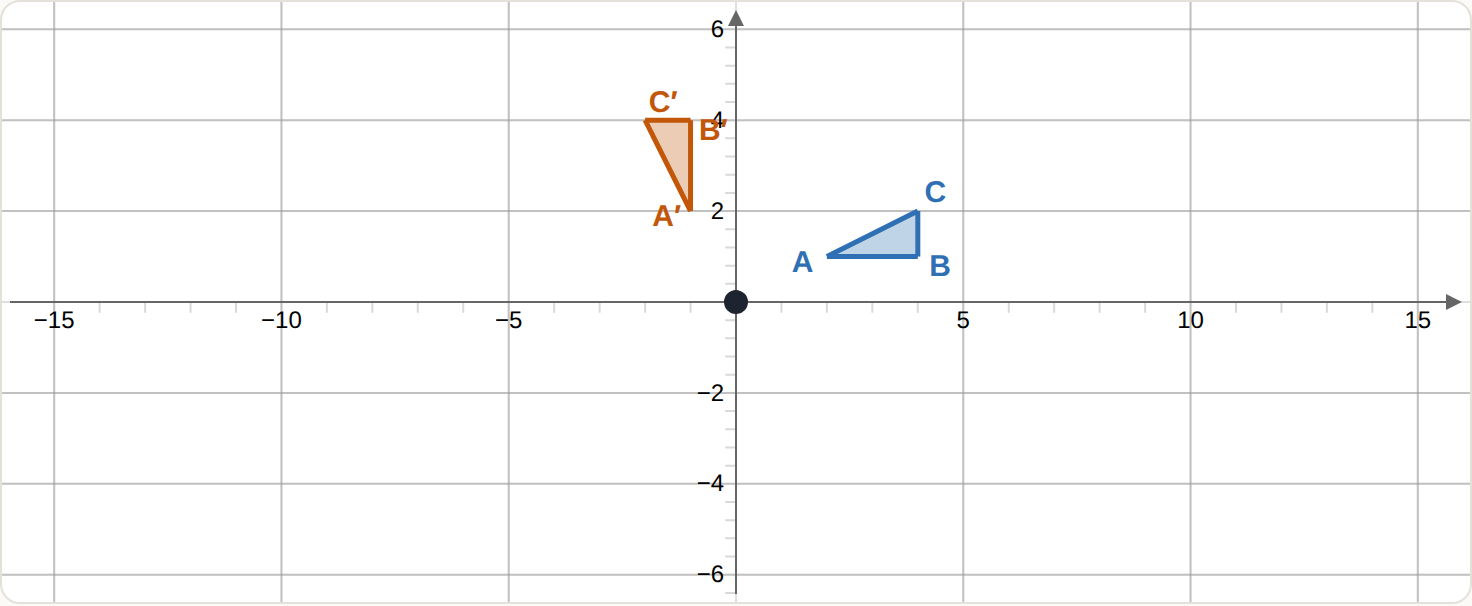
A triangle turned a quarter turn about the origin
ask the most specific question first\text{ask the most specific question first}
algorithm

A set of steps and decisions that gives the right result every time. Test it on one shape of every class.

Congruence, similarity and 3D

SSS, SAS, ASA or AAS, RHS\text{SSS},\ \text{SAS},\ \text{ASA or AAS},\ \text{RHS}
congruence tests

Each set of equal parts fixes a triangle. In SAS the angle is between the two sides; SSA is not a test, because it can give two triangles.
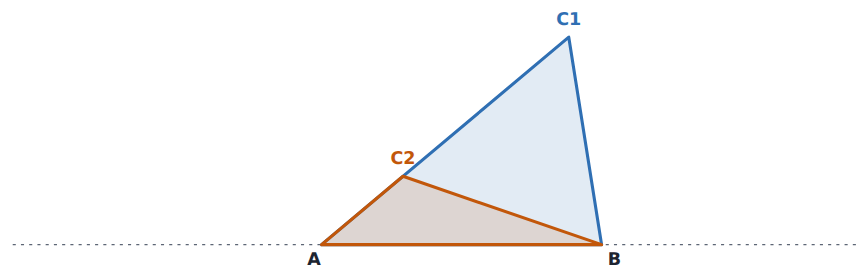
Two different triangles with the same SSA parts
k=copy lengthmatching original lengthk = \dfrac{\text{copy length}}{\text{matching original length}}
scale factor

Similar shapes: every length times k, every angle the same. Triangles are similar by AA, SSS (sides in one ratio) or SAS.
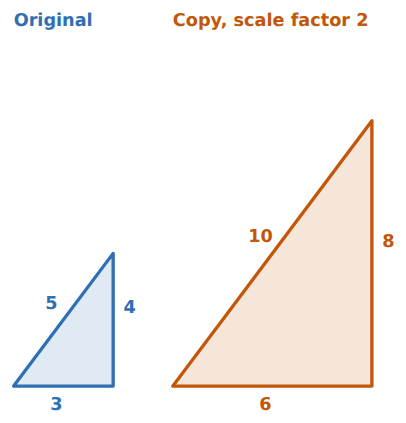
A 3, 4, 5 triangle and a copy twice as big
rectangle: equal, bisectrhombus: bisect at 90∘\text{rectangle: equal, bisect} \quad \text{rhombus: bisect at } 90^\circ
diagonals of quadrilaterals

A parallelogram's diagonals cut each other in half; a kite's cross at 90°. Prove a property with two congruent triangles.

A rectangle with its two equal diagonals
opposite angles equal; neighbours add to 180∘\text{opposite angles equal; neighbours add to } 180^\circ
parallelogram angles

Neighbouring angles are co-interior between parallel sides. All four add to 360°.

(x,y,z)(x, y, z)
3D coordinates

Along x, along y, then up z. The order is always x, y, z; points on the floor have z = 0.
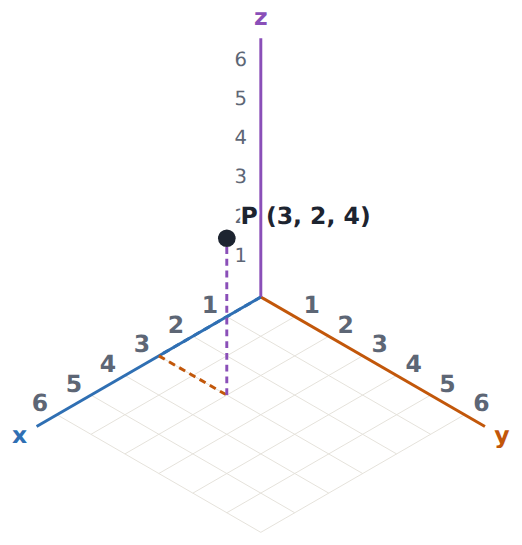
The point (3, 2, 4) on three axes
congruent?→similar?→not enough to tell\text{congruent?} \to \text{similar?} \to \text{not enough to tell}
congruence algorithm

Ask the congruence tests first, then the similarity conditions, and end with a catch-all. Test on one pair of each kind, including SSA.