perpendicular height
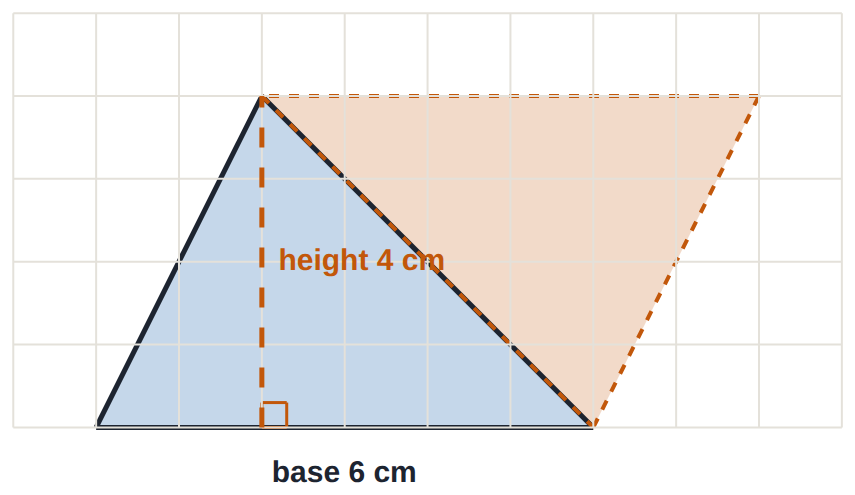
The distance from the base to the opposite side or corner, at a right angle (∟) to the base. A slanted side is longer, and is not the height.
Area, volume, circles and Pythagoras · The words and methods from the lessons, with an example of each.
The distance from the base to the opposite side or corner, at a right angle (∟) to the base. A slanted side is longer, and is not the height.
Two copies make a parallelogram with the same base and height; the triangle is half.
Area counts squares: cm², m². A 1 m square is 100 cm by 100 cm.
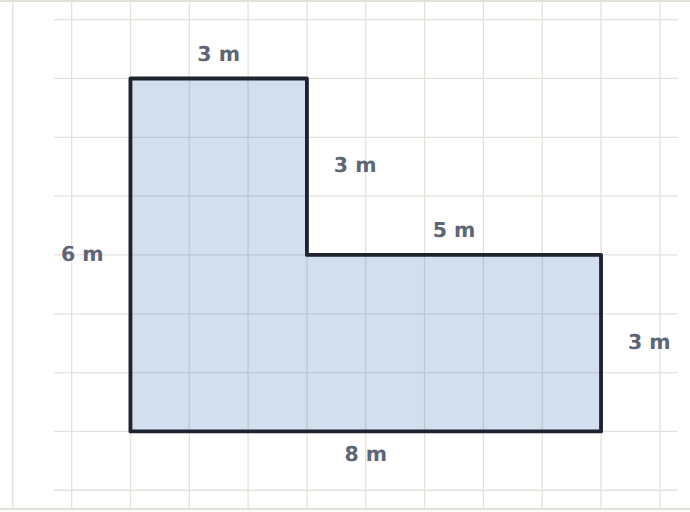
Cut the shape into pieces you know and add their areas, or take the missing pieces away from a big rectangle. Each piece uses its own lengths.
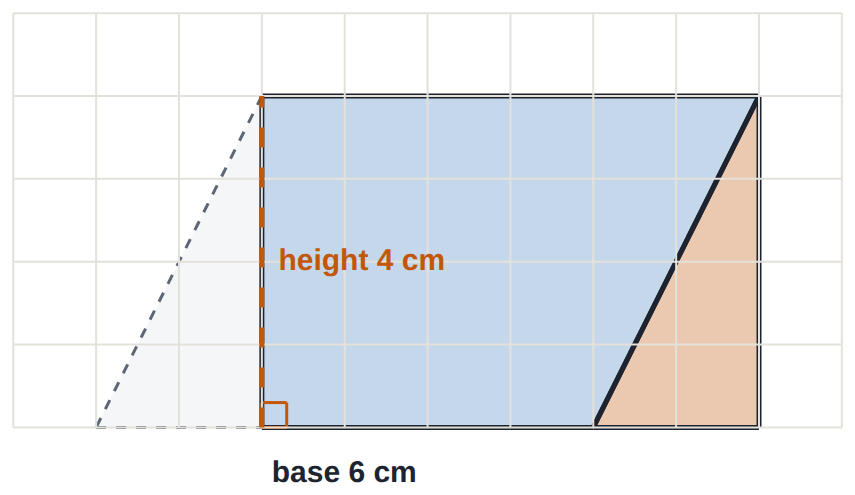
Cut the triangle off one end and move it: a rectangle with the same base and height.
Split the shape into rectangles and triangles and add the parts, or subtract a missing part from a bigger shape. Put every length in the same unit first.
Count the full squares, add half the part squares, multiply by the area of one square. A finer grid gives a closer estimate.