Pick from a list
Students pick an item from a list at random with pick random 0 to length − 1, so every item can come up however long the list grows.
Classroom resources
Load these into Waypoints Prepare: choose Load URL and paste the copied address, or download the file and import it. In Prepare, the worksheet's Teacher edition shows the answers; the student copy hides them.
Students will be able to
- I can pick a random item from a list.
- I can say why the range is 0 to length − 1.
- I can add items to a list without changing the random part.
Timing
Predict and Run 7 min · Investigate 10 min · Modify 8 min · Mix it up 3 min · Make 8 min · Team picker 4 min
Before class
pick random (Math) gives a whole number between two numbers. length of array (Arrays) counts the items. A random item is get value at (pick random 0 to length − 1): the length is one more than the last place, because places start at 0. Using the length means new items are included without changing anything else.
Running the lesson
- Predict: some students think it cycles through or never repeats. Random has no memory.
- Run: shake several times. Repeats happen.
- Investigate: Kai counts from 1; Ana's range stays fixed when her list grows. Both are fixed by 0 to length − 1.
- Modify: students fix Ana's 8-ball with length, then show the length.
- Mix it up: last lesson's chooser, traced by hand.
- Make: rock, paper, scissors is the same pattern with new items.
In class
On the slides at these points. Students can do the whole lesson on their own; these are for the room. In the deck, the Run, Modify and Make slides have the live playground in them (the tutorial link is the backup), and the notes above are in each slide's speaker notes.
- Roll a dice (predict, 3 min)
Roll a real dice twice. Can it give the same number both times?
Roll a real dice twice to settle it: random has no memory.
- Draw a card (investigate, 3 min)
Three cards numbered 0, 1 and 2 go in a hat. A student draws one, reads the item at that place, and puts it back.
Add two more items to the board but not to the hat: they never come up. That is Ana's bug.
- Play a round (end, 3 min)
Play rock, paper, scissors against the next pair: both shake at once.
The hard part (on purpose)
Why it is length − 1. Ask them to count the places of a 3-item list aloud from 0.
When students get stuck
| What you will see | A question to ask | The fix |
|---|---|---|
| One item never comes up. | Which places can pick random choose from? | Pick from 0 to length − 1, not from 1 and not a fixed number. |
| The minus block will not fit. | Is it the round number minus block from Math? | Drag Math's 0 − 0 block into the slot, then put length of array on its left and 1 on its right. |
| A number shows instead of the word. | Is the random number inside get value at? | pick random gives the place; get value at turns the place into the item. |
Answers to the checks
- Predict: You shake this magic 8-ball twice. Can it give the same answer both times?
Yes. Each shake picks a random place from 0 to 2, with no memory of the last one, so the same place can come up twice. - Which places?: The list has 3 answers. Which places can pick random 0 to length − 1 choose?
0, 1 or 2
The length is 3, so it picks from 0 to 2: exactly the three places. - Kai's 8-ball: Kai's magic 8-ball never says Yes, and sometimes shows nothing at all. Why?
Places start at 0, but Kai picks from 1 to 3: he skips Yes and asks for a place that is not there
Yes is at place 0, which Kai never picks, and place 3 does not exist. Picking from 0 to length − 1 covers every item. - Ana's longer list: Ana added two answers, so the list has five. Her code still picks from 0 to 2. What happens?
The two new answers never come up
0 to 2 only reaches the first three places. Picking from 0 to length − 1 grows with the list. - Mix it up: This is last lesson's mood chooser. choice starts at 0. You press A four times. Which mood shows after the 4th press?
Tired
The presses make choice 1, 2, then 3, which goes back to 0, then 1. Place 1 is Tired.
Solutions
One possible solution for each task. Other correct programs are fine.
Modify › Every answer
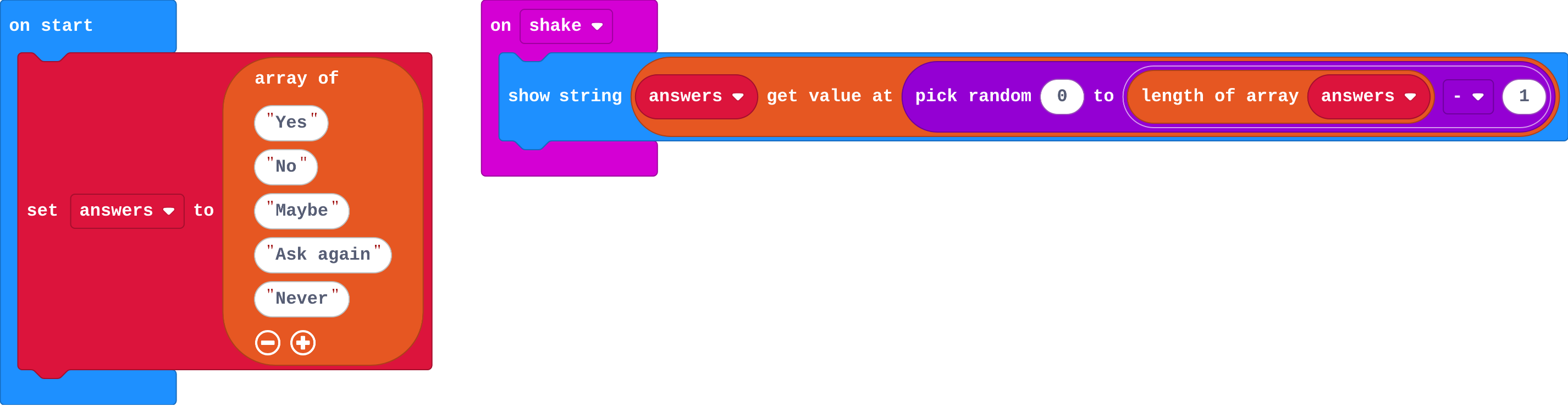
Show as code
let answers = ["Yes", "No", "Maybe", "Ask again", "Never"]
input.onGesture(Gesture.Shake, function () {
    basic.showString(answers[randint(0, answers.length - 1)])
})
Modify › How many?

Show as code
let answers = ["Yes", "No", "Maybe", "Ask again", "Never"]
input.onGesture(Gesture.Shake, function () {
    basic.showString(answers[randint(0, answers.length - 1)])
})
input.onButtonPressed(Button.A, function () {
    basic.showNumber(answers.length)
})
Make

Show as code
let choices = ["Rock", "Paper", "Scissors"]
input.onGesture(Gesture.Shake, function () {
    basic.showString(choices[randint(0, choices.length - 1)])
})
Change a team picker
Open task: any program that does what the step asks.
Stretch and support
Stretch: Make a dice: a list of six show leds pictures is hard to make, so use show number pick random 1 to 6 instead, and say why this one starts at 1.
Support: Give students the list and the on shake block with show string already in, and ask them only to build get value at with pick random.
Exit ticket
A list has 6 items. What should pick random choose between, and why?
0 and 5 (0 to length − 1), because places start at 0, so the last of 6 items is at place 5.
What each step is for
- Investigate: pick random 0 to length − 1 gives any place in the list, so every item can come up, and new items are included without changing anything else.
- Modify: Using the list's length means the program still works when the list grows.
- Mix it up: A variable can be the place: change it, and get value at takes out a different item.
Where it leads
Next: the final challenge, a pocket pet that uses everything in this course.