← Year 7 Earth and space

Year 7 Earth and space: recap

Answer each question in your head or on paper first, then check it.

The Earth and the sun

1. Spinning and orbiting

Try firstWhat is the difference between rotation and revolution?

Check your answer

Rotation is the Earth spinning on its axis (once a day, causing day and night); revolution is the Earth travelling round the sun (once a year).

Rotation: the Earth spins on its axis once a day, causing day and night. Revolution: it goes round the sun once a year. The axis is tilted 23.4° and always points the same way in space.
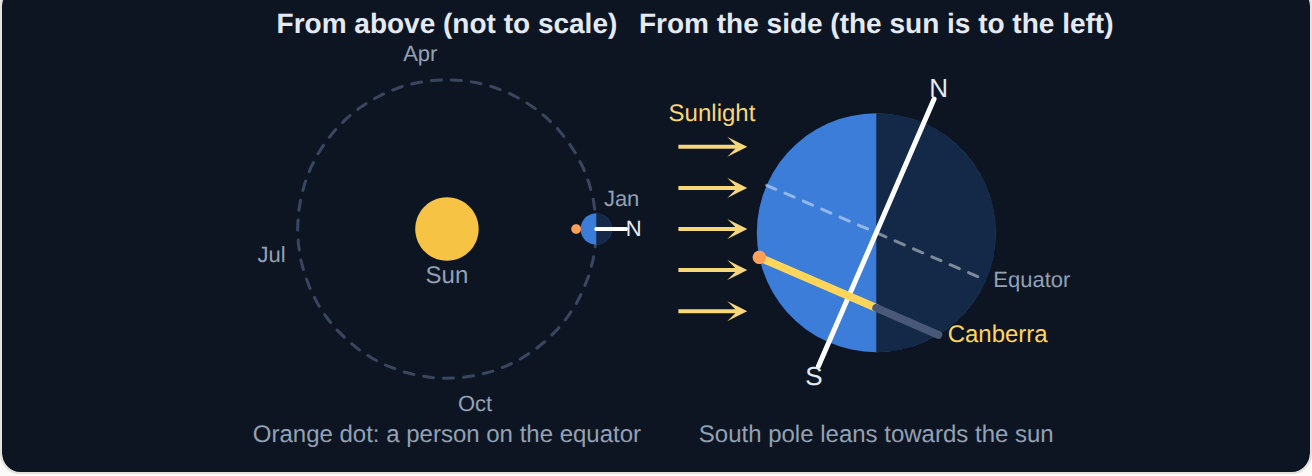
Earth's orbit round the sun, with its tilted axis, and the side view showing day and night.
Spinning and orbiting · Sound on for the voiceover
Open the lesson →

2. Why is summer hot?

Try firstExplain why Canberra is hotter in December than in June.

Check your answer

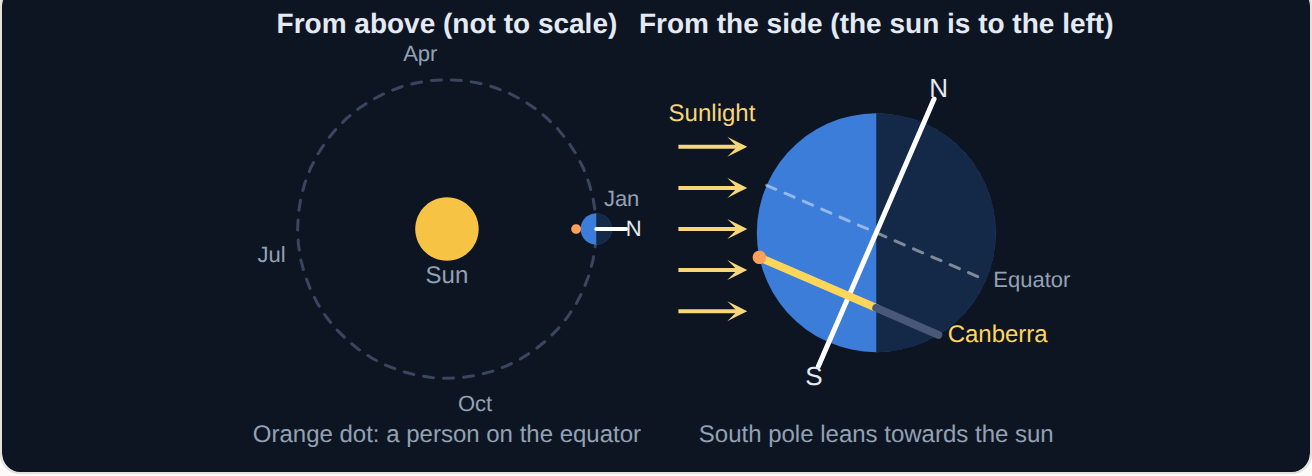
In December the Southern Hemisphere leans towards the sun (the tilt), so the noon sun is higher, concentrating the light, and days are longer. It isn't distance: the Earth is actually slightly closer to the sun in January.

Seasons are caused by the Earth's tilt. Leaning towards the sun gives a higher noon sun (concentrated light) and longer days: summer. The hemispheres have opposite seasons. The Earth is closest to the sun in January, so distance isn't the cause.

Earth's orbit from above, its axis always leaning the same way; from the side, Canberra tilted towards the sun in December.
Why summer is hot · Sound on for the voiceover
Open the lesson →

The moon

3. Why does the moon change shape?

Try firstWhy do we see a half-lit moon at first quarter?

Check your answer

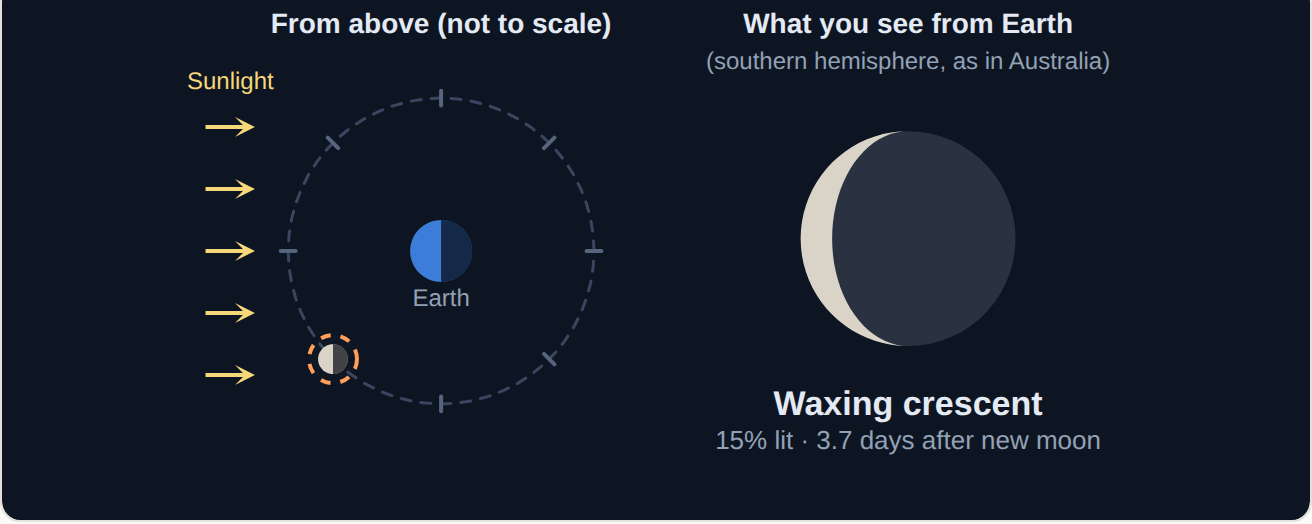
The moon is a quarter of the way round its orbit, at right angles to the sun; we see half of its sunlit half. It isn't Earth's shadow.

Phases: the sun always lights half the moon; as the moon orbits the Earth (29.5 days), we see more or less of that lit half. New → waxing crescent → first quarter → waxing gibbous → full → waning gibbous → last quarter → waning crescent. Not Earth's shadow.

The moon orbiting the Earth, lit on one side by the sun, and how it looks from Earth.
The moon's phases · Sound on for the voiceover
Open the lesson →

4. Why isn't there an eclipse every month?

Try firstWhy doesn't every full moon give a lunar eclipse?

Check your answer

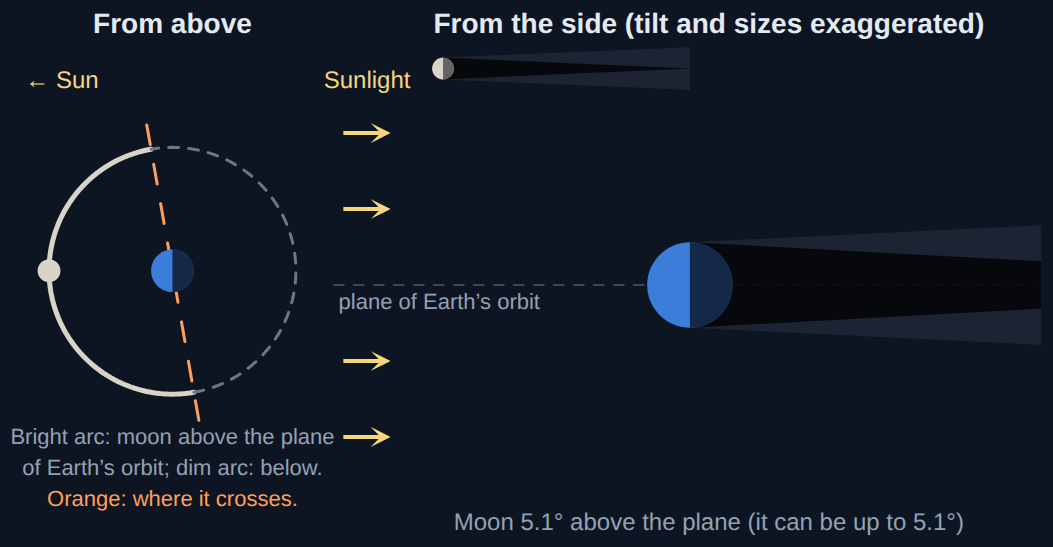
The moon's orbit is tilted about 5° to Earth's, so at most full moons the moon passes above or below Earth's shadow.

Solar eclipse: new moon, the moon's shadow on Earth. Lunar eclipse: full moon, the moon in Earth's shadow. Umbra: full shadow; penumbra: partial. Eclipses are rare because the moon's orbit is tilted about 5°.

From above and from the side: the moon's orbit tilted about 5°, so most new and full moons miss the shadow.
Eclipses are rare · Sound on for the voiceover
Open the lesson →

5. Why are there two high tides a day?

Try firstWhen do spring tides happen, and why are they bigger?

Check your answer

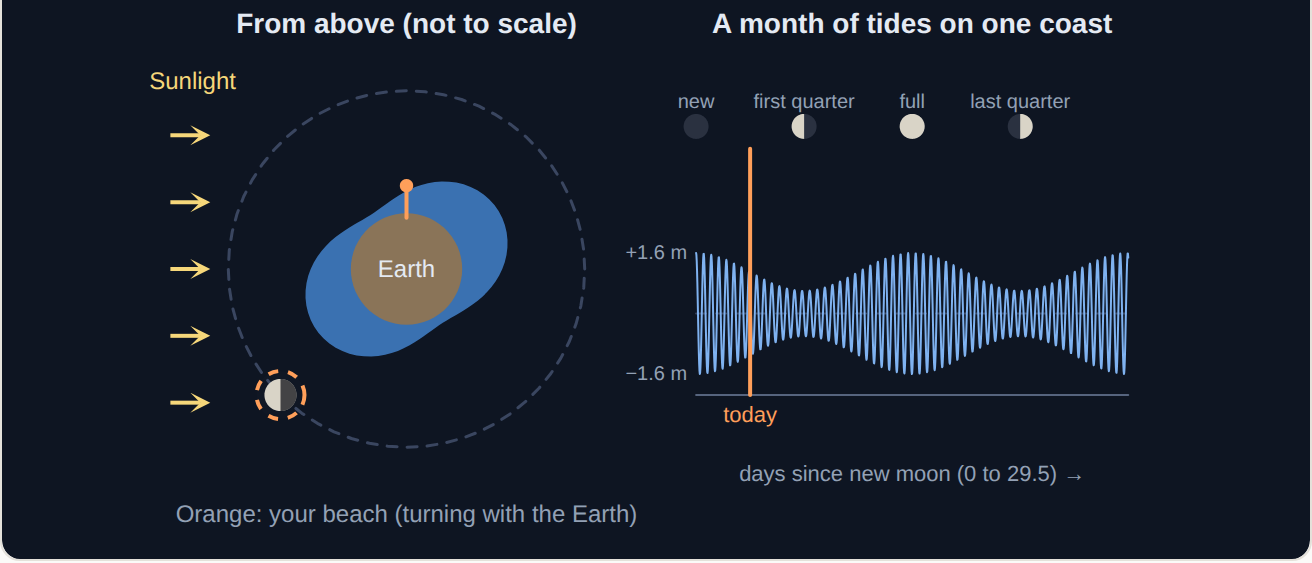
At new and full moon, when the sun and moon are in line, so their pulls on the oceans add together.

Tides: the moon's gravity pulls the oceans into two bulges; the Earth spins through both, so most coasts get two high tides a day. Spring tides (biggest) at new and full moon (sun and moon in line); neap tides (smallest) at the quarters.

The oceans pulled into two bulges by the moon (and two smaller ones by the sun).
Tides · Sound on for the voiceover
Open the lesson →