← Year 9 Biology

Year 9 Biology: recap

Answer each question in your head or on paper first, then check it.

Coordination and control

1. What counts as a stimulus?

Try firstGive one internal stimulus and name its receptor and effector.

Check your answer

For example: body temperature rising; temperature receptors in the brain; sweat glands.

Stimulus: any change the body detects, inside or outside it. Pathway: stimulus → receptor (detects) → command centre (decides) → effector (muscle or gland) → response.

Stimulus to response · Sound on for the voiceover
Open the lesson →

2. Who decides?

Try firstName the command centre in a reflex and say why reflexes are fast.

Check your answer

The spinal cord; the impulse doesn't have to travel to the brain and wait for a decision.

The CNS (brain and spinal cord) is the command centre. Sensory neurons carry impulses in from receptors; motor neurons carry them out to effectors (muscles or glands). A reflex goes through the spinal cord, so it is automatic and fast.

Who decides? · Sound on for the voiceover
Open the lesson →

3. Nerves or hormones?

Try firstGive one difference between how a nerve signal and a hormone travel, and one difference in how long their effects last.

Check your answer

Nerve signals are electrical, along nerves; hormones are chemicals in the blood. Nerve effects are brief; hormone effects last longer.

Both systems run stimulus → receptor → command centre → effector → response. The nervous system sends electrical signals along nerves: very fast, brief, to one place.

The endocrine system uses glands that release hormones into the blood: slower, longer-lasting, reaching target organs anywhere. Many responses use both.

Two ways to send a message · Sound on for the voiceover
Open the lesson →

4. Nerve or hormone?

Try firstGive two differences between a nervous and a hormonal response.

Check your answer

Nerves: electrical, fast, short-lived, one place. Hormones: chemical in the blood, slower, longer-lasting, target cells everywhere.

Nerves: fast electrical impulses to one place, short-lived. Hormones: chemicals released by glands into the blood, slower and longer-lasting; every cell gets them but only target cells (with matching receptors) respond.

Nerves and hormones · Sound on for the voiceover
Open the lesson →

5. How does your body stay at 37 °C?

Try firstDescribe what happens when your body temperature rises above 37 °C.

Check your answer

Temperature receptors detect it; the hypothalamus sends impulses to the sweat glands and skin blood vessels; sweating and widened vessels cool the body; once it is back near 37 °C, they switch off.

Homeostasis: keeping internal conditions near a set point. Negative feedback: a change is detected and the response reverses it, then switches off once conditions return to the set point. Body temperature: sweating and flushed skin when too hot, shivering and pale skin when too cold.

Negative feedback · Sound on for the voiceover
Open the lesson →

Reproduction

6. What makes a sex cell special?

Try firstWhy do sperm and egg cells have 23 chromosomes, not 46?

Check your answer

So that when they fuse at fertilisation, the new cell has 46, the full number, again.

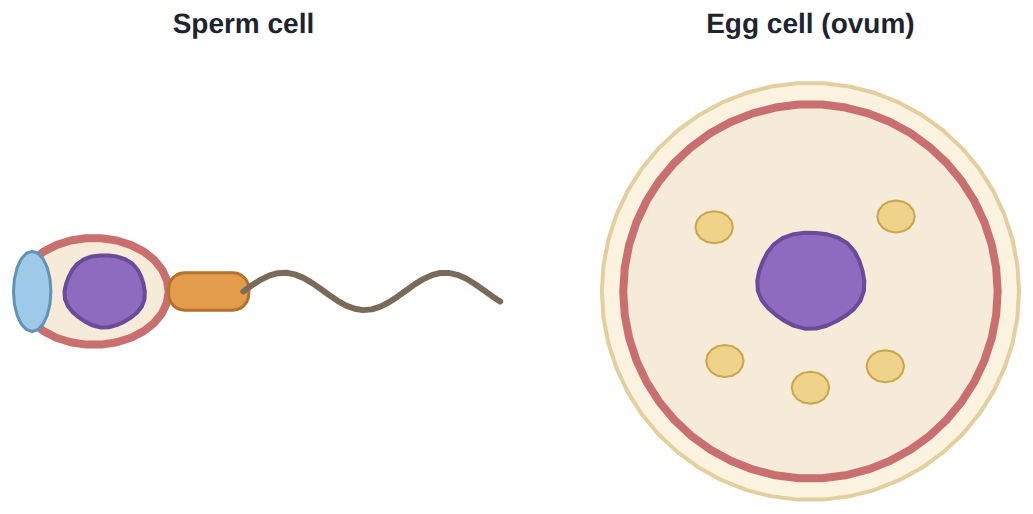
Gametes (sperm and egg) have half the usual number of chromosomes (23 in humans), so fertilisation restores the full number (46). Sperm swim (tail, mitochondria) and digest their way in (acrosome); the egg is large with a food store and lets only one sperm in.

A sperm (head, midpiece, tail) and an egg (much larger, with a food store): each carries 23 chromosomes.
Sperm and egg · Sound on for the voiceover
Open the lesson →

7. Why don't brothers and sisters look the same?

Try firstWhy do two offspring of the same parents look different?

Check your answer

Each gets a random one of each parent's two copies of each gene, so each gets a different combination.

Sexual reproduction: two parents; each offspring gets a random half of each parent's genes, so offspring vary. Asexual reproduction: one parent makes clones. Variation helps a population survive change; asexual reproduction is fast and needs no partner.

Sexual and asexual reproduction · Sound on for the voiceover
Open the lesson →