← Year 10 Biology

Year 10 Biology: recap

Answer each question in your head or on paper first, then check it.

Genetics

1. Where are the instructions?

Try firstWhat's the difference between a gene and an allele?

Check your answer

A gene is a section of DNA coding for a protein; an allele is one version of that gene.

DNA carries the instructions; a chromosome is one long coiled DNA molecule; a gene is a section of DNA coding for a protein; alleles are versions of a gene. Chromosomes come in pairs, one from each parent.

From body to gene · Sound on for the voiceover
Open the lesson →

2. Why is every sperm and egg different?

Try firstWhy does meiosis make every gamete different?

Check your answer

Each gamete gets one chromosome from each pair, and which one is random, so the combination differs.

Meiosis makes gametes with half the chromosomes: one from each pair, chosen at random, so almost every gamete is a different combination (over 8 million possible in humans). Mitosis makes identical cells for growth and repair.

Meiosis · Sound on for the voiceover
Open the lesson →

3. Can you predict the offspring?

Try firstComplete Bb × Bb. What fraction of offspring are expected to show the recessive trait?

Check your answer

BB, Bb, Bb, bb: 1 in 4 (25%).

Punnett square: each parent's possible gametes along the edges, every combination in the grid. It gives probabilities: Pp × Pp gives 1 PP : 2 Pp : 1 pp, so 3 dominant : 1 recessive phenotype. Genotype is the alleles; phenotype is the characteristic seen.

A Punnett square · Sound on for the voiceover
Open the lesson →

Evolution

4. How different are individuals?

Try firstGive an example of inherited variation and one of environmental variation in humans.

Check your answer

For example: blood group (inherited); a scar or a language spoken (environmental).

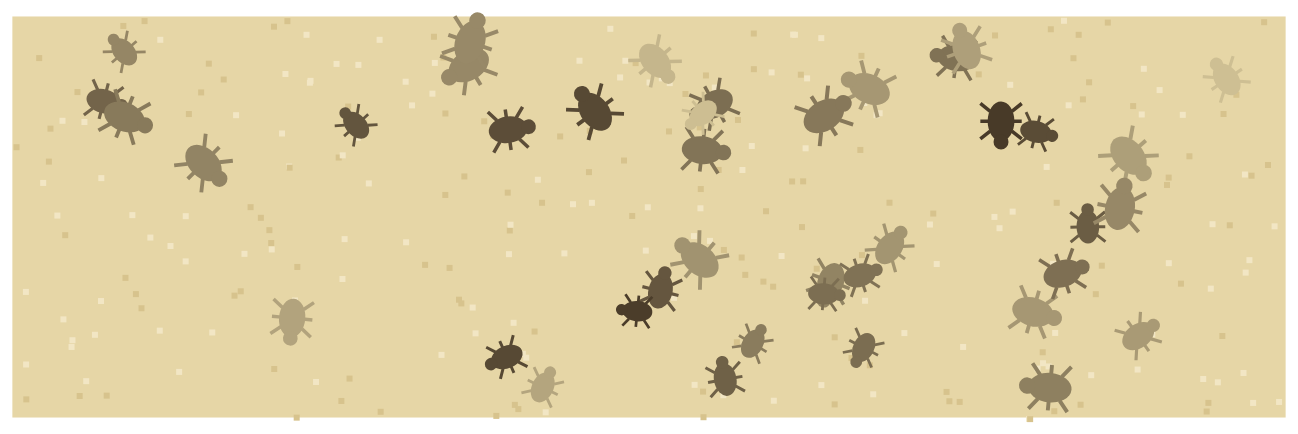
Variation: individuals in a population differ. Continuous (any value, such as height) or discontinuous (groups, such as blood group); inherited, environmental, or both. Only inherited variation is passed on, so only it drives evolution.

No two beetles quite the same colour: continuous variation in one population.
Variation · Sound on for the voiceover
Open the lesson →

5. Why did the beetles change?

Try firstExplain why the beetle population got paler on pale ground.

Check your answer

Beetles varied in colour; birds ate the darker, more visible ones; paler beetles survived and bred, passing on their colour; over generations, the average colour got paler.

Natural selection: individuals vary; those best suited to the environment are more likely to survive and reproduce, passing on their alleles; over generations the population changes. Individuals don't change: the population does. "Fittest" depends on the environment.

Over millions of years this branches into a tree of life: all living things share ancestors, and DNA shows how closely they are related.

A population of beetles: each one a slightly different colour, on pale ground.
Natural selection · Sound on for the voiceover
Open the lesson →