← Irrational numbers and index laws

Irrational numbers and index laws: recap

Answer each question in your head or on paper first, then check it.

Recurring decimals

1. Recurring decimals

Try firstDoes 5/6 terminate or recur? Write it with a dot.

Check your answer

It recurs: 5/6 = 0.8333… = 0.83 with a dot over the 3.

A fraction's decimal terminates (stops) or recurs (repeats a block forever). In long division, a remainder of 0 means it stops; a remainder that comes back means the digits repeat.

Mark the repeating block with a bar or dots: $0.\overline{142857}$, $0.1\dot{6}$. A recurring decimal is still a fraction, so it is rational.
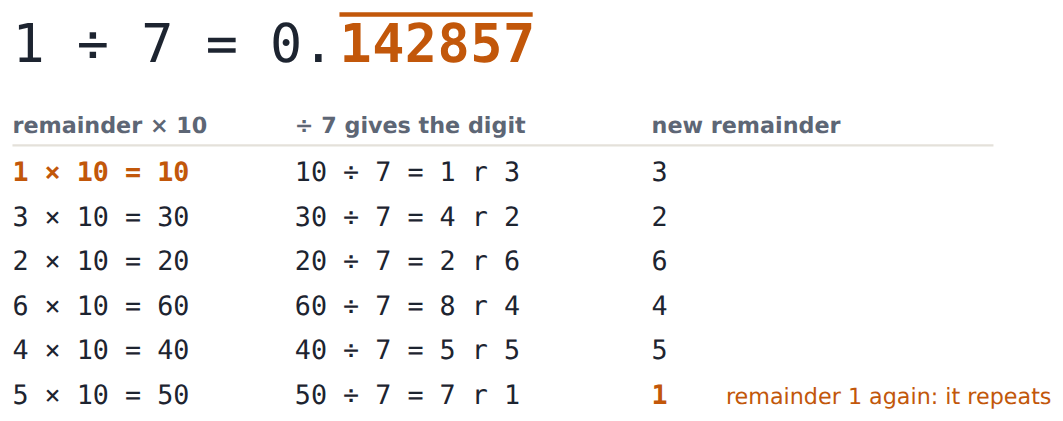
1 ÷ 7: the remainders go 3, 2, 6, 4, 5, then 1 again, so 142857 repeats forever.
Stops or repeats · Sound on for the voiceover
Open the lesson →

2. Which decimals stop?

Try firstDoes 9/24 terminate? Explain.

Check your answer

Yes: 9/24 = 3/8, and 8 = 2 × 2 × 2, only 2s, so it terminates (0.375).

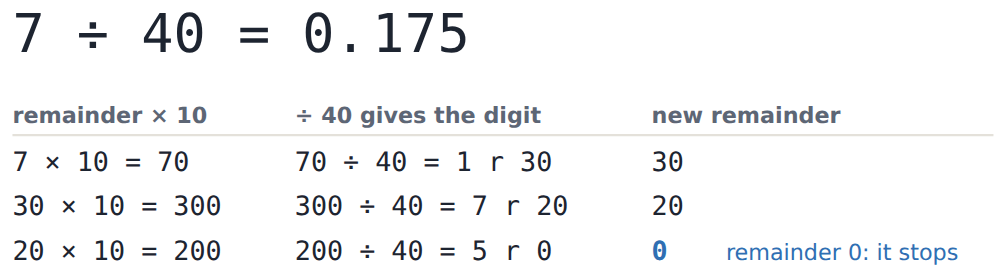
Write the fraction in simplest form and break the denominator into prime factors. Only 2s and 5s: it terminates; any other prime: it recurs.

It works because a terminating decimal is a fraction over 10, 100, 1000…, and $10 = 2 \times 5$.

7/40 = 0.175: 40 = 2 × 2 × 2 × 5, only 2s and 5s, so it terminates.
Simplify first · Sound on for the voiceover
Open the lesson →

Irrational numbers

3. Irrational numbers

Try firstSort √20, √25, 0.4 and 0.454545… into rational and irrational.

Check your answer

Rational: √25 = 5, 0.4, 0.454545… (= 5/11). Irrational: √20.

A rational number is a fraction: its decimal stops or repeats. An irrational number is not a fraction: its decimal never stops and never repeats.

√2, √3, √5 and π are irrational; √16 = 4 and 22/7 are rational. Use the exact form or a rounded value to calculate.

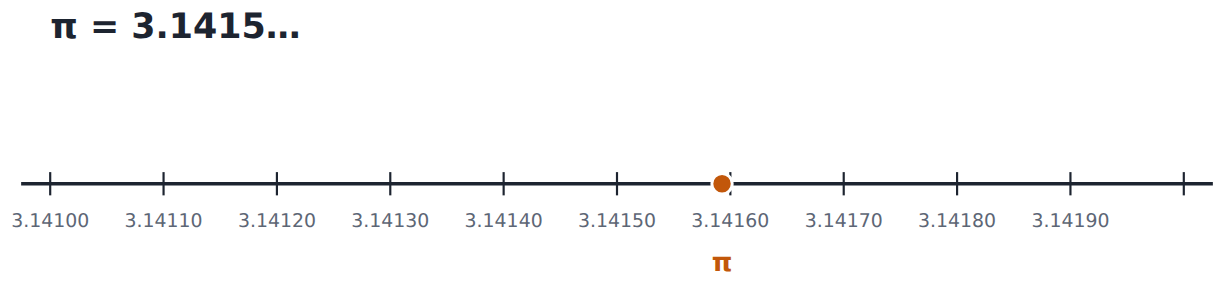
π = 3.14159…: zoom in as far as you like, the digits never stop and never settle into a repeat.
Zooming in on √2 · Sound on for the voiceover
Open the lesson →

4. Irrational numbers on the line

Try firstBetween which two whole numbers is √70? Which is it nearer?

Check your answer

64 < 70 < 81, so between 8 and 9, nearer 8 (√70 ≈ 8.37).

The real numbers fill the number line: rational and irrational. To place a square root, find the perfect squares either side ($25 < 30 < 36$, so $5 < \sqrt{30} < 6$), then square decimals to get closer.

A rounded value such as 5.48 is an approximation; $\sqrt{30}$ is exact.

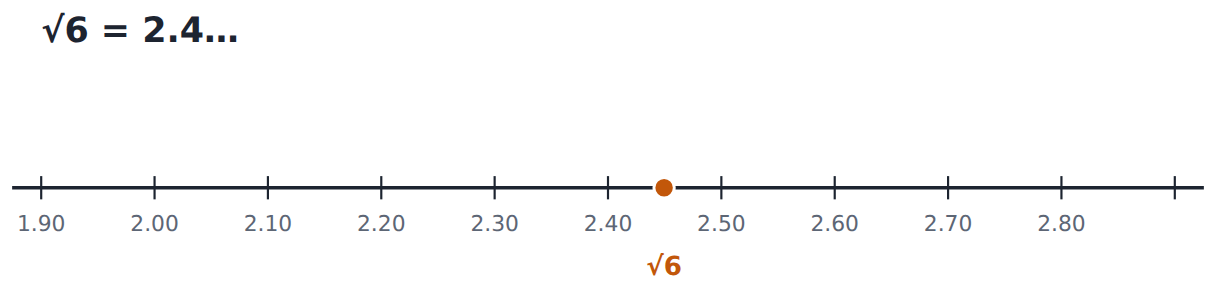
√6 is between 2 and 3 (4 < 6 < 9), then between 2.4 and 2.5 (2.4² = 5.76, 2.5² = 6.25).
Squares either side · Sound on for the voiceover
Open the lesson →

Index laws

5. Index laws

Try firstSimplify 4⁶ ÷ 4² and (3²)⁴, leaving each as a power.

Check your answer

4⁴ and 3⁸.

For powers of the same base: multiplying adds the indices ($a^m \times a^n = a^{m+n}$), dividing subtracts them ($a^m \div a^n = a^{m-n}$), and a power of a power multiplies them ($(a^m)^n = a^{mn}$). The base does not change.

$a^0 = 1$ (for $a \ne 0$), because $a^n \div a^n = 1$ and the quotient law gives $a^0$.

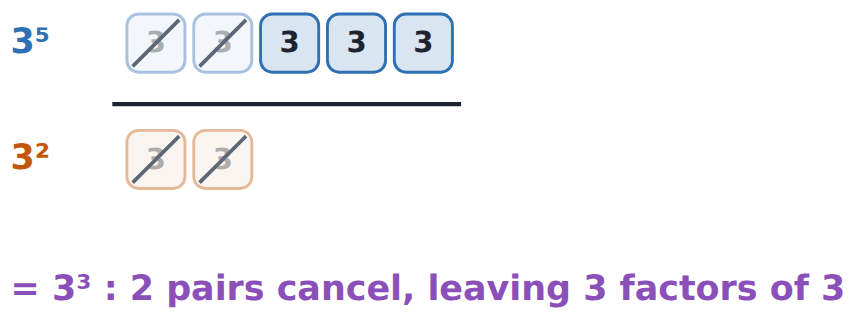
3⁵ ÷ 3²: two pairs of 3s cancel, leaving 3³ = 27. Subtract the indices: 5 − 2 = 3.
Count the factors · Sound on for the voiceover
Open the lesson →

6. Using the index laws

Try firstSimplify (5³)² × 5⁴ ÷ 5⁸.

Check your answer

5⁶ × 5⁴ ÷ 5⁸ = 5¹⁰ ÷ 5⁸ = 5².

Simplify one law at a time: powers of powers first, then multiply and divide from left to right. Only join powers with the same base: $2^3 \times 3^2$ stays as it is (= 72).

Powers of 10 follow the laws, so $(3 \times 10^4) \times (2 \times 10^3) = 6 \times 10^7$.

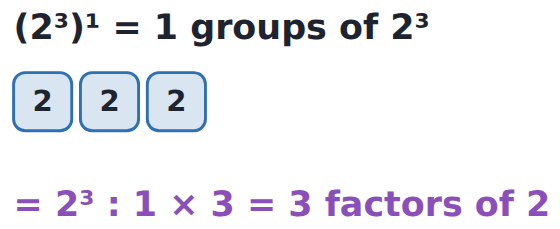
(2³)¹: one group of three 2s. More groups multiply the index.
Groups of factors · Sound on for the voiceover
Open the lesson →