← Reference

Number Foundations: cheat sheet

Number Foundations · The words and methods from the lessons, with an example of each.

Integers

integer

A whole number, zero, or a negative whole number.

…,  −3,  −2,  −1,  0,  1,  2,  3,  …\ldots,\; -3,\; -2,\; -1,\; 0,\; 1,\; 2,\; 3,\; \ldots

less than, greater than

The wide end of the sign faces the greater number. Further left on the line is less.

−7<−23>−1-7 < -2 \qquad 3 > -1
−7 is further left than −2, so −7 < −2

subtracting

Subtracting moves the opposite way to adding: subtracting a positive moves left, past zero if it has to.

2−5=−32 - 5 = -3

subtracting a negative

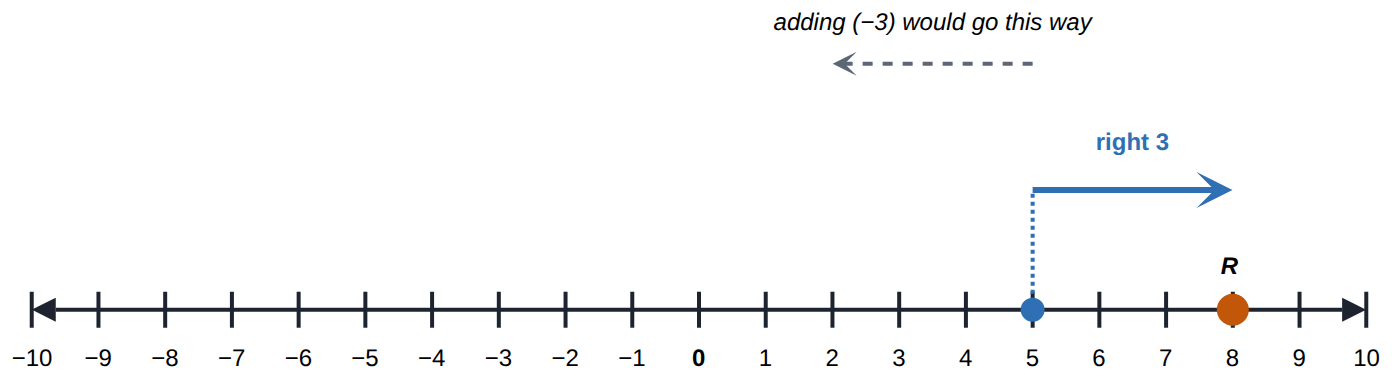
Adding −3-3 would move left 3, so subtracting it moves right 3. It gives the same as adding 33.

5−(−3)=85 - (-3) = 8
Adding −3 would go left; subtracting it goes right 3, to 8

dividing integers

The same sign rule as multiplying, because dividing undoes it: check 3×(−4)=−123 \times (-4) = -12.

−12÷3=−4-12 \div 3 = -4

negative number

A number below zero, to the left of 00 on a number line: five below zero.

−5-5

further from zero

The size of a number without its sign. Among negatives, the one further from zero is the lesser: −10<−1-10 < -1.

−10 is further from zero than −1-10 \text{ is further from zero than } {-1}

adding a negative

Start at the first number. Adding a positive moves right; adding a negative moves left.

4+(−6)=−24 + (-6) = -2
From 4, left 6, to −2

multiplying integers

Same signs give a positive, different signs a negative. On the line: aa jumps of bb; a negative number of jumps goes the opposite way.
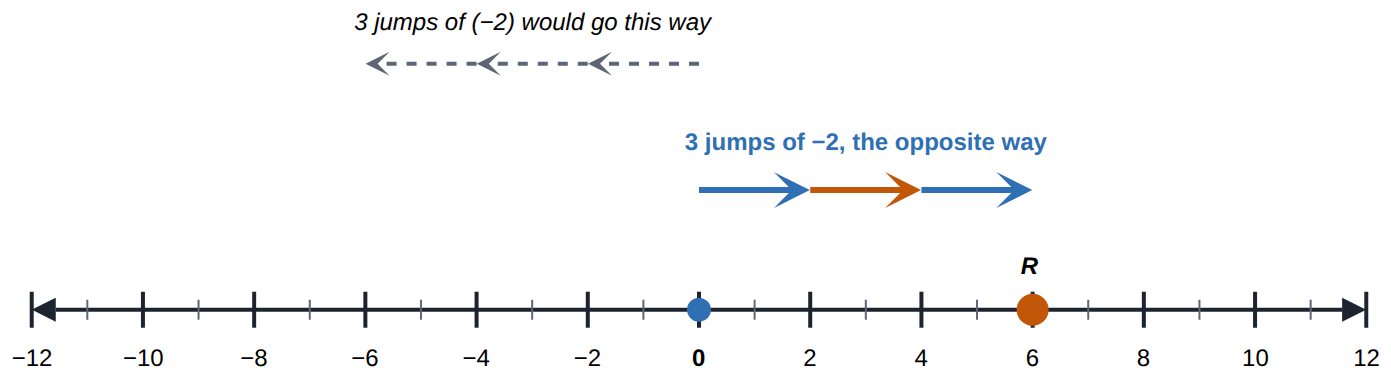
−3×(−2)=63×(−2)=−6-3 \times (-2) = 6 \qquad 3 \times (-2) = -6
−3 jumps of −2 go the opposite way: to 6

Squares, powers and primes

square number

A number times itself: the area of a square with that side. The perfect squares to 144: 1, 4, 9, 16, 25, 36, 49, 64, 81, 100, 121, 144.
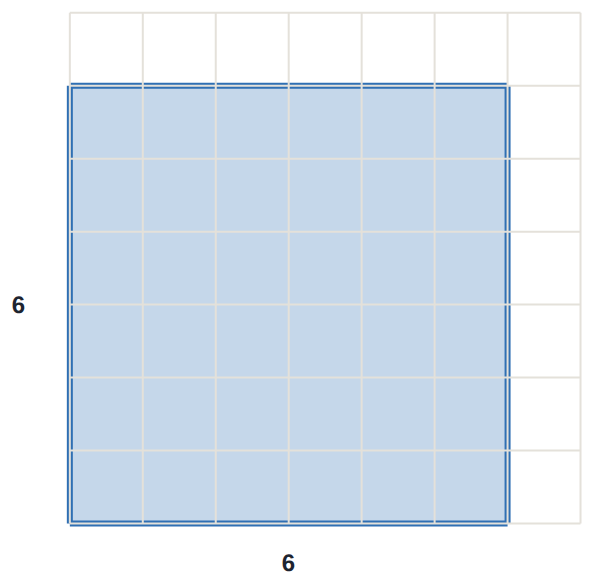
62=6×6=366^2 = 6 \times 6 = 36
A 6 by 6 square covers 36 unit squares

between two squares

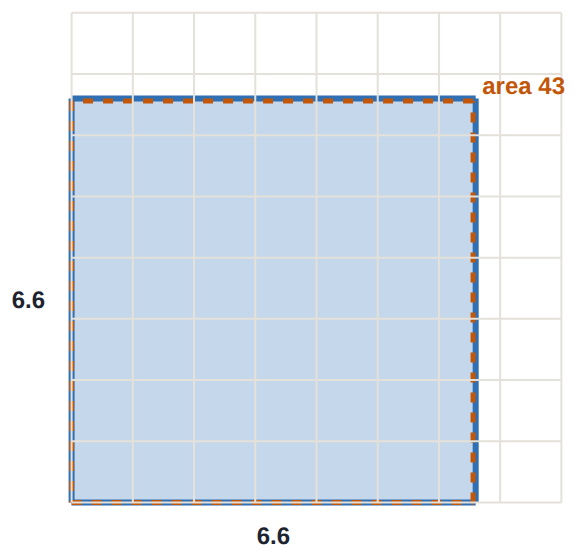
Find the perfect squares either side and take their roots. Square decimals to get closer: 6.62=43.566.6^2 = 43.56, so 43≈6.6\sqrt{43} \approx 6.6.

36<43<49  ⇒  6<43<736 < 43 < 49 \;\Rightarrow\; 6 < \sqrt{43} < 7
A square of side 6.6 is just over the dashed target of 43

HCF and LCM

HCF: the primes both share. LCM: all the primes, shared ones once. Sharing into equal groups needs the HCF; things lining up again need the LCM.

12=22×3,  18=2×32:  HCF=2×3=6,  LCM=22×32=3612 = 2^2 \times 3,\; 18 = 2 \times 3^2:\; \text{HCF} = 2 \times 3 = 6,\; \text{LCM} = 2^2 \times 3^2 = 36

square root

The number that times itself makes this one: the side of a square with that area. Not half: 36≠18\sqrt{36} \ne 18.

36=6 because 6×6=36\sqrt{36} = 6 \text{ because } 6 \times 6 = 36

base and exponent

The base (2) is multiplied; the exponent (5) counts how many times. 252^5 is not 2×52 \times 5.

25=2×2×2×2×2=322^5 = 2 \times 2 \times 2 \times 2 \times 2 = 32

prime

A number with exactly two factors, 1 and itself. 1 is not prime.

2,  3,  5,  7,  11,  13,  …2,\; 3,\; 5,\; 7,\; 11,\; 13,\; \ldots

prime factorisation

Split into factor pairs until every branch is a prime, then write repeated primes with exponents. Every tree gives the same primes.
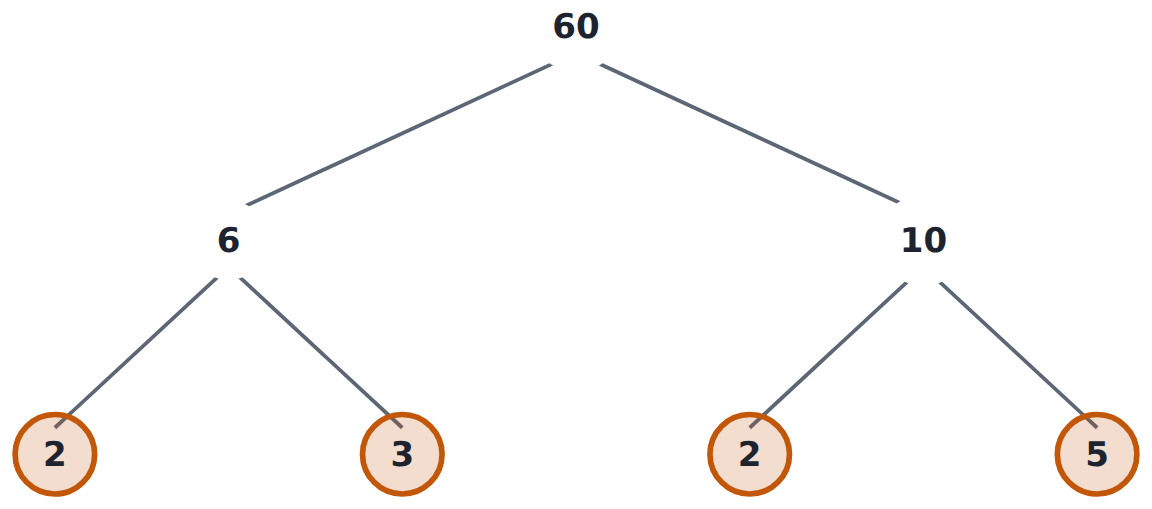
60=22×3×560 = 2^2 \times 3 \times 5
A factor tree for 60 ending in the primes 2, 2, 3 and 5

Fractions and decimals

mixed numeral

A whole number and a fraction. A negative one is both parts below zero: one and a half below zero.

−112=−1.5-1\tfrac{1}{2} = -1.5

simplest form

Divide the top and the bottom by their highest common factor. In simplest form (lowest terms) they share no factor but 1.

1218=12÷618÷6=23\tfrac{12}{18} = \tfrac{12 \div 6}{18 \div 6} = \tfrac{2}{3}

fraction to percentage

Percent means out of 100: make the fraction out of 100, or work out the decimal and multiply by 100.
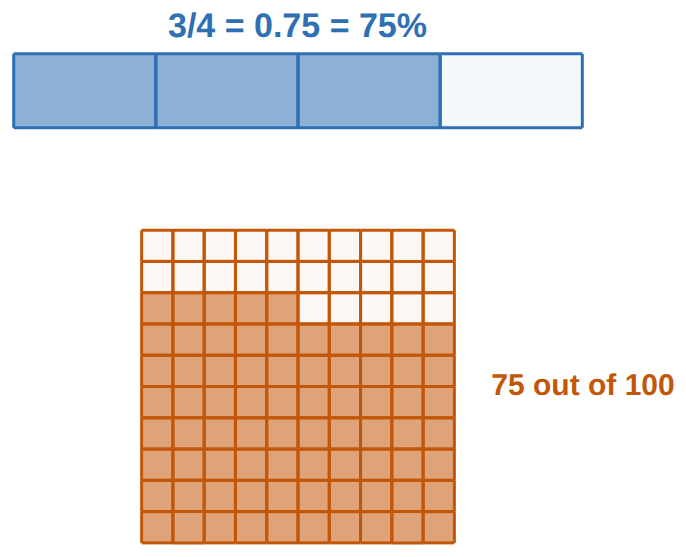
34=75100=75%\tfrac{3}{4} = \tfrac{75}{100} = 75\%
3/4 of the bar is 75 of 100 squares

adding fractions

Cut both into the same parts first (a common denominator; the LCM is the lowest), then add the tops. Never add the bottoms.
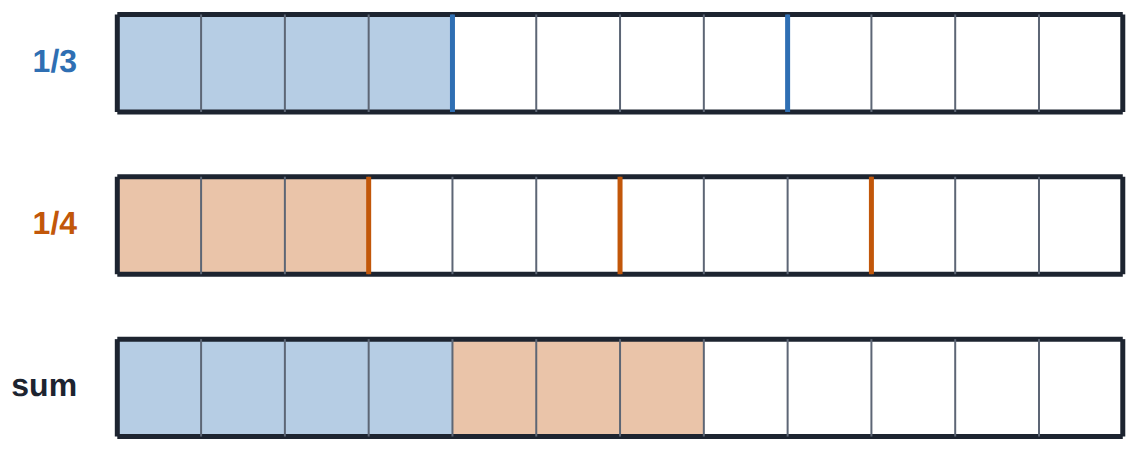
13+14=412+312=712\tfrac{1}{3} + \tfrac{1}{4} = \tfrac{4}{12} + \tfrac{3}{12} = \tfrac{7}{12}
Thirds and quarters both cut into twelfths: 4 + 3 = 7 twelfths

dividing by a fraction

How many fit? Dividing by a fraction is multiplying by it flipped (top and bottom swapped): 23÷16=23×6=4\tfrac{2}{3} \div \tfrac{1}{6} = \tfrac{2}{3} \times 6 = 4.

3÷14=3×4=123 \div \tfrac{1}{4} = 3 \times 4 = 12

increase and decrease

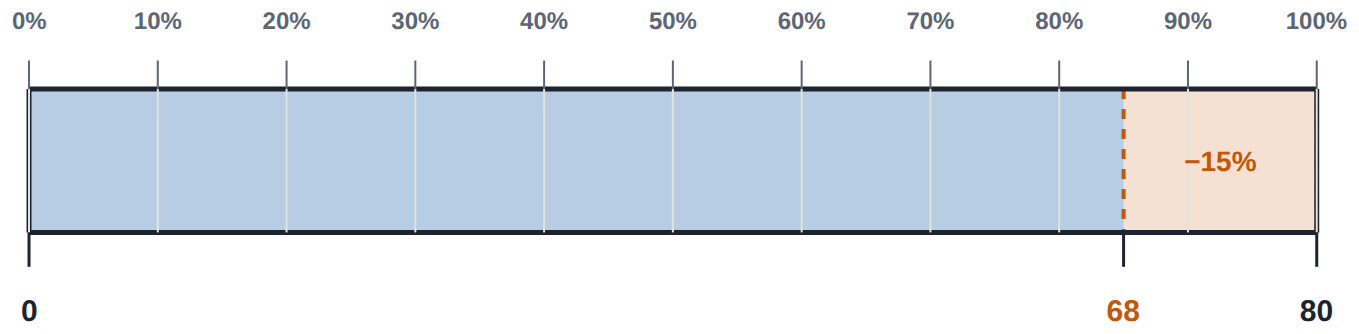
15% off leaves 85%: × 0.85. 15% on makes 115%: × 1.15. For what percentage, divide and × 100: 18÷24=75%18 \div 24 = 75\%.

80×0.85=6880×1.15=9280 \times 0.85 = 68 \qquad 80 \times 1.15 = 92
15% off 80 leaves 68

placing a negative fraction

Split each unit into equal parts and count from zero. A negative counts left, and the part counts further from zero, not back towards it.

−114 is between −2 and −1-1\tfrac{1}{4} \text{ is between } {-2} \text{ and } {-1}
Quarters: A at −1 1/4, B at −3/4

equivalent fractions

Multiply (or divide) the top and the bottom by the same number: the same amount, cut into more (or fewer) parts. Adding the same number to both changes the amount.
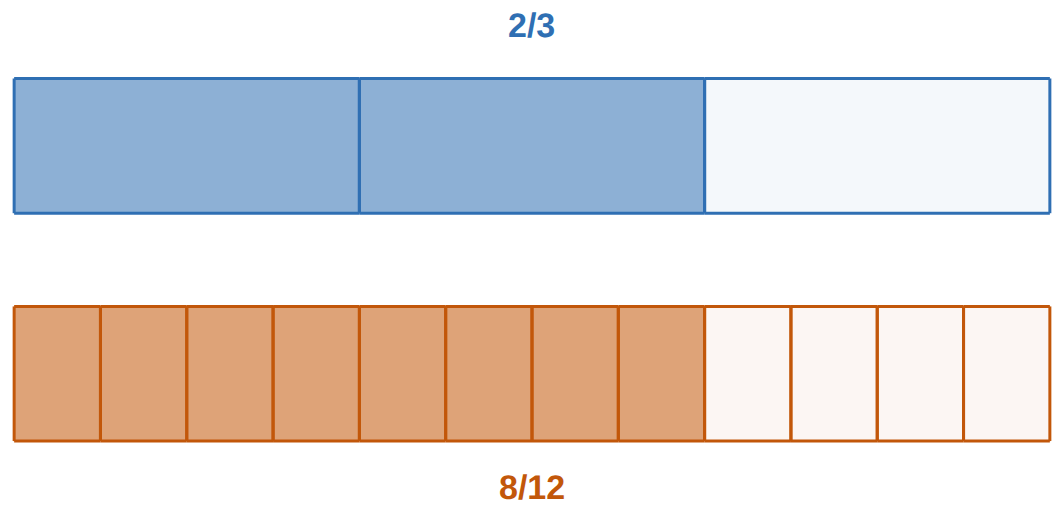
23=2×43×4=812\tfrac{2}{3} = \tfrac{2 \times 4}{3 \times 4} = \tfrac{8}{12}
2/3 and 8/12 shade the same amount

fraction to decimal

Divide the top by the bottom. Some never end: 13=0.333…\tfrac{1}{3} = 0.333\ldots

38=3÷8=0.375\tfrac{3}{8} = 3 \div 8 = 0.375

decimal and percentage

Decimal to percentage: × 100 (0.5 is 50 hundredths, not 5%). Percentage to decimal: ÷ 100.

0.5=50%45%=0.450.5 = 50\% \qquad 45\% = 0.45

percentage to fraction

Put it over 100, then simplify.

16%=16100=42516\% = \tfrac{16}{100} = \tfrac{4}{25}

multiplying fractions

Multiply the tops and the bottoms, then simplify. Multiplying by a fraction less than 1 makes smaller.
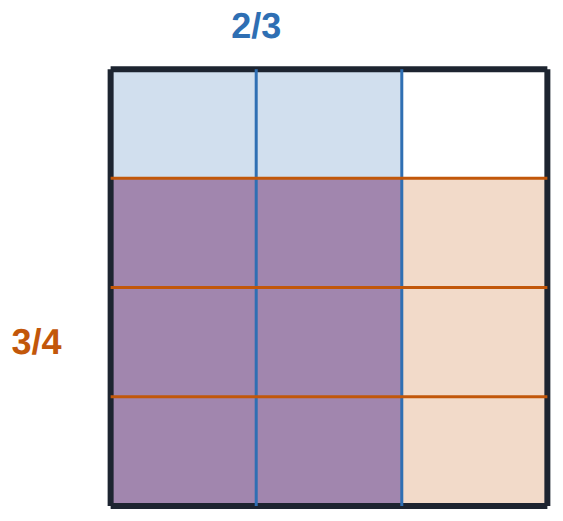
23×34=612=12\tfrac{2}{3} \times \tfrac{3}{4} = \tfrac{6}{12} = \tfrac{1}{2}
3/4 of 2/3 of a square: 6 of 12 parts

percentage of an amount

Of means multiply. Mentally: 10% is a tenth (8), 5% is half of that (4).

15% of 80=0.15×80=1215\% \text{ of } 80 = 0.15 \times 80 = 12
15% of a bar of 80 is 12

quick strategies

Change the order (4×2.7×25=100×2.74 \times 2.7 \times 25 = 100 \times 2.7), change the form (0.75 = 3/4), or split (12×2.5=24+612 \times 2.5 = 24 + 6). Then estimate to check.

0.75×36=34×36=270.75 \times 36 = \tfrac{3}{4} \times 36 = 27

negative fractions and decimals

The integer sign rules hold for every fraction and decimal. Sign first, then size.

−34×25=−310-\tfrac{3}{4} \times \tfrac{2}{5} = -\tfrac{3}{10}

efficient order

Multiply in any order, pairing friendly numbers; or split a number: 6×(−2.5)=6×(−2)+6×(−0.5)6 \times (-2.5) = 6 \times (-2) + 6 \times (-0.5).

25×(−3.7)×4=100×(−3.7)=−37025 \times (-3.7) \times 4 = 100 \times (-3.7) = -370

Place value and estimating

power of 10

Each place value column is a power of 10. The exponent counts the zeros, and the ones column is 100=110^0 = 1.

103=10×10×10=100010^3 = 10 \times 10 \times 10 = 1000

decimal places

The number of digits after the decimal point. To 2 decimal places means to the nearest hundredth.

3.746 has 3 decimal places3.746 \text{ has 3 decimal places}

estimate

A quick, close answer from rounded numbers. Round to the first digit and keep the size; then compare with the exact answer.
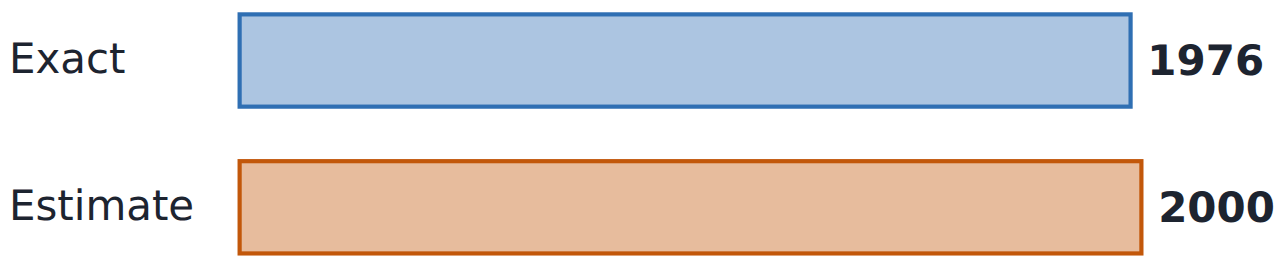
38×52≈40×50=200038 \times 52 \approx 40 \times 50 = 2000
38 × 52 ≈ 40 × 50 = 2000; the exact answer is 1976

estimating

Round each number to its first digit, keep its size, calculate, then compare with the exact answer.

19.6×4.1≈20×4=8019.6 \times 4.1 \approx 20 \times 4 = 80

expanded notation

A number as the sum of each digit times its place value. A column holding 0 adds nothing, so leave it out.

4052=4×10³+5×101+2×1004052 = 4 \times 10^3 + 5 \times 10^1 + 2 \times 10^0
4052 on the columns: 4 × 10³ + 5 × 10¹ + 2 × 10⁰

round to decimal places

Look at the digit straight after the place. 5 or more rounds up; 4 or less leaves the digit. Halfway rounds up.
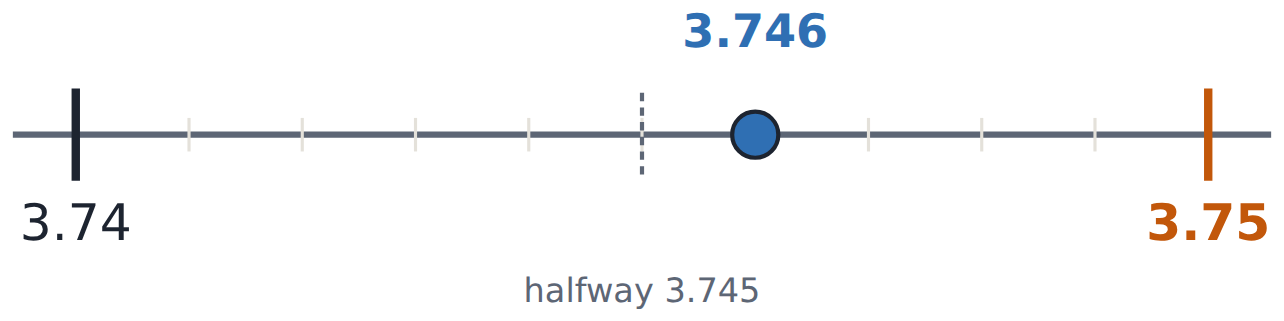
3.746→3.75 (2 d.p.)3.746 \to 3.75 \ (2 \text{ d.p.})
3.746 is past the halfway mark 3.745, so it rounds to 3.75

Ratios

ratio

Compares quantities in a stated order. The first thing named is the first number.
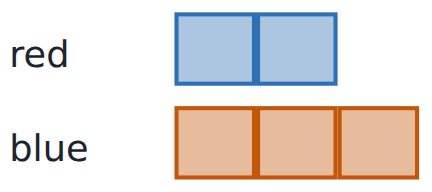
red:blue=2:3\text{red} : \text{blue} = 2 : 3
2 red blocks to 3 blue blocks

simplest form of a ratio

Divide both terms by their highest common factor (here 6). No number above 1 divides both.

12:18=2:312 : 18 = 2 : 3

share in a ratio

Add the parts, divide the total by the parts to find one part, then multiply. The shares add back to the total.
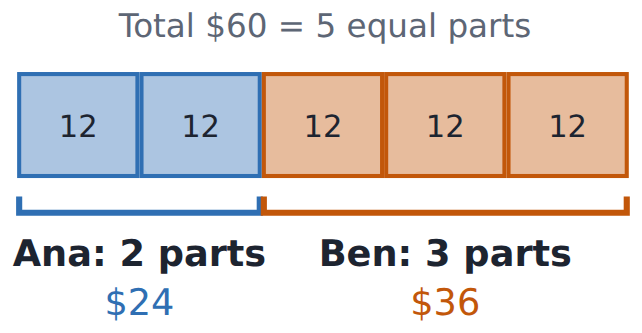
$60 in 2:3→$60÷5=$12→$24,$36\$60 \text{ in } 2 : 3 \to \$60 \div 5 = \$12 \to \$24, \$36
$60 in the ratio 2 : 3: five parts of $12, Ana $24 and Ben $36

part to part, part to whole

Part to whole adds the parts: 2+3=52 + 3 = 5. The part-to-whole ratio 2:52 : 5 matches the fraction 25\tfrac{2}{5}.

2:3 (red to blue)2:5 (red to all)2 : 3 \text{ (red to blue)} \qquad 2 : 5 \text{ (red to all)}

equivalent ratios

Multiply or divide both terms by the same number. Adding the same number to both changes the ratio.
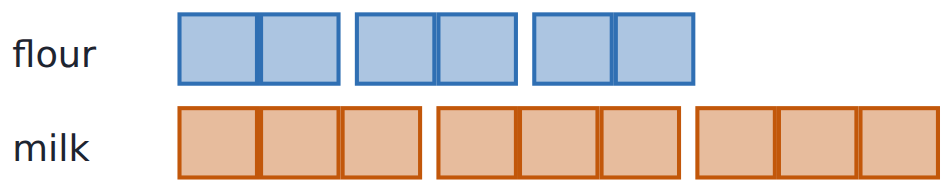
2:3=4:6=6:92 : 3 = 4 : 6 = 6 : 9
Three copies of 2 : 3 make 6 : 9

Rates

rate

A rate compares quantities with different units (km per h, $ per kg); a ratio compares the same kind. 1 km/h = 1000 m ÷ 3600 s: divide by 3.6 for m/s.

unit rate=first quantity÷second quantity\text{unit rate} = \text{first quantity} \div \text{second quantity}
At 60 km per hour, 2.5 hours matches 150 km

using a rate

Write the units in: km ÷ km/h = h. Then check the size makes sense.

total=rate×amountamount=total÷rate\text{total} = \text{rate} \times \text{amount} \qquad \text{amount} = \text{total} \div \text{rate}

Modelling

scale

A ratio of the drawing (or model) to the real thing. Each 1 unit on the drawing is 50 units in real life.

1:50⇒3 cm→150 cm1 : 50 \Rightarrow 3\text{ cm} \to 150\text{ cm}

percentage change multiplier

One change after another: multiply the multipliers. Up 20% then down 20% is × 0.96.
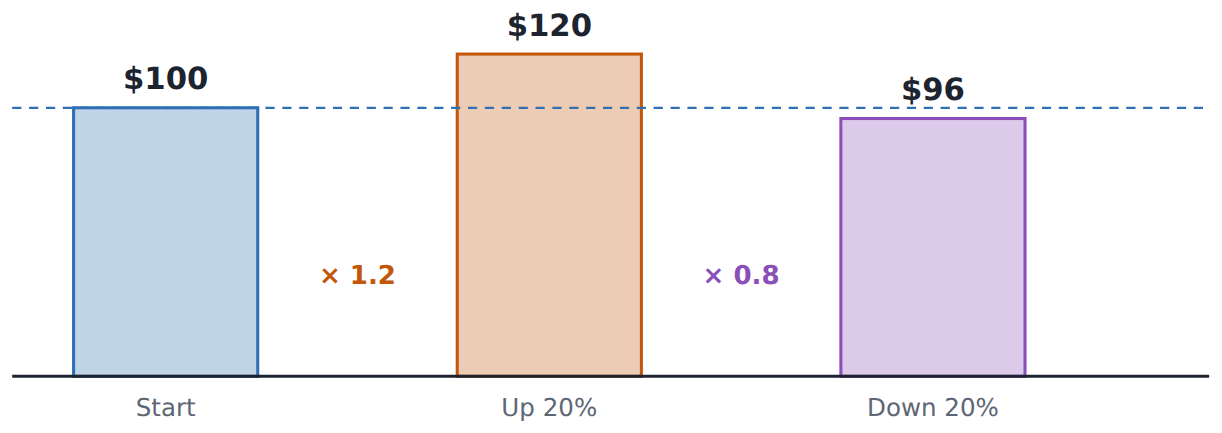
up p%:×(1+p100)down p%:×(1−p100)\text{up } p\%: \times\left(1 + \tfrac{p}{100}\right) \qquad \text{down } p\%: \times\left(1 - \tfrac{p}{100}\right)
$100 up 20%, then down 20%: $96

percentages in two steps

Each percentage is of a different amount, so they cannot be added: 20% off then 10% off is not 30% off.

200×0.8×0.9=144200 \times 0.8 \times 0.9 = 144

known, unknown, relationship

The first step in modelling: say what you know, what you need, and how they are linked. Then calculate.

known→unknown\text{known} \to \text{unknown}

tax brackets

The marginal rate is the rate on the last dollar; the effective rate is total tax ÷ income.

each part of the income×its bracket’s rate\text{each part of the income} \times \text{its bracket's rate}

model assumptions

Every model assumes something (steady speed, no fees, no starting charge). When it disagrees with real life, name the assumption and refine the model.

fare=4.20+2.10×km\text{fare} = 4.20 + 2.10 \times \text{km}

profit as a percentage

A percentage profit or change is out of the original amount, the cost, not the selling price.

profitcost×100%\dfrac{\text{profit}}{\text{cost}} \times 100\%