← Number Foundations

Number Foundations: recap

Answer each question in your head or on paper first, then check it.

Integers

1. Comparing integers

Try firstPut in order from least to greatest: 4, −6, 0, −1, −10.

Check your answer

−10, −6, −1, 0, 4.

On a number line, the number further left is less. That is true below zero too.

$-7$ is further left than $-2$, so $-7 < -2$ ("$-7$ is less than $-2$"), even though 7 is more than 2. Think of temperatures: $-7$ °C is colder than $-2$ °C.

To put integers in order, place each on the line and read from left to right. Zero is greater than every negative number.

-7 is further left than -2, so -7 < -2.
−7-7 is further left than −2-2, so −7<−2-7 < -2.
Further left is less · Sound on for the voiceover
Open the lesson →

2. Adding and subtracting integers

Try firstWork out −3 + 7, 2 − 9 and 4 − (−5).

Check your answer

4, −7 and 9.

To add or subtract integers, start at the first number and move along the number line.

  • Adding a positive moves right: $-3 + 5 = 2$.
  • Adding a negative moves left: $4 + (-6) = -2$.
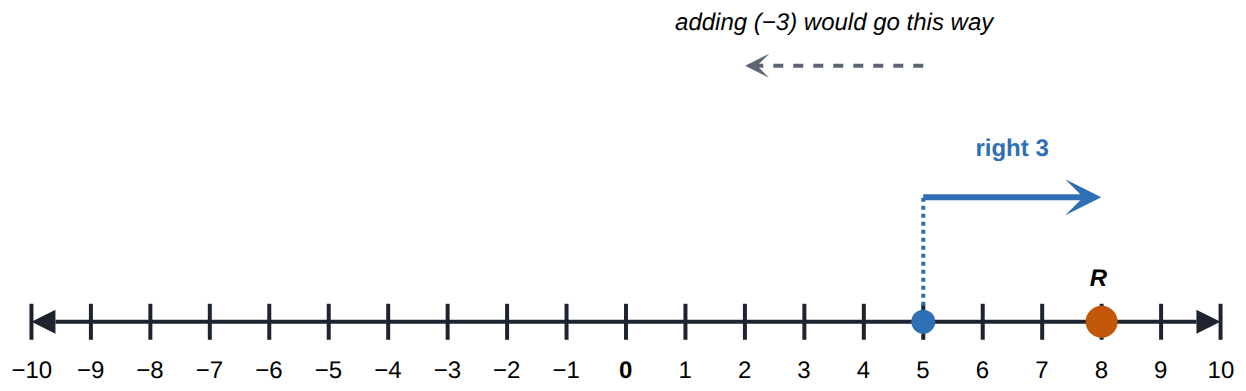
  • Subtracting moves the opposite way to adding. Adding $-3$ would move left 3, so subtracting $-3$ moves right 3: $5 - (-3) = 8$.

So subtracting a negative gives the same answer as adding the positive.

5 - (-3): adding -3 would go left 3, so subtracting goes right 3, to 8.
5−(−3)5 - (-3): adding −3-3 would go left 3, so subtracting goes right 3, to 8.
Adding and subtracting are moves along the line · Sound on for the voiceover
Open the lesson →

3. Multiplying and dividing integers

Try firstWork out −7 × (−4), 24 ÷ (−6) and (−1)⁴.

Check your answer

28, −4 and 1.

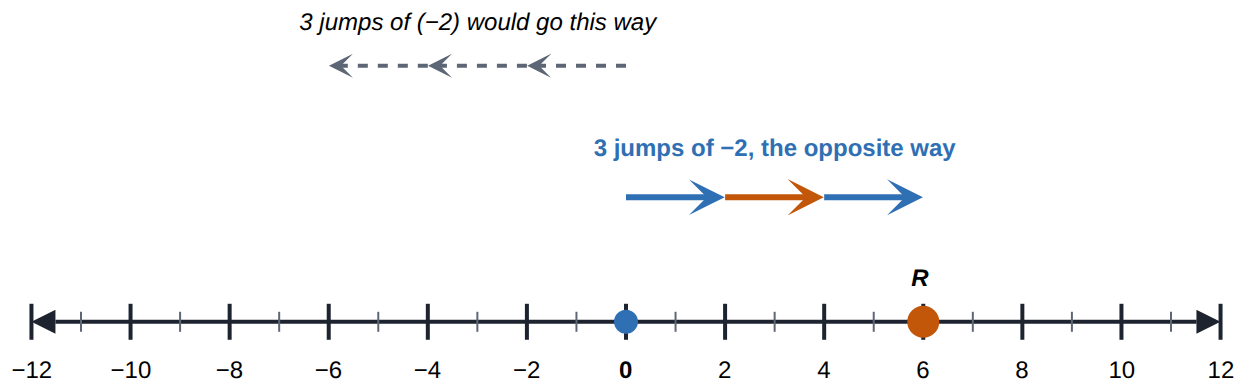
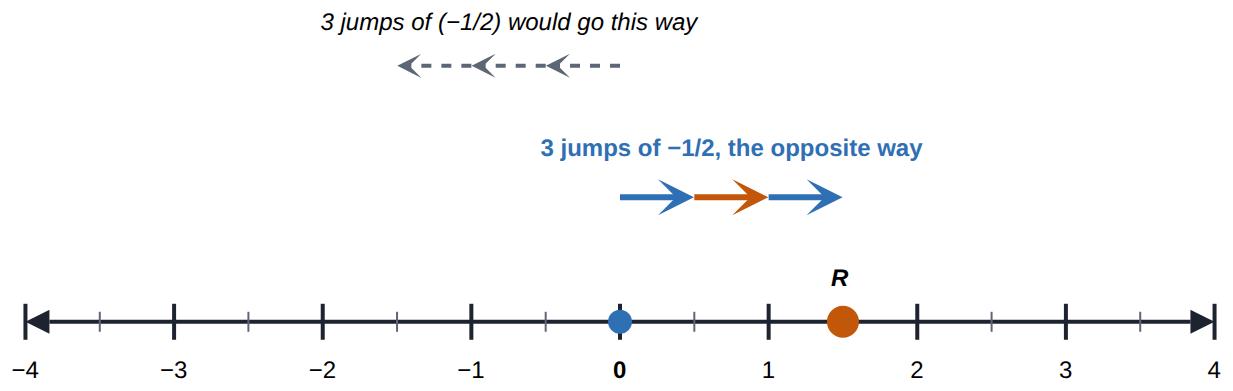
$a \times b$ is $a$ jumps of $b$ from zero. $3 \times (-2)$ is 3 jumps of $-2$: left to $-6$.

A negative number of jumps goes the opposite way: $-3 \times (-2) = 6$. The pattern agrees: $3 \times (-2) = -6$, $2 \times (-2) = -4$, $1 \times (-2) = -2$, $0 \times (-2) = 0$, so $-1 \times (-2) = 2$.

The rule: same signs give a positive, different signs give a negative. Dividing follows the same rule, because it undoes multiplying: $-12 \div 3 = -4$, since $3 \times (-4) = -12$.

-3 \times (-2): 3 jumps of -2 would go to -6; a negative number of jumps goes the opposite way, to 6.
−3×(−2)-3 \times (-2): 3 jumps of −2-2 would go to −6-6; a negative number of jumps goes the opposite way, to 66.
Multiplying is jumps from zero · Sound on for the voiceover
Open the lesson →

Squares, powers and primes

4. Squares and square roots

Try firstA square has area 81 cm². Find its side and its perimeter.

Check your answer

Side √81 = 9 cm; perimeter 4 × 9 = 36 cm.

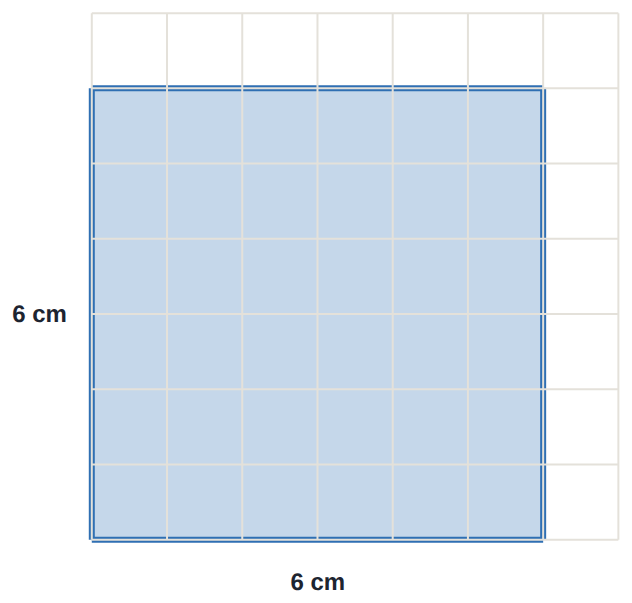
A square number is a number times itself: $6^2 = 6 \times 6 = 36$. It is the area of a square with side 6. The perfect squares to 144 are 1, 4, 9, 16, 25, 36, 49, 64, 81, 100, 121 and 144.

The square root undoes squaring: $\sqrt{36} = 6$ because $6 \times 6 = 36$. It is the side of a square with area 36. (Squared is not doubled: $5^2 = 25$, not 10.)

A square of side 6 cm covers 6 \times 6 = 36 unit squares: 6^2 = 36, so \sqrt{36} = 6.
A square of side 6 cm covers 6×6=366 \times 6 = 36 unit squares: 62=366^2 = 36, so 36=6\sqrt{36} = 6.
Side and area · Sound on for the voiceover
Open the lesson →

5. Between the squares

Try firstBetween which two whole numbers is √55? Give a reason.

Check your answer

7 and 8, because 7² = 49 and 8² = 64, and 55 is between them.

For a number that is not a perfect square, find the perfect squares either side: $36 < 43 < 49$. Their roots give the whole numbers either side: $6 < \sqrt{43} < 7$.

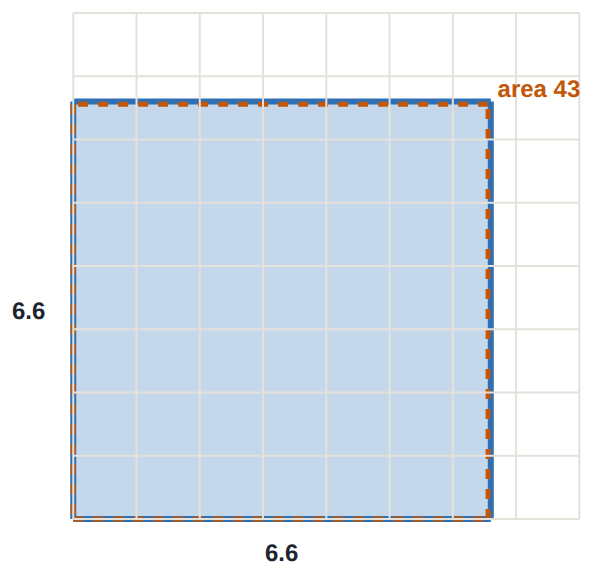
To get closer, square decimals: $6.5^2 = 42.25$ and $6.6^2 = 43.56$. The closer one wins: $\sqrt{43} \approx 6.6$. (A square root is not a half: $\sqrt{50}$ is about 7, not 25.)

6.6^2 = 43.56: just over 43. 6^2 = 36 and 7^2 = 49, so \sqrt{43} is between 6 and 7, about 6.6.
6.62=43.566.6^2 = 43.56: just over 43. 62=366^2 = 36 and 72=497^2 = 49, so 43\sqrt{43} is between 6 and 7, about 6.6.
Between two squares · Sound on for the voiceover
Open the lesson →

6. Powers

Try firstWork out 3³ and write 5 × 5 × 5 × 5 as a power.

Check your answer

3³ = 27; 5⁴.

Exponent notation is short for repeated multiplication: $2 \times 2 \times 2 \times 2 = 2^4$. The base (2) is multiplied; the exponent (4) counts how many times. So $2^4 = 16$, not $2 \times 4 = 8$.

Squares are powers with exponent 2 ($5^2 = 25$) and cubes exponent 3 ($2^3 = 8$). Powers of 10 count zeros: $10^3 = 1000$.

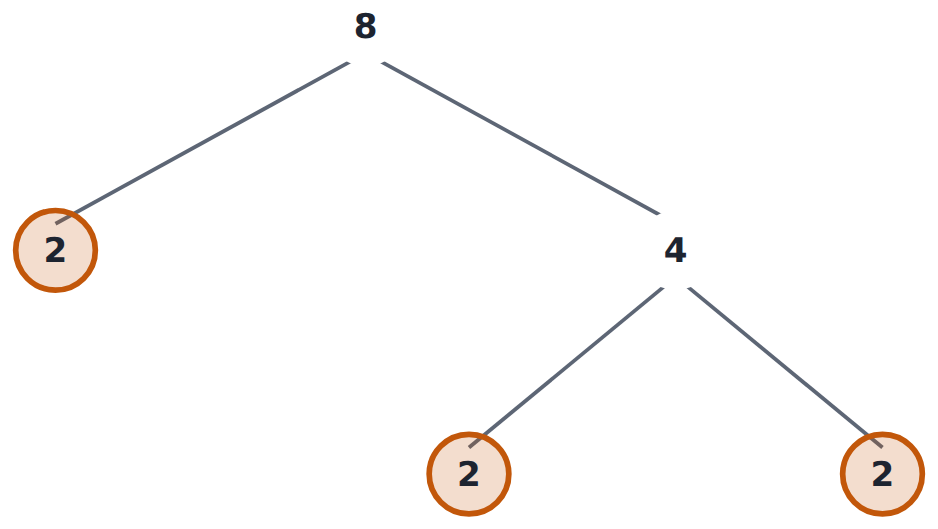
A factor tree for 8: split it until every branch is a prime. Three 2s: 8 = 2 \times 2 \times 2 = 2^3.
A factor tree for 8: split it until every branch is a prime. Three 2s: 8=2×2×2=238 = 2 \times 2 \times 2 = 2^3.
Three 2s · Sound on for the voiceover
Open the lesson →

7. Prime factors

Try firstWrite 84 as a product of prime factors, with exponents.

Check your answer

84 = 2² × 3 × 7.

A prime has exactly two factors: 1 and itself (1 is not prime). A factor tree splits a number into a factor pair, then splits every branch that is not prime, until all the branches are primes.

The prime factorisation collects them with exponents: $36 = 2 \times 2 \times 3 \times 3 = 2^2 \times 3^2$. Every tree for 36 ends with these primes. Check by expanding: $4 \times 9 = 36$.

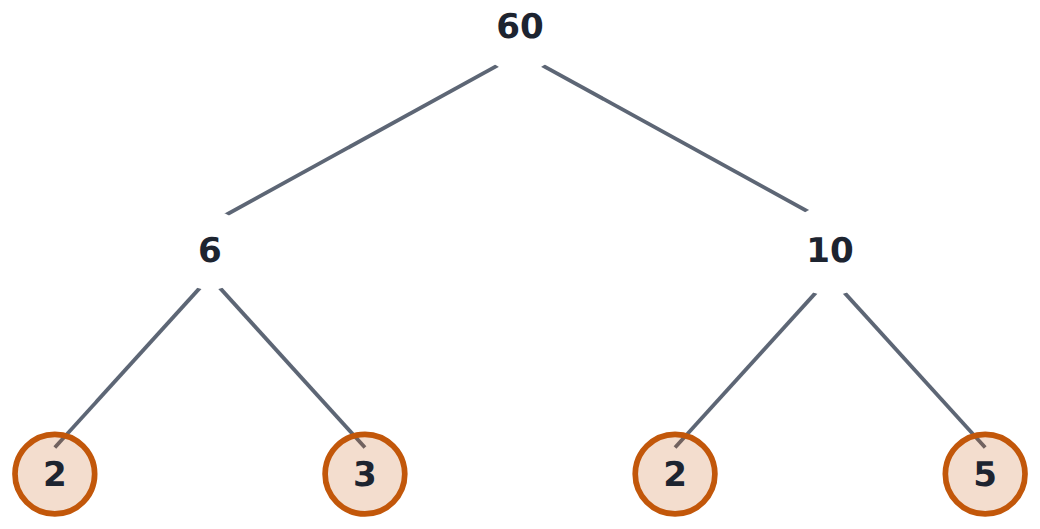
A factor tree for 60 starts with a factor pair and splits until every branch ends in a circled prime: 60 = 2^2 \times 3 \times 5.
A factor tree for 60 starts with a factor pair and splits until every branch ends in a circled prime: 60=22×3×560 = 2^2 \times 3 \times 5.
Down to the primes · Sound on for the voiceover
Open the lesson →

8. HCF and LCM

Try firstFind the HCF and LCM of 20 and 30.

Check your answer

20 = 2² × 5 and 30 = 2 × 3 × 5. HCF = 2 × 5 = 10; LCM = 2² × 3 × 5 = 60.

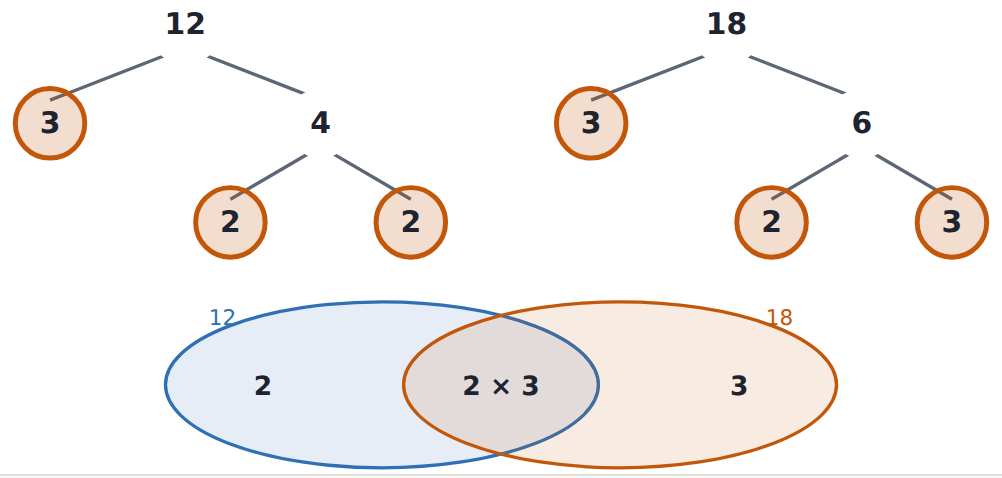
Write both numbers as products of primes: $12 = 2^2 \times 3$ and $18 = 2 \times 3^2$.

The HCF is the product of the primes they share (each to its lower power): $2 \times 3 = 6$. The LCM is the product of all the primes, each shared one counted once (each to its higher power): $2^2 \times 3^2 = 36$. Multiplying the two numbers ($12 \times 18 = 216$) counts the shared primes twice, so it is a common multiple but not usually the lowest.

12 = 2^2 \times 3 and 18 = 2 \times 3^2. Shared: 2 \times 3, so the HCF is 6. All the primes: 2 \times 2 \times 3 \times 3, so the LCM is 36.
12=22×312 = 2^2 \times 3 and 18=2×3218 = 2 \times 3^2. Shared: 2×32 \times 3, so the HCF is 6. All the primes: 2×2×3×32 \times 2 \times 3 \times 3, so the LCM is 36.
Shared primes · Sound on for the voiceover
Open the lesson →

Fractions and decimals

9. Equivalent fractions

Try firstWrite 20/32 in its simplest form, and give one other fraction equal to it.

Check your answer

5/8 (÷ 4). For example 10/16 or 15/24.

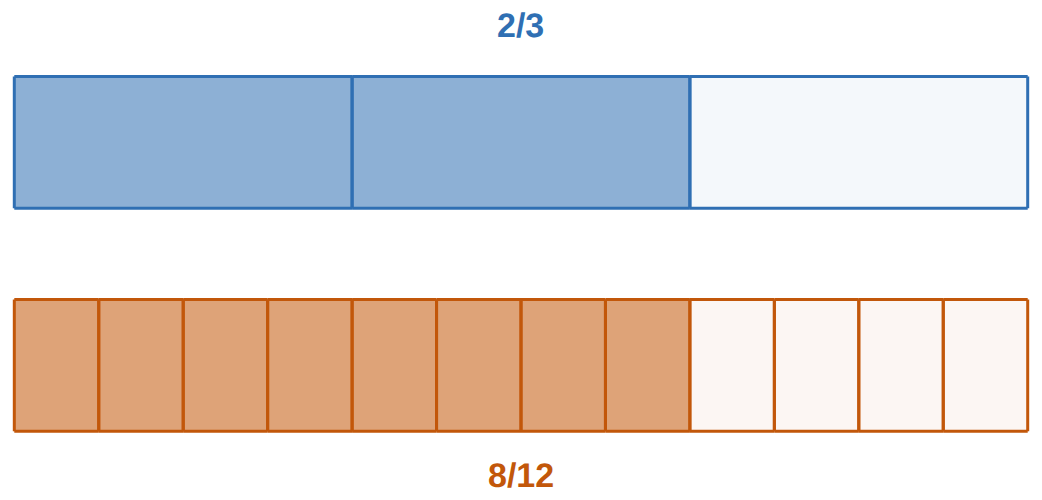
Fractions are equivalent when they name the same amount. Multiply or divide the top and the bottom (the numerator and the denominator) by the same number: $\tfrac{2}{3} = \tfrac{2 \times 4}{3 \times 4} = \tfrac{8}{12}$. (Adding the same number to both changes the amount.)

A fraction is in simplest form when the top and the bottom share no factor but 1. Divide both by their highest common factor: $\tfrac{12}{18} = \tfrac{2}{3}$ (÷ 6).

\tfrac{2}{3} = \tfrac{8}{12}: each third is split into 4, so the top and the bottom are both multiplied by 4.
23=812\tfrac{2}{3} = \tfrac{8}{12}: each third is split into 4, so the top and the bottom are both multiplied by 4.
The same amount, more parts · Sound on for the voiceover
Open the lesson →

10. Fractions, decimals and percentages

Try firstWrite 3/5 as a decimal and as a percentage, and 0.08 as a percentage.

Check your answer

0.6 and 60%; 0.08 = 8%.

Percent means out of 100, so a percentage is a fraction over 100: $75% = \tfrac{75}{100} = \tfrac{3}{4}$. A decimal counts tenths and hundredths: $0.75$ is 75 hundredths.

  • Fraction to decimal: divide the top by the bottom ($\tfrac{3}{8} = 0.375$).
  • Decimal to percentage: × 100 ($0.5 = 50%$, not 5%).
  • Percentage to fraction: over 100, then simplify ($16% = \tfrac{4}{25}$).

Some decimals never end: $\tfrac{1}{3} = 0.333\ldots$

\tfrac{3}{4} of the bar and 75 of the 100 squares: \tfrac{3}{4} = \tfrac{75}{100} = 0.75 = 75\%.
34\tfrac{3}{4} of the bar and 75 of the 100 squares: 34=75100=0.75=75%\tfrac{3}{4} = \tfrac{75}{100} = 0.75 = 75\%.
One amount, three names · Sound on for the voiceover
Open the lesson →

11. Fractions and decimals on the line

Try firstPut in order from least to greatest: 0.4, −1 1/4, −0.8, −1/2.

Check your answer

−1 1/4, −0.8, −1/2, 0.4.

To place a fraction or decimal, split each unit into equal parts and count from zero. Quarters: split each unit into 4. Tenths: into 10.

A negative number counts to the left of zero. $-\tfrac{3}{4}$ is three quarters left of 0. A negative mixed numeral or decimal is further left still: $-1.5$ is one unit left, then half a unit further left, halfway between $-2$ and $-1$.

Once they are on the line, read from left to right to put them in order.

Quarters: -1\tfrac{1}{4} (A), -\tfrac{3}{4} (B) and \tfrac{1}{2} (C).
Quarters: −114-1\tfrac{1}{4} (A), −34-\tfrac{3}{4} (B) and 12\tfrac{1}{2} (C).
Split each unit, then count from zero · Sound on for the voiceover
Open the lesson →

12. Adding and subtracting fractions

Try firstWork out 2/3 + 1/5 and 1 1/4 − 2/3.

Check your answer

10/15 + 3/15 = 13/15. 15/12 − 8/12 = 7/12.

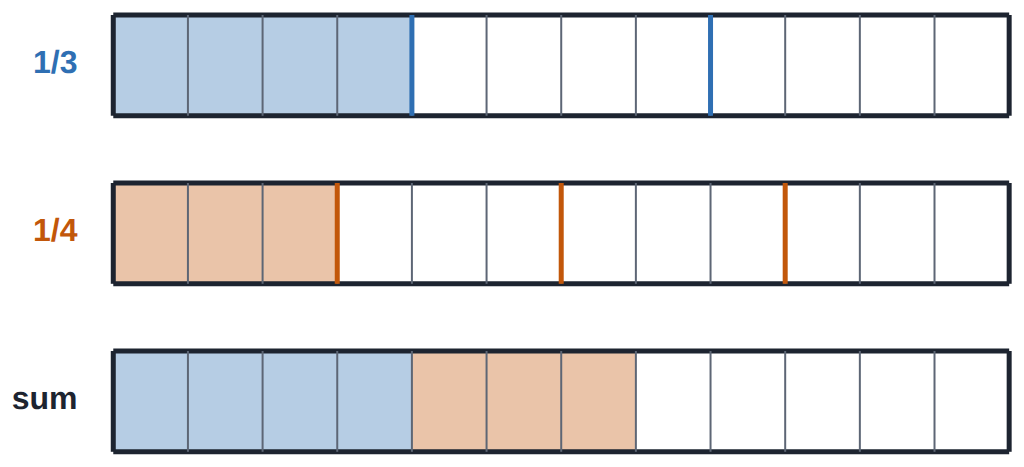
Fractions can be added only when the parts are the same size. Cut both into the same parts with equivalent fractions, using a common denominator (the LCM of the bottoms is the lowest):

$\tfrac{1}{3} + \tfrac{1}{4} = \tfrac{4}{12} + \tfrac{3}{12} = \tfrac{7}{12}$. Then add the tops and keep the bottom. (Adding across gives $\tfrac{2}{7}$, which is less than $\tfrac{1}{3}$ alone.)

For mixed numerals, change them to improper fractions first. For decimals, line up the points so tenths go with tenths.

Cut into twelfths, \tfrac{1}{3} = \tfrac{4}{12} and \tfrac{1}{4} = \tfrac{3}{12}: together 7 twelfths.
Cut into twelfths, 13=412\tfrac{1}{3} = \tfrac{4}{12} and 14=312\tfrac{1}{4} = \tfrac{3}{12}: together 7 twelfths.
The same size parts · Sound on for the voiceover
Open the lesson →

13. Multiplying and dividing fractions

Try firstWork out 3/5 × 10/12, and 2 ÷ 1/3.

Check your answer

30/60 = 1/2. 2 ÷ 1/3 = 6 (six thirds in 2).

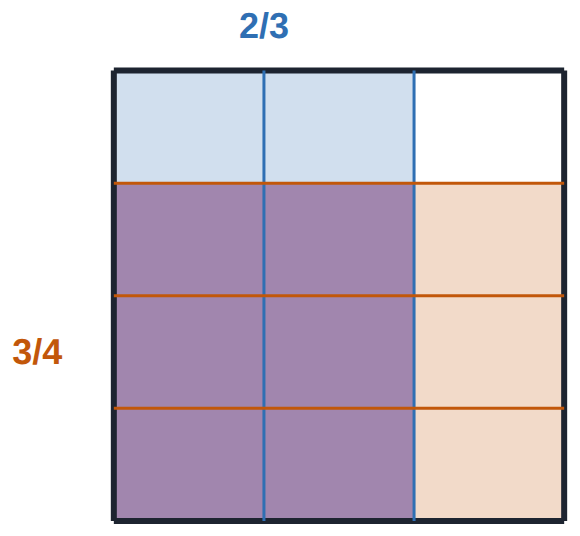
To multiply fractions, multiply the tops and multiply the bottoms, then simplify: $\tfrac{2}{3} \times \tfrac{3}{4} = \tfrac{6}{12} = \tfrac{1}{2}$. It is $\tfrac{3}{4}$ of $\tfrac{2}{3}$: in a square, 3 of 4 rows of 2 of 3 columns is 6 of 12 parts.

Multiplying by a fraction less than 1 makes a number smaller ($\tfrac{3}{4} \times 20 = 15$). Dividing asks how many fit: $3 \div \tfrac{1}{4} = 12$, the same as $3 \times 4$. To divide by a fraction, multiply by it flipped (top and bottom swapped: $\tfrac{1}{6}$ becomes $\tfrac{6}{1} = 6$).

\tfrac{3}{4} of \tfrac{2}{3}: the purple overlap is 6 of the 12 small parts, so \tfrac{2}{3} \times \tfrac{3}{4} = \tfrac{6}{12} = \tfrac{1}{2}.
34\tfrac{3}{4} of 23\tfrac{2}{3}: the purple overlap is 6 of the 12 small parts, so 23×34=612=12\tfrac{2}{3} \times \tfrac{3}{4} = \tfrac{6}{12} = \tfrac{1}{2}.
A fraction of a fraction · Sound on for the voiceover
Open the lesson →

14. Percentages of amounts

Try firstA $40 shirt is 35% off. Find the sale price.

Check your answer

35% of $40 = $14, so $26. Or 40 × 0.65 = 26.

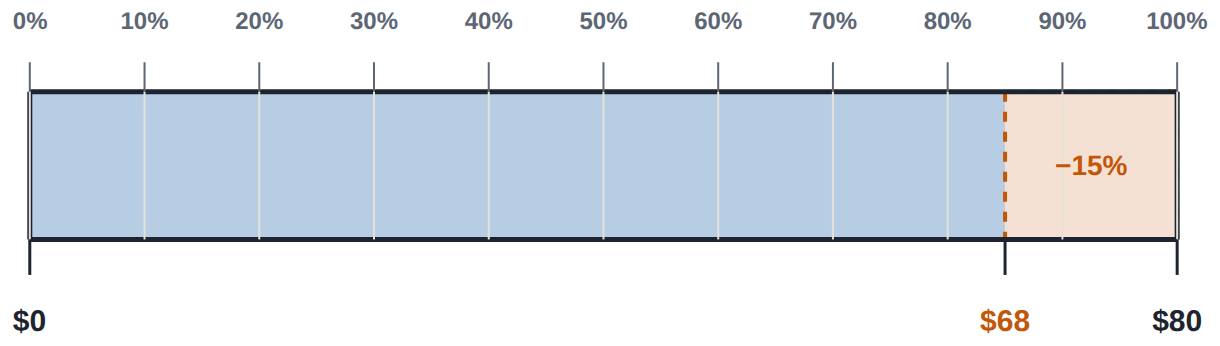
A percentage is hundredths: $15% = 0.15$. So 15% of $80 is 0.15 × 80 = $12 (or 10% is $8 and 5% is $4).

For a decrease, take it off or multiply by what is left: $80 \times 0.85 = 68$. For an increase, add it on or multiply by $1.15$. To find what percentage 18 is of 24, divide and $\times 100$: $18 \div 24 = 0.75 = 75%$.

15% off 80: the orange 15% is 12, and the blue 85% left is 68. 80 × 0.85 = 68 in one step.
15% off $80: the orange 15% is $12, and the blue 85% left is $68. $80 × 0.85 = $68 in one step.
A percentage of an amount · Sound on for the voiceover
Open the lesson →

15. Choosing a strategy

Try firstWork out 5 × 3.6 × 2 and 40% of 15, each in a quick way. Say which move you used.

Check your answer

5 × 2 = 10, then × 3.6 = 36 (any order). 40% = 2/5: 15 ÷ 5 × 2 = 6 (change the form).

A quick strategy usually comes from one of three moves:

  • Change the order: multiplying can be done in any order, $4 \times 2.7 \times 25 = 100 \times 2.7 = 270$.
  • Change the form: $0.75 = \tfrac{3}{4}$, so $0.75 \times 36 = 27$; $25% = \tfrac{1}{4}$.
  • Split a number: $12 \times 2.5 = 12 \times 2 + 12 \times 0.5 = 30$.

Then check with an estimate: is the answer about the right size?

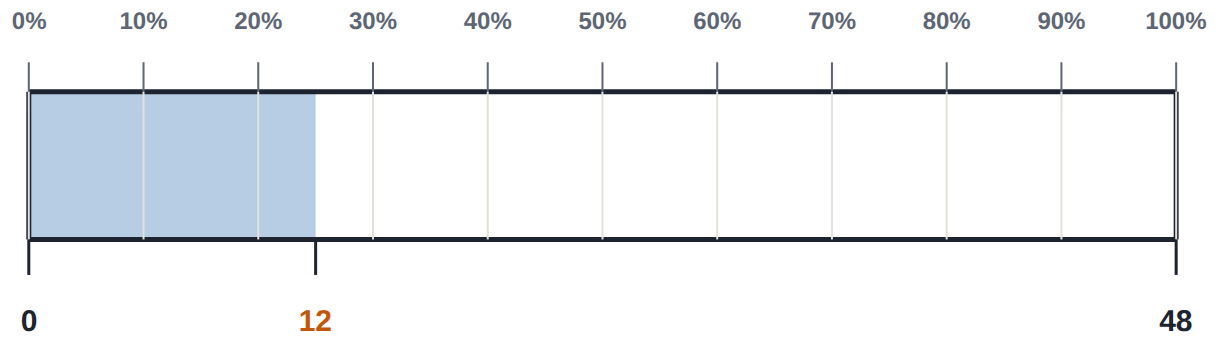
25% of 48 is a quarter of the bar: half of 48 is 24, half again is 12.
Halve, and halve again · Sound on for the voiceover
Open the lesson →

16. Calculating with negative fractions and decimals

Try firstWork out −3/5 × 10/9 and −4 × (−2.25). Show one strategy.

Check your answer

−2/3. 9 (−4 × −2 = 8, −4 × −0.25 = 1, so 8 + 1 = 9).

The sign rules for integers work for every fraction and decimal: same signs give a positive, different signs a negative (for × and ÷). Work out the sign first, then the size: $-\tfrac{3}{4} \times \tfrac{2}{5} = -\tfrac{6}{20} = -\tfrac{3}{10}$.

Make the size easy: multiply in any order ($25 \times (-3.7) \times 4 = 100 \times (-3.7) = -370$), or split a number ($6 \times (-2.5) = 6 \times (-2) + 6 \times (-0.5) = -15$).

-3 \times (-\tfrac{1}{2}) = 1\tfrac{1}{2}: 3 jumps of -\tfrac{1}{2} would go left to -1\tfrac{1}{2}; a negative number of jumps goes the opposite way.
−3×(−12)=112-3 \times (-\tfrac{1}{2}) = 1\tfrac{1}{2}: 3 jumps of −12-\tfrac{1}{2} would go left to −112-1\tfrac{1}{2}; a negative number of jumps goes the opposite way.
The sign rules work for fractions too · Sound on for the voiceover
Open the lesson →

Place value and estimating

17. Place value and powers of 10

Try firstWrite 7 304 in expanded notation using powers of 10.

Check your answer

7 × 10³ + 3 × 10² + 4 × 10⁰. (The 0 in the tens column is left out.)

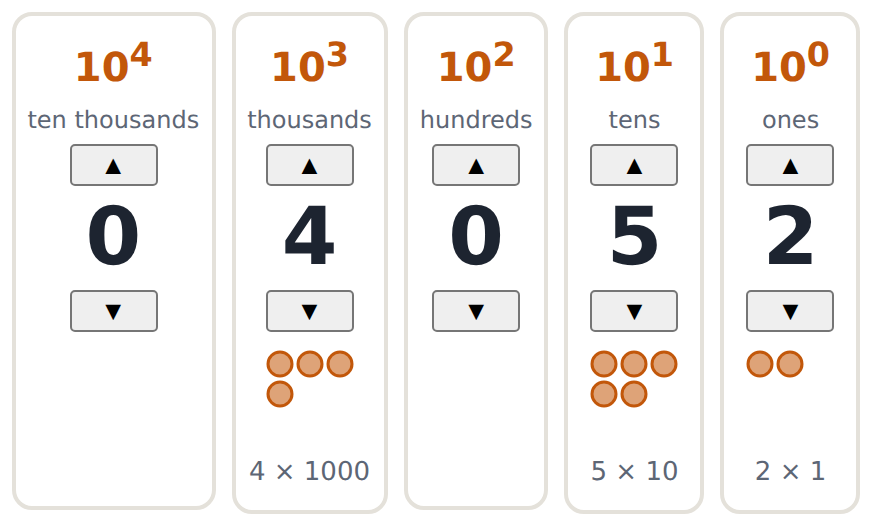
Every place value column is ten times the one on its right, so each is a power of 10: ones $10^0 = 1$, tens $10^1$, hundreds $10^2$, thousands $10^3$. The exponent counts the zeros in the value, and it counts from 0 at the ones column.

A number in expanded notation is the sum of each digit times its power of 10: $4052 = 4 \times 10^3 + 5 \times 10^1 + 2 \times 10^0$. A column holding 0 adds nothing, so it is left out.

4052 on the columns: 4 × 10³ + 0 × 10² + 5 × 10¹ + 2 × 10⁰. The 0 is a column with nothing in it.
Digits and powers of 10 · Sound on for the voiceover
Open the lesson →

18. Rounding decimals

Try firstA stick is measured as 83.46 cm with a ruler marked in millimetres. Round it sensibly, and say why.

Check your answer

83.5 cm: the ruler shows millimetres, which is 1 decimal place of a centimetre.

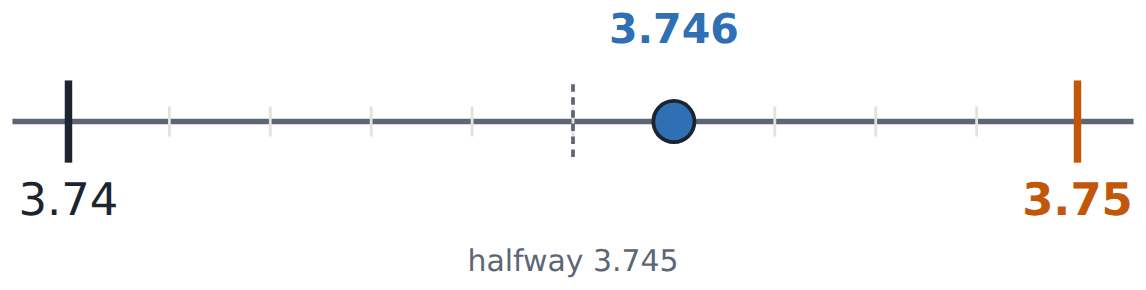
To round to a number of decimal places, find the two numbers with that many places that your number sits between, and take the nearer. Look at the one digit straight after the place: 5 or more rounds up, 4 or less leaves the digit as it is. Halfway rounds up. So 3.746 to 2 places is 3.75.

How much to round depends on the job: money to the cent, a ruler measurement to what the ruler can show, tins of paint up so there is enough. More digits than the instrument measures only gives a false sense of accuracy.

3.746 sits between 3.74 and 3.75. It is past the halfway mark 3.745, so it rounds up to 3.75.
Rounding on a number line · Sound on for the voiceover
Open the lesson →

19. Estimating to check

Try firstEstimate 4.8 × 31. The calculator shows 148.8. Is it reasonable?

Check your answer

5 × 30 = 150, so yes.

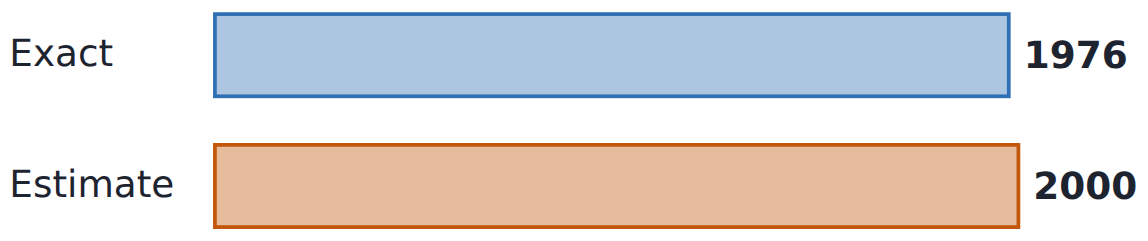
An estimate is a quick, close answer from rounding. Round each number to its first digit and keep its size: $38 \times 52 \approx 40 \times 50 = 2000$. If the exact answer is near the estimate it is reasonable; if it is out by a factor of ten, check the decimal point.

Rounding can go up or down, so an estimate can be above or below the exact answer. What matters is that it is close and quick.

38 × 52 ≈ 40 × 50 = 2000. The exact answer 1976 is close, so it is reasonable.
An estimate and the exact answer · Sound on for the voiceover
Open the lesson →

Ratios

20. What is a ratio?

Try firstA jar has 4 black and 5 white beads. Write the ratio of black to white, and of black to all the beads.

Check your answer

4 : 5 and 4 : 9.

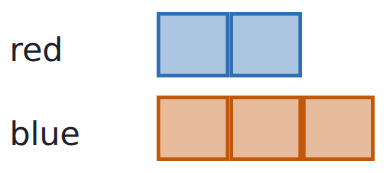
A ratio compares quantities in a stated order. With 2 red and 3 blue counters, red to blue is $2 : 3$ (part to part). The whole is $2 + 3 = 5$ counters, so red to all is $2 : 5$ (part to whole), which is the fraction $\tfrac{2}{5}$.

The order matters: $2 : 3$ is not $3 : 2$. The first thing named is the first number.

2 red blocks and 3 blue blocks: red to blue is 2 : 3, red to all the blocks is 2 : 5.
Part to part and part to whole · Sound on for the voiceover
Open the lesson →

21. Equivalent and simplest ratios

Try firstSimplify 24 : 36, and find the missing term: 3 : 5 = 12 : ?

Check your answer

24 : 36 = 2 : 3. 3 → 12 is × 4, so 5 × 4 = 20.

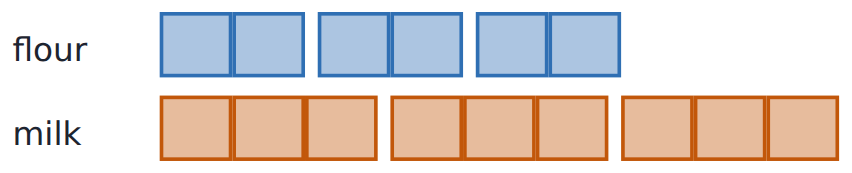
Two ratios are equivalent when both terms of one are the other's both terms multiplied (or divided) by the same number: $2 : 3 = 4 : 6 = 6 : 9$. Picture it as copies of the same pattern of blocks.

To simplify, divide both terms by their highest common factor: $12 : 18 = 2 : 3$ (÷ 6). Adding the same number to both terms changes the ratio.

Three copies of 2 : 3 give 6 : 9. The groups repeat, so the ratio is the same.
Copies of the same ratio · Sound on for the voiceover
Open the lesson →

22. Sharing in a ratio

Try firstShare $84 between Sam and Tia in the ratio 3 : 4. How much does Tia get?

Check your answer

3 + 4 = 7 parts. 84 ÷ 7 = 12. Tia has 4 parts: $48.

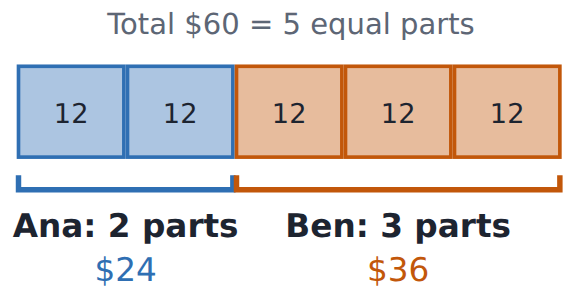
To share a total in a ratio: add the parts ($2 + 3 = 5$), find one part (total ÷ parts: $$60 \div 5 = $12$), and multiply for each share ($2 \times 12 = 24$, $3 \times 12 = 36$). The shares add back to the total.

To work backwards, use a known share to find one part: if 3 parts are $24, one part is $8.

60 in the ratio 2 : 3: 5 equal parts of 12. Ana gets 2 parts (24), Ben 3 parts (36).
$60 in the ratio 2 : 3: 5 equal parts of $12. Ana gets 2 parts ($24), Ben 3 parts ($36).
Share in a ratio · Sound on for the voiceover
Open the lesson →

Rates

27. Rates

Try firstA cyclist rides 45 km in 1.5 hours. Find her speed in km/h and m/s.

Check your answer

45 ÷ 1.5 = 30 km/h; 30 ÷ 3.6 ≈ 8.3 m/s.

A rate compares two quantities with different units (km per hour, $ per kg); a ratio compares the same kind of quantity.

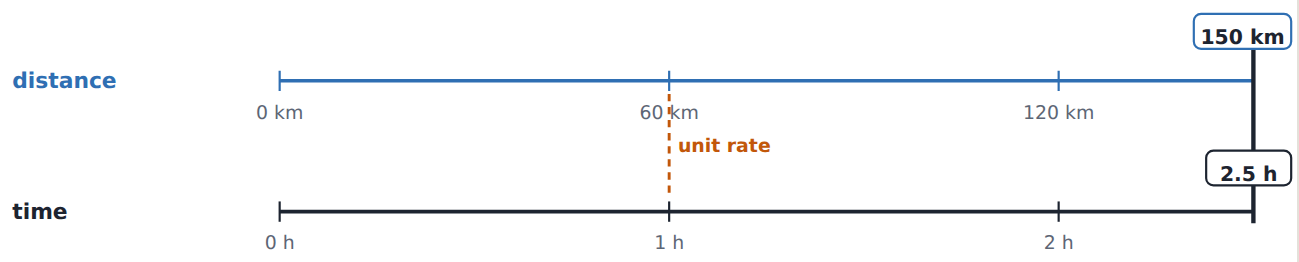
The unit rate is the amount for one of the second quantity: divide the first by the second, and keep both units. To convert km/h to m/s, divide by 3.6.

At 60 km per hour, 2.5 hours matches 150 km: each hour adds another 60 km.
Per one hour · Sound on for the voiceover
Open the lesson →

28. Using rates

Try firstA plane flies 2100 km at 700 km/h. How long does it take?

Check your answer

2100 ÷ 700 = 3 hours.

Use a rate both ways: total = rate × amount and amount = total ÷ rate. For speed, distance = speed × time and time = distance ÷ speed.

Write the units at each step (km ÷ km/h = h); they tell you whether to multiply or divide. Then check the size makes sense.

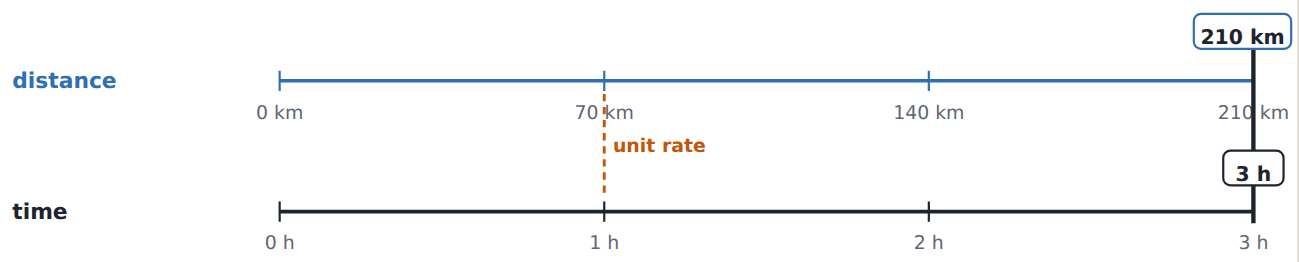
At 70 km/h, 3 hours covers 210 km; 210 km ÷ 70 km/h gives back the 3 hours.
Both ways along the line · Sound on for the voiceover
Open the lesson →

Modelling

23. Modelling with money

Try firstA $80 jacket is marked up 25% then sold at 25% off the new price. Is the final price more than, less than or equal to $80? Work it out.

Check your answer

80 × 1.25 = 100, then 100 × 0.75 = 75: less than $80.

Modelling with money: formulate (known, unknown, which representation: fraction, decimal, percentage or ratio), solve (estimate, then calculate efficiently), interpret and justify (the answer in dollars, rounded to the cent, and why that representation).

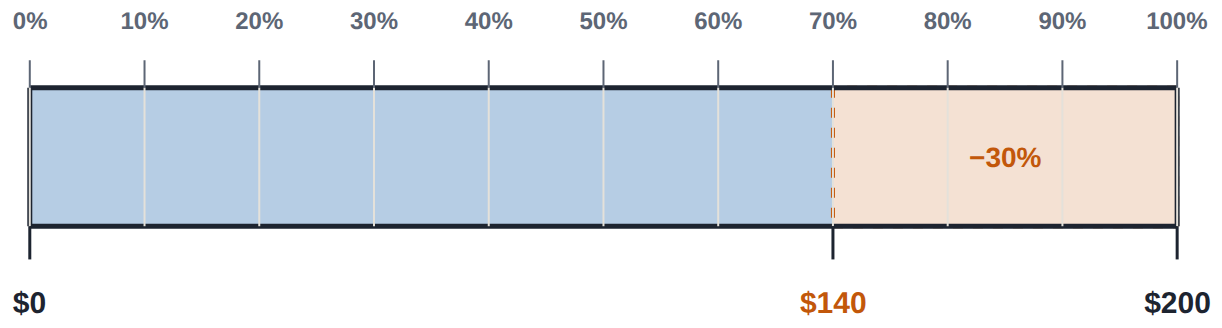
A percentage is always of something. Profit is a percentage of the cost. Percentages of different amounts do not add: 20% off $200 then 10% off the new price is $200 × 0.8 × 0.9 = $144, not 30% off.

30% off 200 is 140. But 20% off then 10% off leaves 200 × 0.8 × 0.9 = 144: percentages of different amounts do not add.
30% off $200 is $140. But 20% off then 10% off leaves $200 × 0.8 × 0.9 = $144: percentages of different amounts do not add.
Percentages in steps · Sound on for the voiceover
Open the lesson →

24. Modelling with ratios

Try firstA recipe mixes juice and water 2 : 7. How much juice is in a 900 mL drink?

Check your answer

2 + 7 = 9 parts. 900 ÷ 9 = 100 mL a part. Juice is 200 mL.

Modelling with ratios: formulate (what is known, what is unknown, what relationship?), solve, then interpret (the answer in the situation's units, and does it make sense?).

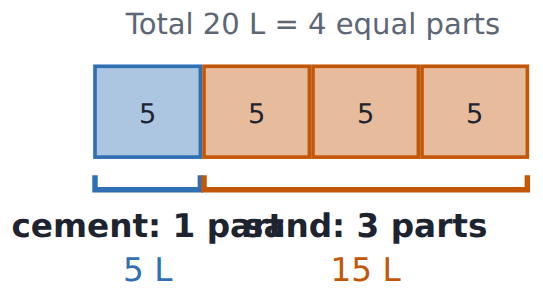
For a mix, add the parts and find one part: a dry mix 1 : 3 in 20 L has 4 parts of 5 L, so 5 L of cement and 15 L of sand. For a scale such as $1 : 50$, each 1 cm on the drawing is 50 cm in real life.

20 L of mortar in the ratio 1 : 3: 4 equal parts of 5 L. Cement 5 L, sand 15 L.
From a problem to a ratio · Sound on for the voiceover
Open the lesson →

25. Percentage change

Try firstA $60 item is discounted 25%, then the discounted price goes up 25%. What is the final price?

Check your answer

60 × 0.75 × 1.25 = $56.25.

An increase of $p%$ multiplies by $1 + \frac{p}{100}$; a decrease multiplies by $1 - \frac{p}{100}$.

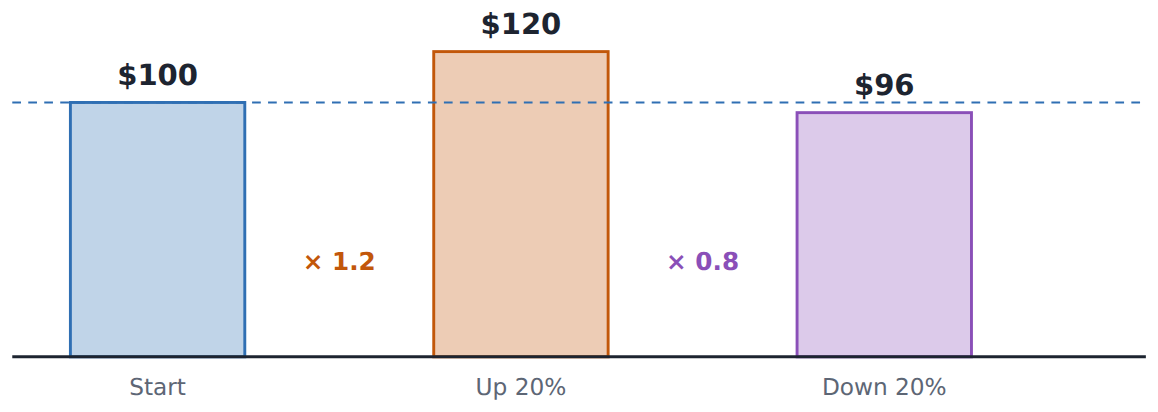
For one change after another, multiply the multipliers: each percentage is of the current amount. Up 20% then down 20% is $1.2 \times 0.8 = 0.96$: 4% less.

100 up 20% is 120; then down 20% takes off 20% of 120 (24), leaving 96.
$100 up 20% is $120; then down 20% takes off 20% of $120 ($24), leaving $96.
Up 20%, down 20% · Sound on for the voiceover
Open the lesson →

26. Money models

Try firstTax is 0% on the first $18 200 of income, 15% on the next part up to $45 000, and 30% on the part from $45 000 to $135 000. Find the tax on $50 000.

Check your answer

15% of (45 000 − 18 200) = 15% of 26 800 = $4020, plus 30% of 5000 = $1500: $5520 in all.

To model a money problem: decide what to find, choose the calculation, work it out, and check it makes sense.

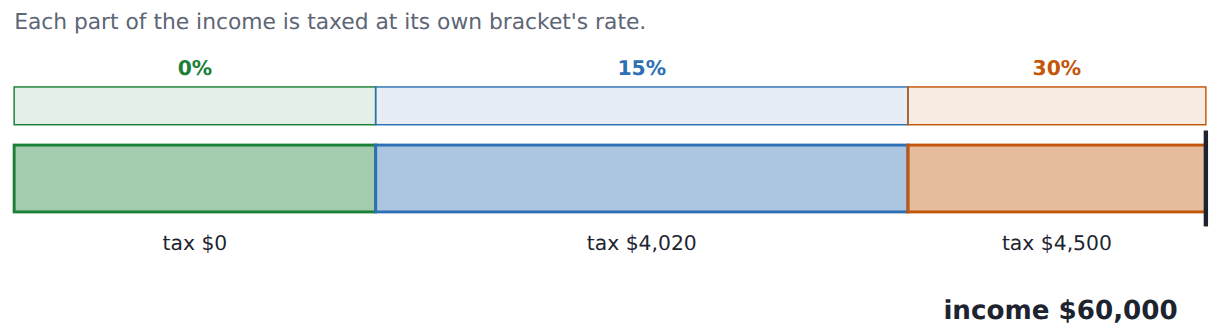
Income tax is worked out in brackets: each part of the income is taxed at its own rate. The marginal rate is the rate on the last dollar; the effective rate is total tax ÷ income, which is lower (for incomes above $18 200).

On 60 000: nothing on the first 18 200, 15% of the next 26 800 (4020), and 30% of the last 15 000 (4500). Tax 8520.
On $60 000: nothing on the first $18 200, 15% of the next $26 800 ($4020), and 30% of the last $15 000 ($4500). Tax $8520.
Tax in brackets · Sound on for the voiceover
Open the lesson →

29. Ratio and rate models

Try firstA recipe uses 2 cups of rice to 3 cups of water. How much water for 5 cups of rice? Is this a ratio or a rate?

Check your answer

A ratio (cups to cups): 5 × 1.5 = 7.5 cups of water.

To model a problem: say what you need (with units), choose a ratio (same kind of quantity) or a rate (different units), solve, then interpret the answer in the situation.

Paint comes in whole tins and buses in whole buses: round up when you must have enough.

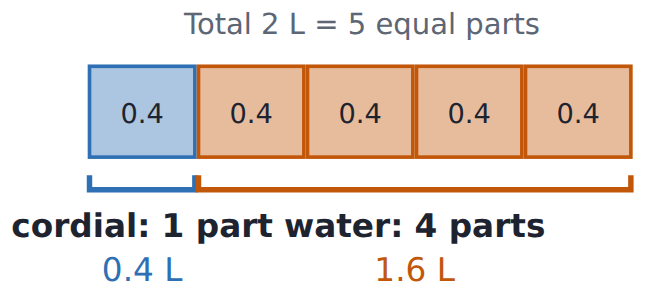
Cordial 1 : 4 water: 2 L of drink is 5 equal parts of 0.4 L, so 0.4 L of cordial and 1.6 L of water.
A ratio model · Sound on for the voiceover
Open the lesson →

30. Checking a model

Try firstA model says 4 kg of apples at $3.50 per kg cost $14. The shop charges $12.60 for 4 kg. Name a possible assumption that failed.

Check your answer

A fixed price per kg: the shop may give a discount for buying more (a bulk price).

Every model makes assumptions (steady speed, no fees, no starting charge). When the model and real life differ, check the arithmetic, then name the assumption that did not hold.

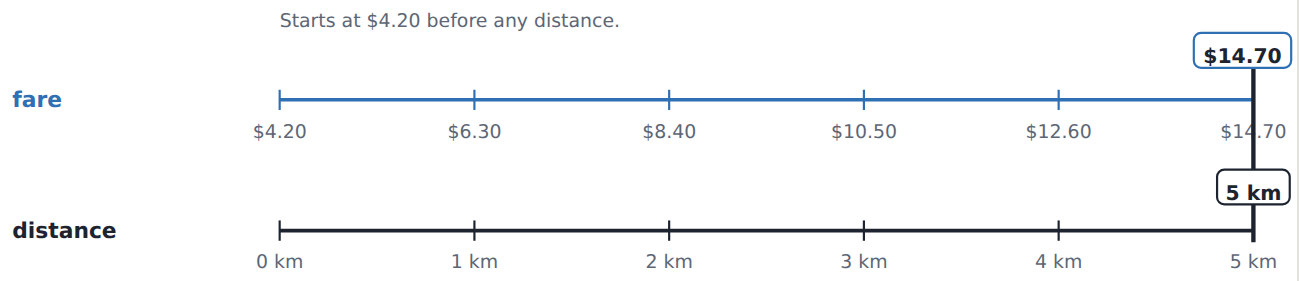
Refine the model by adding what was left out, such as a starting charge: fare = $4.20 + $2.10 × km. A simple model is good enough when its error does not change the decision.

A taxi fare: 4.20 to start, then 2.10 per km. A 5 km ride costs 4.20 + 10.50 = 14.70.
A taxi fare: $4.20 to start, then $2.10 per km. A 5 km ride costs $4.20 + $10.50 = $14.70.
A simple model · Sound on for the voiceover
Open the lesson →