← Area, volume, circles and Pythagoras

Area, volume, circles and Pythagoras: recap

Answer each question in your head or on paper first, then check it.

Area

1. Area of parallelograms

Try firstA parallelogram has base 9 cm, slanted side 5 cm and perpendicular height 4 cm. Find its area.

Check your answer

9 × 4 = 36 cm² (the 5 cm slanted side is not used).

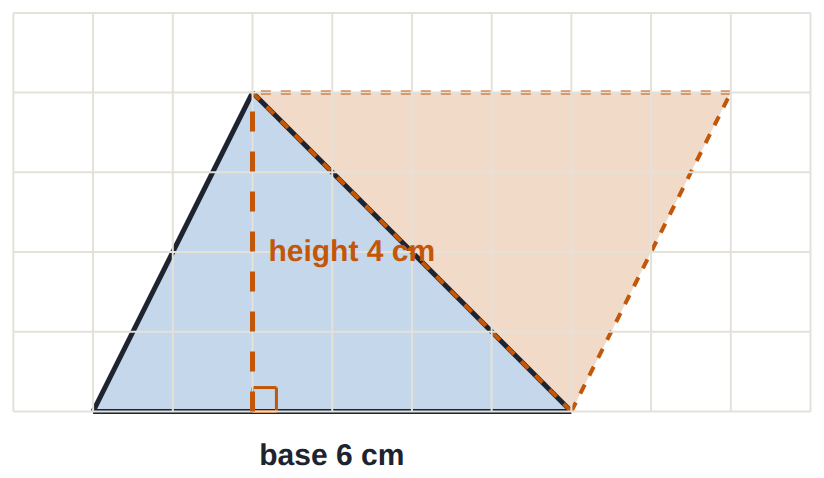
A parallelogram is a rectangle pushed over. Cut the triangle off one end along the perpendicular height and move it to the other end: it becomes a rectangle with the same base and height. So:

$$A = b \times h$$

where $h$ is the perpendicular height, at a right angle to the base, not the slanted side. Area is in square units: cm², m².
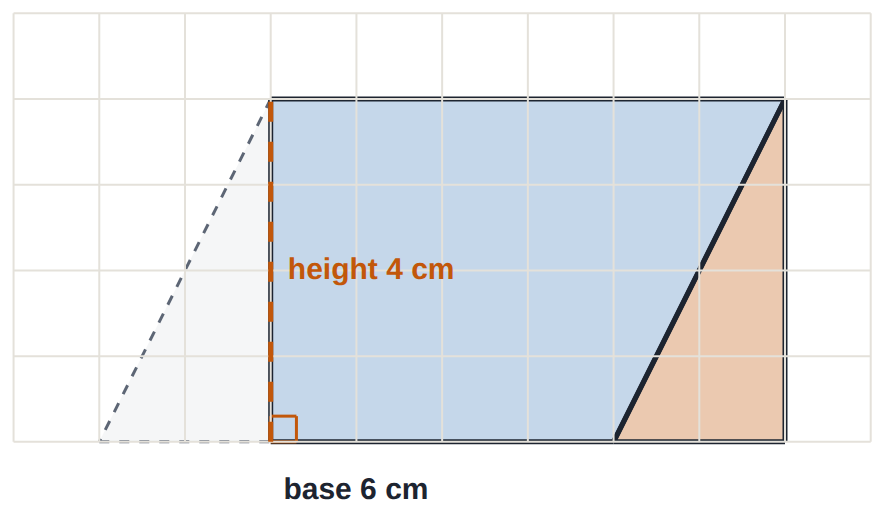
The triangle cut off the left end fills the gap on the right: a 6 by 4 rectangle, so the parallelogram's area is 6 \times 4 = 24 cm².
The triangle cut off the left end fills the gap on the right: a 6 by 4 rectangle, so the parallelogram's area is 6×4=246 \times 4 = 24 cm².
Cut and move · Sound on for the voiceover
Open the lesson →

2. Area of triangles

Try firstA triangle has base 9 cm and height 6 cm. Find its area. A triangle with area 24 cm² has base 8 cm: find its height.

Check your answer

½ × 9 × 6 = 27 cm². ½ × 8 × h = 24, so h = 6 cm.

Two copies of a triangle, one turned round, make a parallelogram with the same base and height. So the triangle's area is half of base × height:

$$A = \tfrac{1}{2} \times b \times h$$

The height is perpendicular to the base. If the top leans past the end of the base, extend the base: the height meets it outside the triangle. Moving the top along a line parallel to the base keeps the area.

A turned copy (dashed) makes a parallelogram, 6 \times 4 = 24 cm². The triangle is half: \tfrac{1}{2} \times 6 \times 4 = 12 cm².
A turned copy (dashed) makes a parallelogram, 6×4=246 \times 4 = 24 cm². The triangle is half: 12×6×4=12\tfrac{1}{2} \times 6 \times 4 = 12 cm².
Half a parallelogram · Sound on for the voiceover
Open the lesson →

3. Area problems

Try firstA shape is a 7 m by 4 m rectangle with a triangle on top (base 7 m, height 2 m). Find its area.

Check your answer

28 + ½ × 7 × 2 = 28 + 7 = 35 m².

Area problems have three moves:

  • Choose the base and the height at a right angle to it; a slanted side is extra information.
  • Convert every length to the same unit first (250 cm = 2.5 m). Area is in square units, and 1 m² = 10 000 cm².
  • Split a shape into rectangles and triangles and add the parts, or subtract a missing part from a bigger shape.
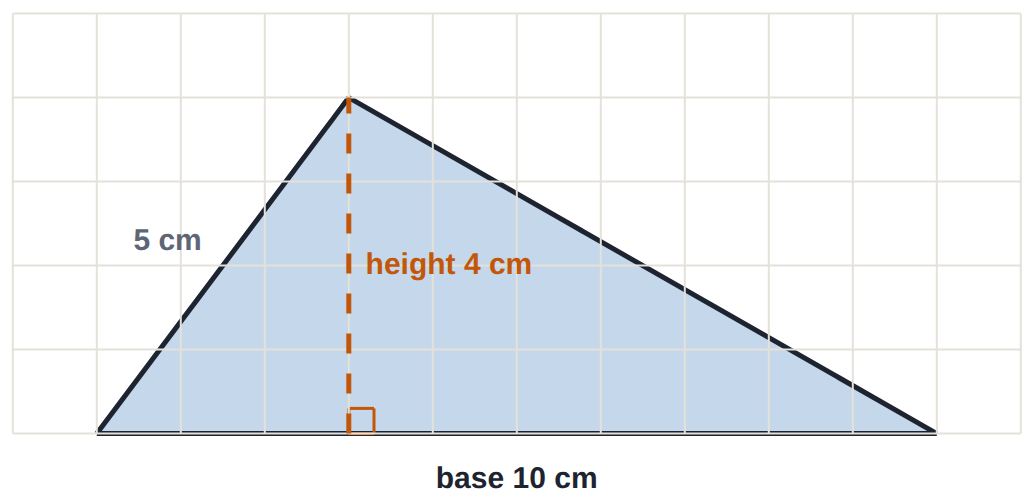
Base 10 cm, height 4 cm, and a slanted side of 5 cm. The area uses the base and the height at a right angle to it: \tfrac{1}{2} \times 10 \times 4 = 20 cm².
Base 10 cm, height 4 cm, and a slanted side of 5 cm. The area uses the base and the height at a right angle to it: 12×10×4=20\tfrac{1}{2} \times 10 \times 4 = 20 cm².
Choose the right lengths · Sound on for the voiceover
Open the lesson →

12. Composite shapes

Try firstA rectangle 12 m by 5 m has a 4 m by 2 m corner cut out. Find its area.

Check your answer

12 × 5 − 4 × 2 = 60 − 8 = 52 m².

A composite shape is made of shapes you know. Cut it into pieces and add their areas, or see a big rectangle and take away the missing pieces: both give the same area, if each piece uses its own lengths.

Missing sides are differences of other sides. The perimeter adds every side, in units of length.

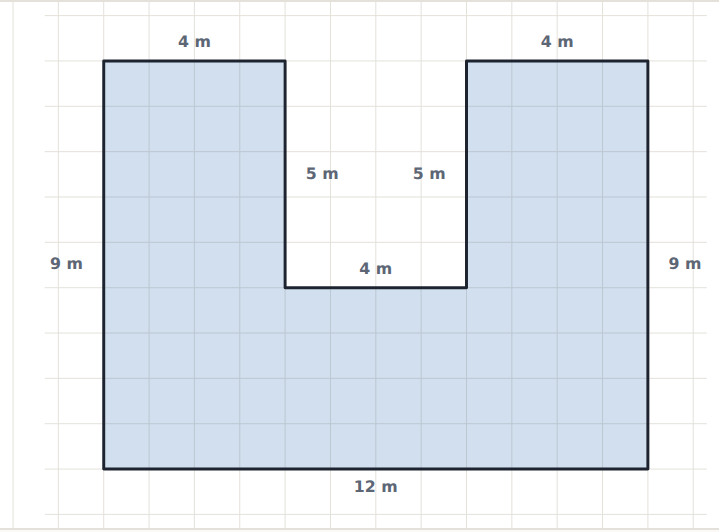
A U-shape: the 12 m by 9 m rectangle is 108 m², and the gap is 4 m by 5 m, so the area is 108 − 20 = 88 m².
Two ways, one area · Sound on for the voiceover
Open the lesson →

13. Irregular shapes

Try firstA shape covers 18 full squares and part of 10 more on a 1 cm grid. Estimate its area.

Check your answer

18 + 10 ÷ 2 = 23 cm².

For an irregular shape, put a grid over it: count the full squares, add half the part squares, and multiply by one square's area. A finer grid gives a better estimate.

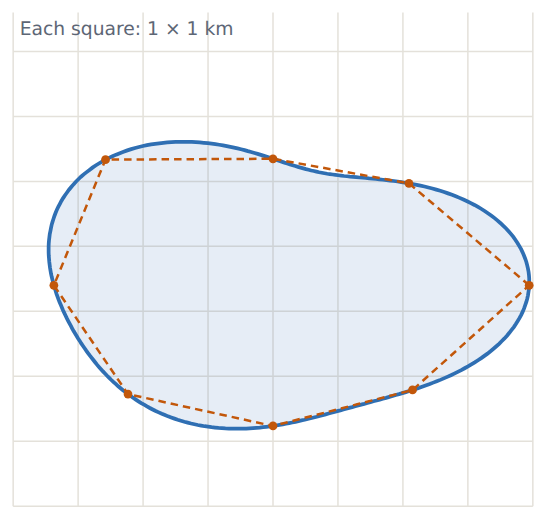
For the perimeter, join points on the edge with straight pieces and add them: more pieces get closer (always slightly short). State how precise the estimate is.

A lake on a grid of 1 km squares, with 8 straight pieces round its edge.
Count, then refine · Sound on for the voiceover
Open the lesson →

Volume

4. Volume in layers

Try firstA box is 5 cm by 4 cm by 3 cm. Find its volume. A box with base 6 cm² has volume 42 cm³: how high is it?

Check your answer

5 × 4 × 3 = 60 cm³. 42 ÷ 6 = 7 cm.

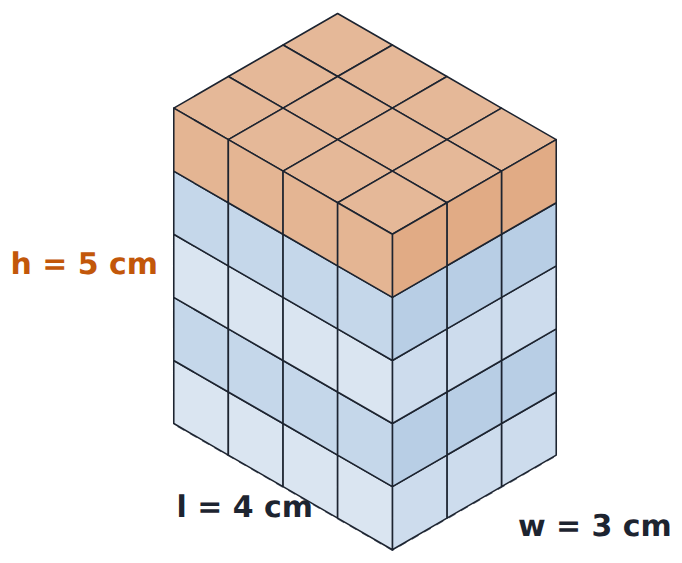
Volume counts unit cubes (cm³, m³). A prism fills up in layers: each layer covers the base, so it has as many cubes as the base has squares. The number of layers is the height:

$$V = A \times h$$

For a box, $A = l \times w$, so $V = l \times w \times h$. The cubes fill the inside, not just the outside you can see.

Each layer is the 4 by 3 base: 12 cubes. 5 layers: 12 \times 5 = 60 cm³.
Each layer is the 4 by 3 base: 12 cubes. 5 layers: 12×5=6012 \times 5 = 60 cm³.
Layer on layer · Sound on for the voiceover
Open the lesson →

5. Prisms and capacity

Try firstA prism's triangle end has base 5 cm and height 4 cm; it is 6 cm long. Find its volume and its capacity in mL.

Check your answer

½ × 5 × 4 = 10 cm², × 6 = 60 cm³ = 60 mL.

A right prism has the same cross-section all the way along. Its volume is that slice's area times the length:

$$V = A \times h$$

For a triangular prism, the cross-section is a triangle: halve first ($\tfrac{1}{2} \times 6 \times 4 = 12$ cm², then $\times 10 = 120$ cm³). Capacity: 1 cm³ holds 1 mL, and 1000 cm³ = 1 L.

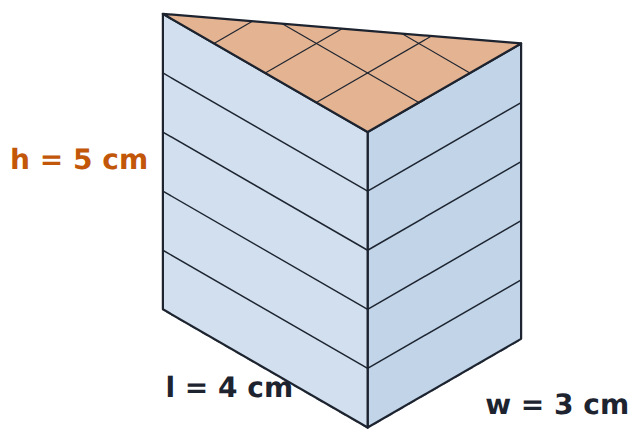
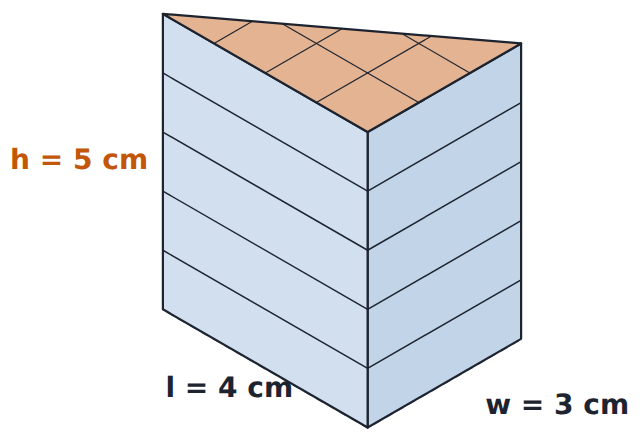
The triangle is half of a 4 by 3 rectangle: 6 cm². 5 layers of it: 6 \times 5 = 30 cm³.
The triangle is half of a 4 by 3 rectangle: 6 cm². 5 layers of it: 6×5=306 \times 5 = 30 cm³.
The same all the way along · Sound on for the voiceover
Open the lesson →

14. Volume and capacity

Try firstA fish tank is 50 cm by 30 cm by 40 cm. How many litres does it hold?

Check your answer

50 × 30 × 40 = 60 000 cm³ = 60 L.

Volume is in cubic units; capacity is in mL, L or kL. 1 cm³ holds 1 mL, 1000 cm³ holds 1 L, and 1 m³ holds 1000 L.

A cubic metre is 100 cm × 100 cm × 100 cm = 1 000 000 cm³: convert each of the three lengths.

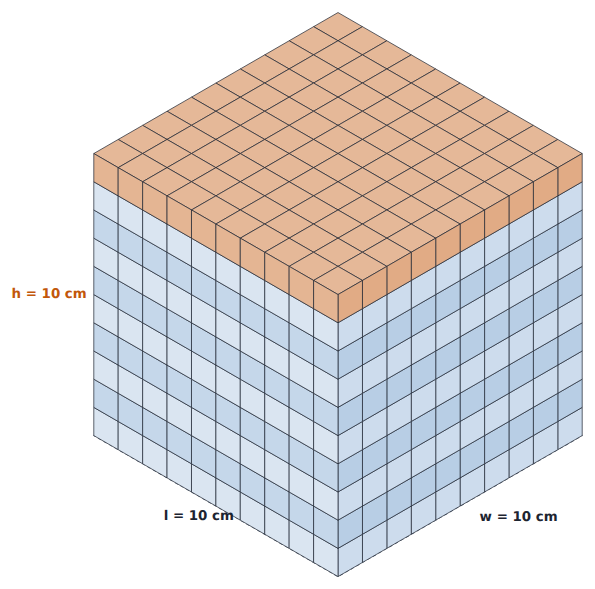
A 10 cm cube: 10 × 10 × 10 = 1000 cm³, which holds exactly 1 L.
A litre is a 10 cm cube · Sound on for the voiceover
Open the lesson →

15. Prism problems

Try firstA tank with a 2 m by 1.5 m base holds 4500 L. How deep is the water?

Check your answer

4500 L = 4.5 m³; 4.5 ÷ 3 = 1.5 m.

For any right prism, $V = A \times h$: the area of the end times the length. Find the end's area with its own formula (rectangle, triangle or composite).

To find a missing length, divide: $h = V \div A$. Convert units first, and answer in the units the problem asks for (mL, L or m³).

A triangular prism: the end is ½ × 4 × 3 = 6 cm², so 5 layers make 30 cm³.
End area times length · Sound on for the voiceover
Open the lesson →

Circles

6. Parts of a circle

Try firstA circular pond has diameter 9 m. Find its radius. What is a chord?

Check your answer

4.5 m. A straight line joining two points on the circle.

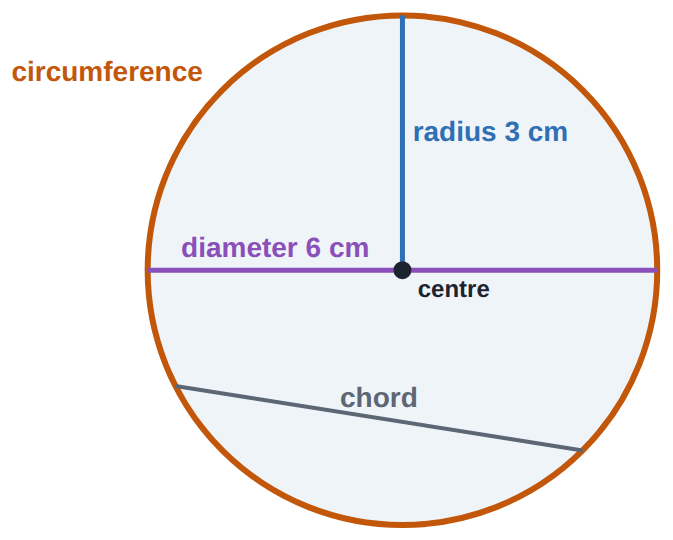
A circle is all the points the same distance (the radius, $r$) from its centre.

  • The diameter ($d$) goes right across through the centre: $d = 2r$, and $r = d \div 2$.
  • A chord joins any two points; the diameter is the longest chord.
  • The circumference ($C$) is the distance all the way round.
Centre, radius (3 cm), diameter (6 cm: two radii), a chord, and the circumference all the way round.
Radius and diameter · Sound on for the voiceover
Open the lesson →

7. Discovering π

Try firstWhat is π? Estimate the circumference of a circle with diameter 20 cm.

Check your answer

π is the circumference divided by the diameter, the same for every circle, about 3.14. C ≈ 3.14 × 20 = 62.8 cm.

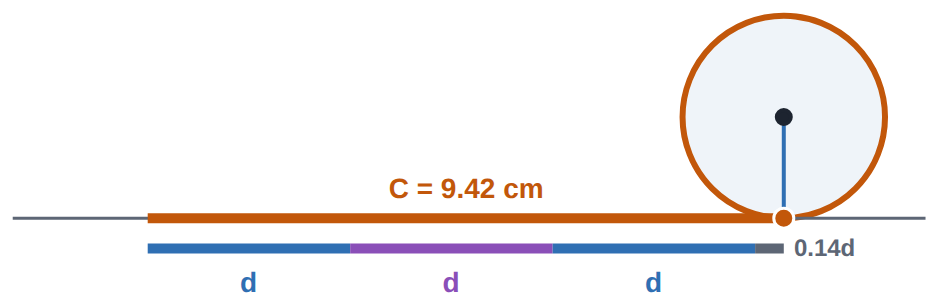
Roll a circle out flat for one turn and its circumference is a bit more than 3 diameters. For every circle, the circumference divided by the diameter is the same number, π:

$$\pi = \frac{C}{d} = 3.14159\ldots$$

π's digits never end and never settle into a repeating pattern; 3.14 and $\tfrac{22}{7}$ are approximations. A quick estimate: the circumference is a bit more than 3 diameters.

Rolled out flat, the circumference is 3 diameters and a little bit more (about 0.14 of a diameter): C \div d \approx 3.14.
Rolled out flat, the circumference is 3 diameters and a little bit more (about 0.14 of a diameter): C÷d≈3.14C \div d \approx 3.14.
Roll it out · Sound on for the voiceover
Open the lesson →

8. Circumference

Try firstFind the circumference of a circle with radius 4 cm. A circle has circumference 12.56 cm: find its diameter. (π ≈ 3.14)

Check your answer

2 × 3.14 × 4 = 25.12 cm. 12.56 ÷ 3.14 = 4 cm.

Because $C \div d = \pi$, the circumference is

$$C = \pi d = 2\pi r$$

Use the diameter (or double the radius). Going backwards, divide by π: $d = C \div \pi$. An exact answer keeps π: a circle with diameter 10 cm has $C = 10\pi$ cm, about 31.4 cm.

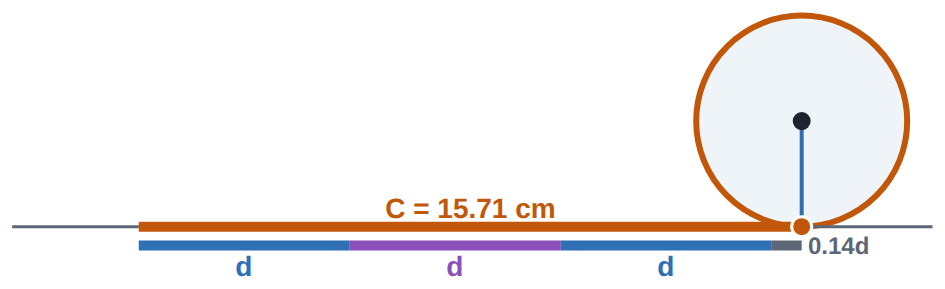
Radius 2.5 cm, diameter 5 cm: rolled out, C = \pi \times 5 \approx 15.71 cm.
Radius 2.5 cm, diameter 5 cm: rolled out, C=π×5≈15.71C = \pi \times 5 \approx 15.71 cm.
C = πd · Sound on for the voiceover
Open the lesson →

16. Area of a circle

Try firstFind the area of a circle with diameter 8 cm.

Check your answer

r = 4 cm; A = π × 16 ≈ 50.3 cm².

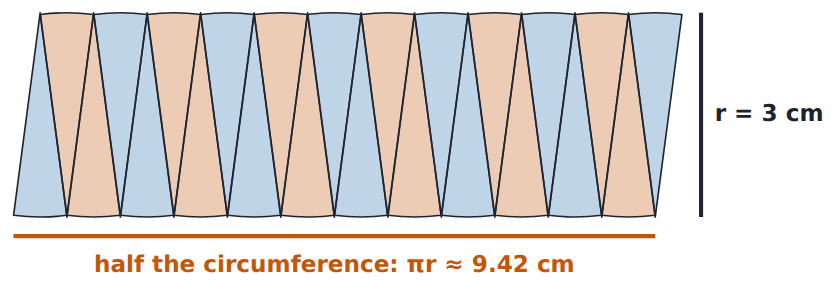
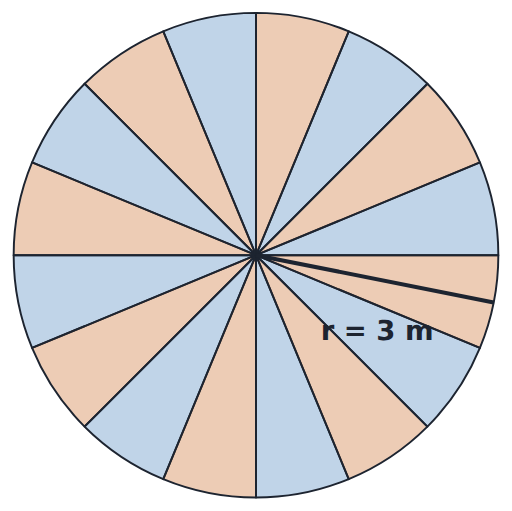
Cut a circle into thin slices and lay them top to tail: the shape is nearly a rectangle πr long (half the circumference) and r high. So $A = \pi r^2$.

Check: the area is between $2r^2$ and $4r^2$. Do not mix it up with the circumference $C = 2\pi r$, a length.

24 slices of a circle of radius 3 cm, top to tail: nearly a rectangle 3π ≈ 9.42 cm long and 3 cm high, so about 28.3 cm².
Slices into a rectangle · Sound on for the voiceover
Open the lesson →

17. Circle problems

Try firstA circular pond has an area of 28.3 m². What is its radius?

Check your answer

28.3 ÷ π ≈ 9, and √9 = 3 m.

Choose the formula: circumference $C = 2\pi r$ (a length) or area $A = \pi r^2$ (a space). From an area, $r = \sqrt{A \div \pi}$.

Parts of circles: a semicircle is half the area; its perimeter is half the circumference plus the diameter. Say which value of π you used.

A circle of radius 3 m: A = π × 9 ≈ 28.27 m².
From area back to radius · Sound on for the voiceover
Open the lesson →

Pythagoras

9. Pythagoras' theorem

Try firstA right-angled triangle has sides 10 cm and 24 cm at the right angle. Find the hypotenuse.

Check your answer

100 + 576 = 676, √676 = 26 cm.

In a right-angled triangle, the hypotenuse $c$ is the side opposite the right angle (the longest). Pythagoras' theorem: the squares on the two shorter sides add to the square on the hypotenuse,

$$a^2 + b^2 = c^2$$

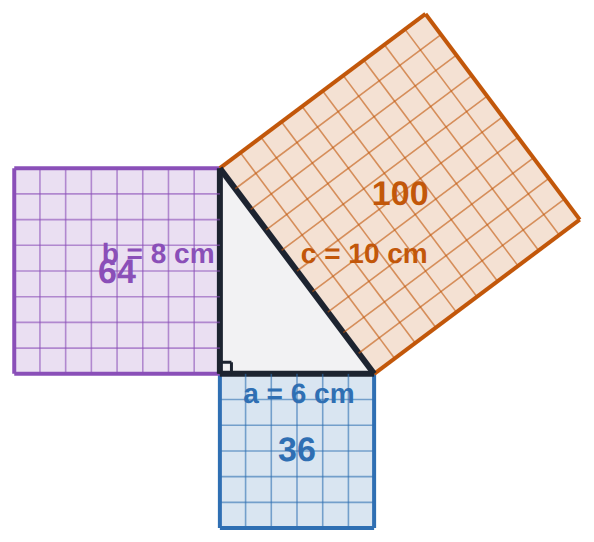
To find $c$: square $a$ and $b$, add, then take the square root. With 6 and 8: $36 + 64 = 100$, $c = 10$.

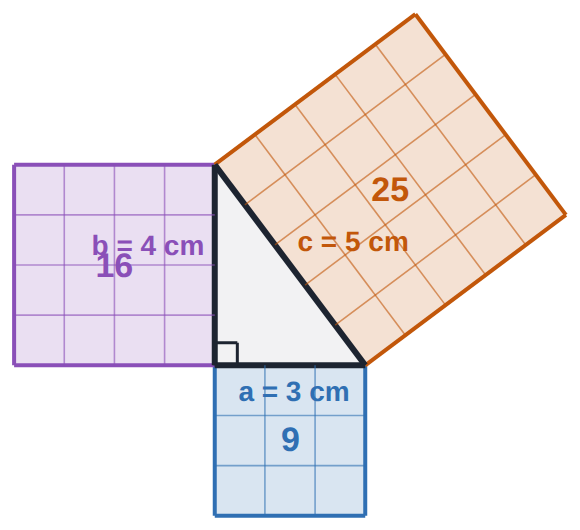
Squares on the sides of a 3-4-5 right-angled triangle: 9 + 16 = 25. The two smaller squares exactly make the biggest.
Squares on the sides of a 3-4-5 right-angled triangle: 9+16=259 + 16 = 25. The two smaller squares exactly make the biggest.
Squares on the sides · Sound on for the voiceover
Open the lesson →

10. Finding a side

Try firstA right-angled triangle has hypotenuse 17 cm and one side 8 cm. Find the other side.

Check your answer

289 − 64 = 225, √225 = 15 cm.

Pythagoras finds any side of a right-angled triangle:

  • the hypotenuse: add the squares, $c^2 = a^2 + b^2$;
  • a shorter side: subtract, $b^2 = c^2 - a^2$.

Then take the square root (to two decimal places if it is not whole). Check: the hypotenuse must be the longest side.

Hypotenuse 10 and one side 6: the missing square is 100 - 36 = 64, so the side is \sqrt{64} = 8.
Hypotenuse 10 and one side 6: the missing square is 100−36=64100 - 36 = 64, so the side is 64=8\sqrt{64} = 8.
A shorter side · Sound on for the voiceover
Open the lesson →

11. Right, acute or obtuse?

Try firstClassify triangles with sides (a) 8, 15, 17 and (b) 4, 6, 8.

Check your answer

(a) 64 + 225 = 289 = 17²: right-angled. (b) 16 + 36 = 52 < 64: obtuse.

To test a triangle, call its longest side $c$ and compare $a^2 + b^2$ with $c^2$:

  • equal: right-angled;
  • $a^2 + b^2 < c^2$: obtuse (the angle opposite $c$ is over 90°);
  • $a^2 + b^2 > c^2$: acute.

Whole numbers that fit exactly are Pythagorean triples: 3-4-5, 5-12-13, 8-15-17, and their multiples.

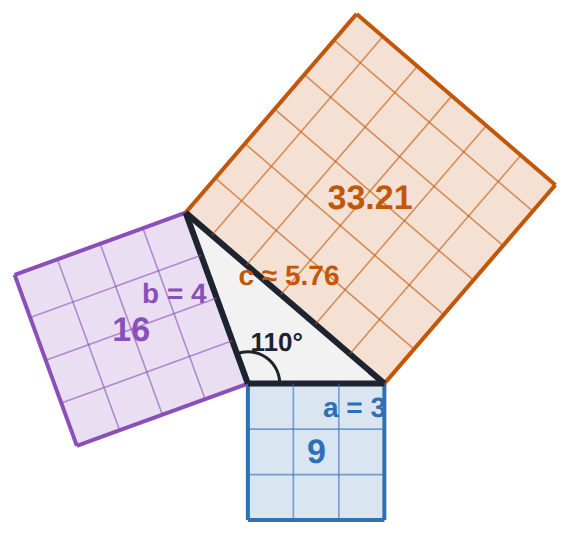
Open the angle to 110° and the biggest square grows: c^2 \approx 33.2, more than 9 + 16 = 25. The triangle is obtuse.
Open the angle to 110° and the biggest square grows: c2≈33.2c^2 \approx 33.2, more than 9+16=259 + 16 = 25. The triangle is obtuse.
Open the angle · Sound on for the voiceover
Open the lesson →

Time zones

18. Time zones

Try firstIt is 18:30 Tuesday in Sydney (UTC+11). What time and day is it in Los Angeles (UTC−7)?

Check your answer

Los Angeles is 18 hours behind: 00:30 Tuesday.

A time zone is an offset from UTC. A city with a bigger offset is ahead; a smaller one is behind. Find the difference, add or take it away, and change the day when you cross midnight.

For a flight, add the flight time to the departure (in the departure zone), then change to the arrival zone. Use 24-hour time to avoid am and pm mistakes.

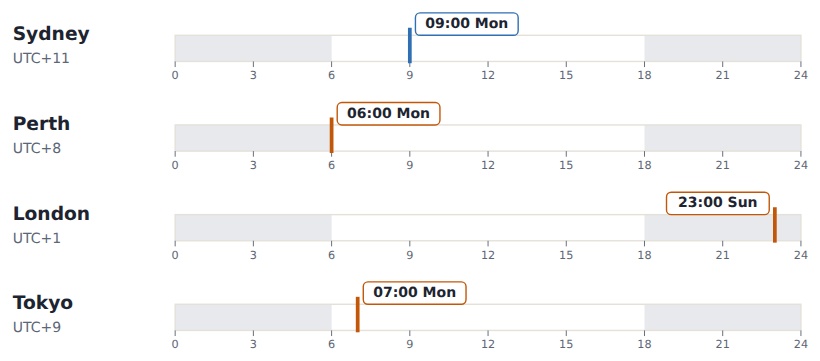
9:00 am Monday in Sydney is 6:00 am in Perth, 11:00 pm Sunday in London and 7:00 am in Tokyo.
One moment, four clocks · Sound on for the voiceover
Open the lesson →