← Angles and shapes

Angles and shapes: recap

Answer each question in your head or on paper first, then check it.

Parallel lines

1. Angles at parallel lines

Try firstA transversal crosses two parallel lines. Which angle pairs are equal, and which pair adds to 180°?

Check your answer

Corresponding angles and alternate angles are equal (so are vertically opposite angles); co-interior angles add to 180°.

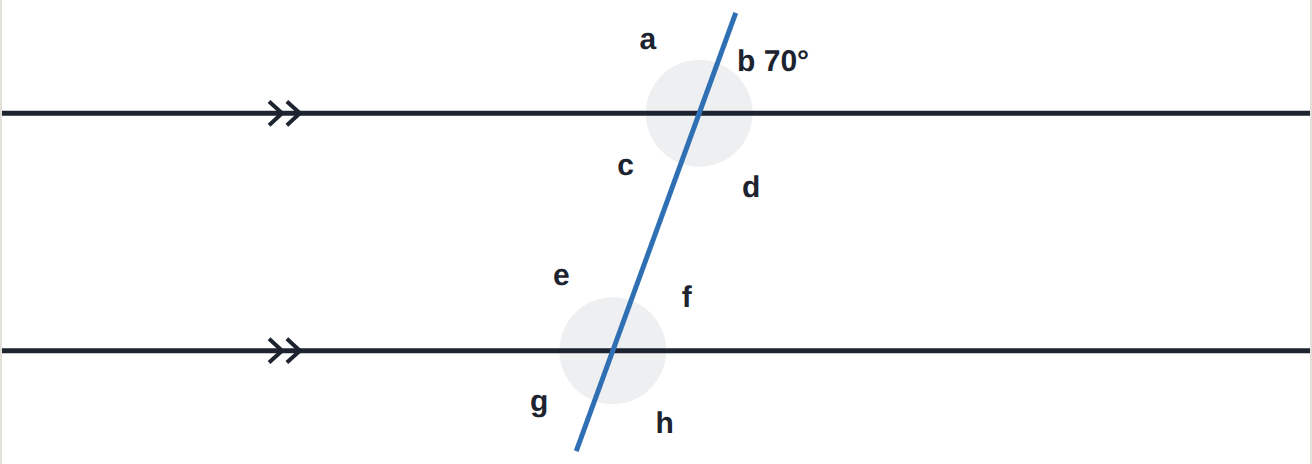
A line crossing two parallel lines (a transversal) makes eight angles, $a$ to $h$. Each pair below takes one angle from each crossing:

  • corresponding: the same place at each crossing, such as $a$ and $e$ (an F shape);
  • alternate: between the parallel lines, on opposite sides of the transversal, such as $c$ and $f$ (a Z shape);
  • co-interior: between the parallel lines, on the same side, such as $c$ and $e$ (a C shape).

Two angles at one crossing, opposite each other, are vertically opposite: not one of these pairs.
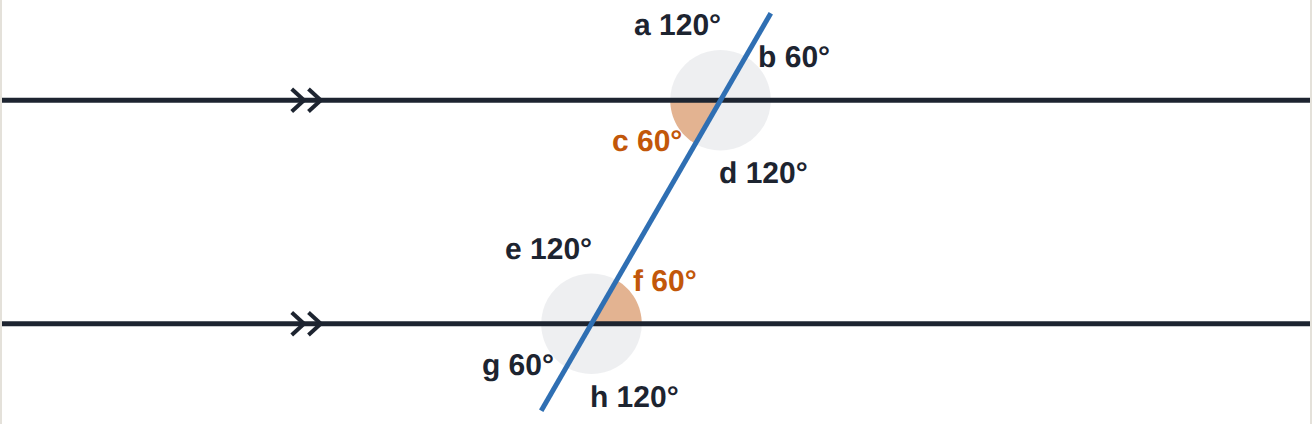
c and f are alternate angles: between the parallel lines, on opposite sides of the crossing line. Both are 60^\circ.
cc and ff are alternate angles: between the parallel lines, on opposite sides of the crossing line. Both are 60∘60^\circ.
The angle pairs at parallel lines · Sound on for the voiceover
Open the lesson →

2. Finding angles with parallel lines

Try firstA transversal crosses two parallel lines. One angle is 75°. Find the angle corresponding to it, and the angle next to that one on a straight line, with a reason for each.

Check your answer

75° (corresponding angles are equal), then 180° − 75° = 105° (angles on a straight line).

When the lines are parallel:

  • corresponding angles are equal;
  • alternate angles are equal;
  • co-interior angles add to $180^\circ$ (they are not equal unless both are $90^\circ$).

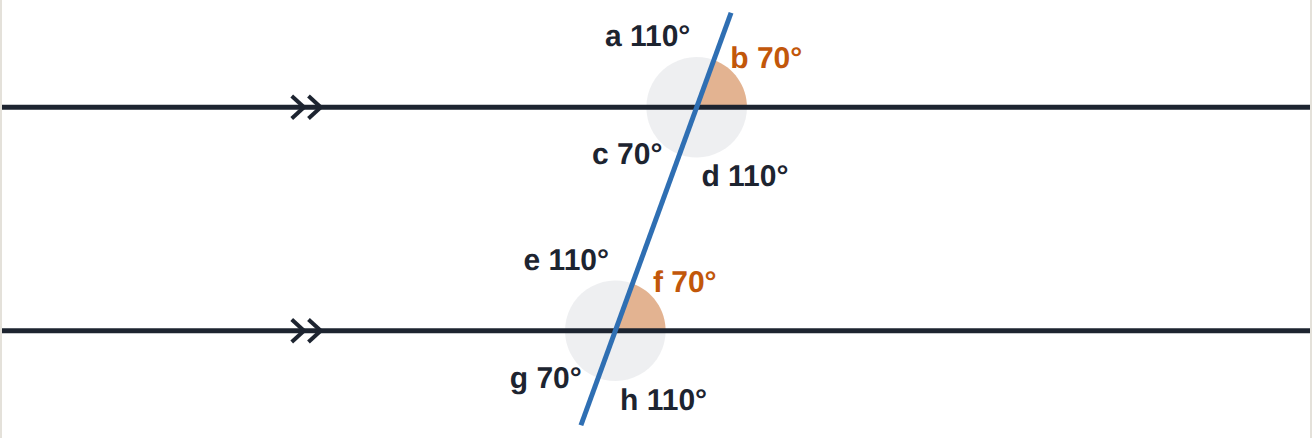
With vertically opposite angles (equal) and angles on a straight line (add to $180^\circ$), one angle gives all eight. Give a reason for each: "$f = 70^\circ$, corresponding to $b$". If the lines are not parallel, these rules do not hold.

b and f are corresponding, so both are 70^\circ. From one angle, every other is 70^\circ or 110^\circ.
bb and ff are corresponding, so both are 70∘70^\circ. From one angle, every other is 70∘70^\circ or 110∘110^\circ.
Equal pairs, and a pair that adds to 180° · Sound on for the voiceover
Open the lesson →

3. Reasoning with angles

Try firstA transversal crosses two parallel lines, making a 120° angle. Find the angle alternate to it and the angle co-interior to it, with reasons.

Check your answer

120° (alternate angles are equal) and 180° − 120° = 60° (co-interior angles add to 180°).

Most angle problems take more than one step. For each step:

  1. Know: an angle you already have.
  2. Choose: a rule that links it to a new angle: corresponding or alternate angles are equal, co-interior angles add to $180^\circ$, vertically opposite angles are equal, angles on a straight line add to $180^\circ$.
  3. Say why: write the rule as the reason.

$b = 70^\circ$: $f = 70^\circ$ (corresponding to $b$), then $h = 110^\circ$ ($f$ and $h$ are on a straight line). If two angles only look related, find one in between that a rule links to both.

b = 70^\circ. Then f = 70^\circ (corresponding to b) and h = 110^\circ (f and h are on a straight line).
b=70∘b = 70^\circ. Then f=70∘f = 70^\circ (corresponding to bb) and h=110∘h = 110^\circ (ff and hh are on a straight line).
One step at a time, each with a reason · Sound on for the voiceover
Open the lesson →

Angle sums

4. Angles in a triangle

Try firstA student says the angles of a very large triangle add to more than 180°. Explain why they are wrong.

Check your answer

Every triangle's angles add to 180°: tear off the corners and they fill a straight line. Size changes the sides, not the angles.

The three angles of any triangle add to $180°$.

When you change a triangle's shape, one angle grows and the others shrink by exactly as much. Making it bigger without changing its shape does not change the angles at all.

Why? Tear off the three corners and put their points together: they fill a straight line, and angles on a straight line add to $180°$.

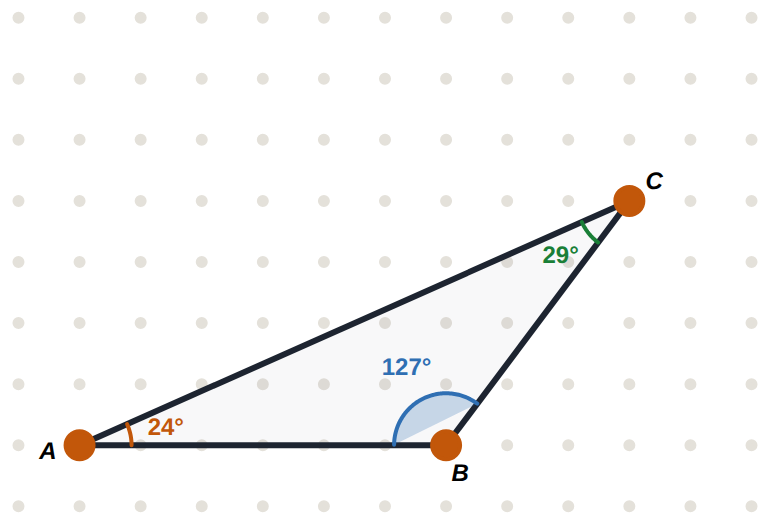
An obtuse triangle: 24° + 127° + 29° = 180°.
An obtuse triangle: 24°+127°+29°=180°24° + 127° + 29° = 180°.
A triangle's angles add to 180° · Sound on for the voiceover
Open the lesson →

5. Angles in a polygon

Try firstFind the angle sum of a heptagon (7 sides), and explain your method.

Check your answer

900°. From one corner it splits into 7 − 2 = 5 triangles, and 5 × 180° = 900°.

To find the angle sum of a polygon, split it into triangles from one corner: draw lines from that corner to every corner that is not next to it.

A shape with $n$ sides splits into $n - 2$ triangles, and their angles exactly fill the polygon's corners. So the angle sum is $(n - 2) \times 180°$.

A quadrilateral: $2 \times 180° = 360°$. A pentagon: $3 \times 180° = 540°$. A hexagon: $4 \times 180° = 720°$.

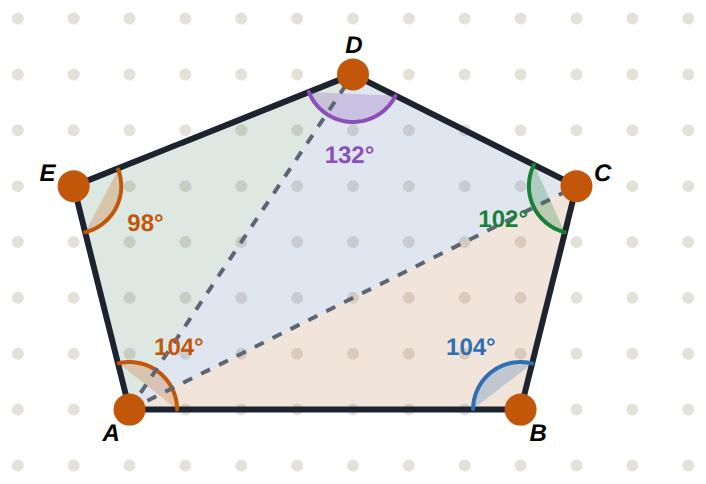
A pentagon splits into 3 triangles from A: 3 \times 180° = 540°.
A pentagon splits into 3 triangles from AA: 3×180°=540°3 \times 180° = 540°.
Split it into triangles · Sound on for the voiceover
Open the lesson →

6. Unknown angles in shapes

Try firstA triangle has angles of 48° and 67°. Find the third angle, and the exterior angle next to it, with reasons.

Check your answer

180° − 48° − 67° = 65° (angles in a triangle). Exterior angle 180° − 65° = 115° (a straight line). Check: 48° + 67° = 115°.

To find an unknown angle in a shape, choose the angle sum for the shape: $180^\circ$ for a triangle, $(n - 2) \times 180^\circ$ for $n$ sides ($360^\circ$ for a quadrilateral, $540^\circ$ for a pentagon). Add the angles you know and subtract from the sum.

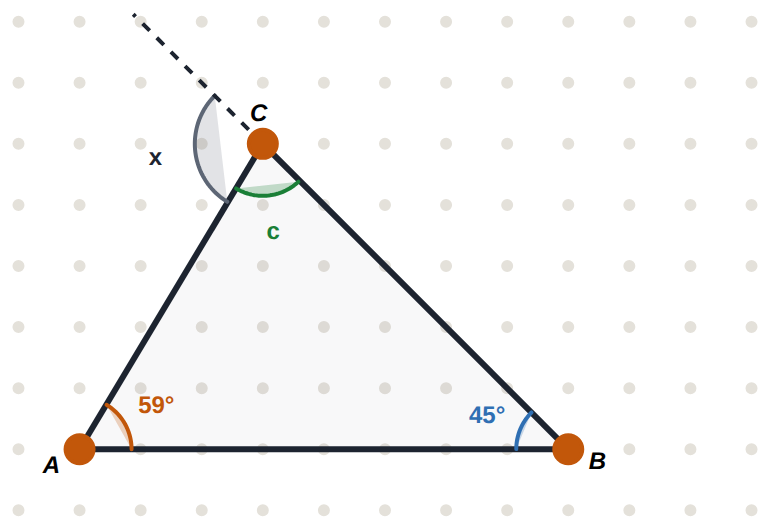
Combine it with other facts, one step at a time, each with a reason. Extend a side of a triangle and the outside angle $x$ makes a straight line with $c$: $x = 180^\circ - c$. Since $a + b = 180^\circ - c$ too, $x = a + b$.

a = 59^\circ, b = 45^\circ. Then c = 76^\circ (angles in a triangle add to 180^\circ) and x = 104^\circ (c and x are on a straight line). And x = a + b.
a=59∘a = 59^\circ, b=45∘b = 45^\circ. Then c=76∘c = 76^\circ (angles in a triangle add to 180∘180^\circ) and x=104∘x = 104^\circ (cc and xx are on a straight line). And x=a+bx = a + b.
From the angle sum to the exterior angle · Sound on for the voiceover
Open the lesson →

Classifying shapes

7. Classifying triangles

Try firstA triangle has angles 30°, 30° and 120°. Name it by its sides and its angles.

Check your answer

Isosceles (two equal angles, so two equal sides) and obtuse (120°).

Name a triangle by its sides: scalene (none equal), isosceles (two equal), equilateral (all three equal). And by its biggest angle: acute (all under 90°), right-angled (one is 90°), obtuse (one over 90°).

Equal sides sit opposite equal angles. So an equilateral triangle has three 60° angles, and can never be right-angled or obtuse.

Two sides are marked with a tick: they are equal, so the triangle is isosceles. Every angle is less than 90°, so it is also acute.
Two names for a triangle · Sound on for the voiceover
Open the lesson →

8. The quadrilateral family

Try firstA shape has two pairs of parallel sides and four equal sides but no right angles. Give all its names.

Check your answer

Rhombus, parallelogram and kite.

A quadrilateral's name comes from its properties: a trapezium has at least one pair of parallel sides; a parallelogram two; a rhombus four equal sides; a rectangle four right angles; a square four equal sides and four right angles; a kite two pairs of equal sides next to each other.

A shape with all of another name's properties belongs to that family too: every square is a rectangle and a rhombus, every rhombus and rectangle is a parallelogram, and every parallelogram is a trapezium.

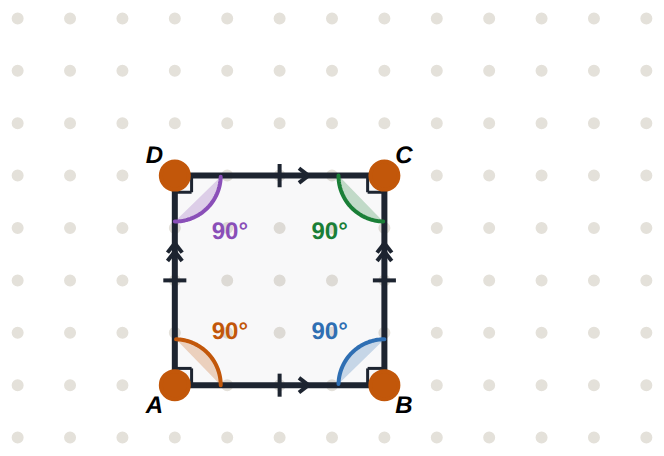
A square: four equal sides (ticks), two pairs of parallel sides (arrows) and four right angles. So it is also a rectangle, a rhombus, a parallelogram, a trapezium and a kite.
Named by properties · Sound on for the voiceover
Open the lesson →

9. Polygons

Try firstA pentagon has angles 100°, 110°, 110°, 100° and 120°. Is it regular? Convex or concave?

Check your answer

Irregular (its angles are not equal), convex (every angle under 180°).

A polygon is named by its number of sides: pentagon 5, hexagon 6, heptagon 7, octagon 8, nonagon 9, decagon 10.

It is regular when all its sides and all its angles are equal (a rhombus has equal sides but is not regular). It is concave when a corner points in (an angle over 180°), and convex when every corner points out.

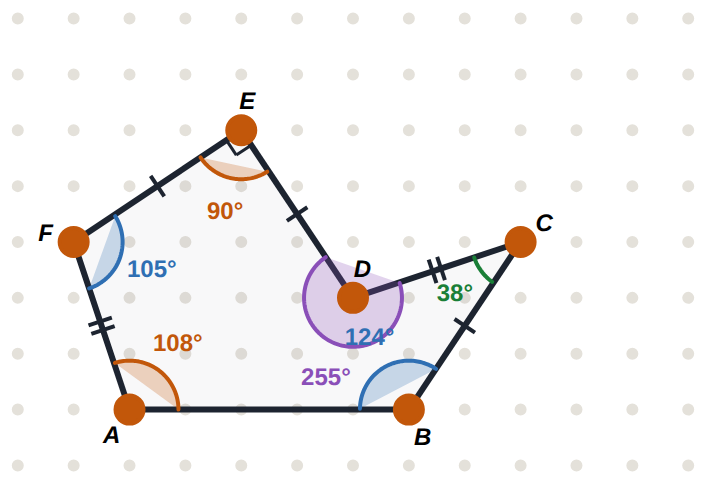
A hexagon with one corner pointing in: concave. Its sides are not all equal, so it is irregular too.
Regular, or not · Sound on for the voiceover
Open the lesson →

Solids

10. Nets

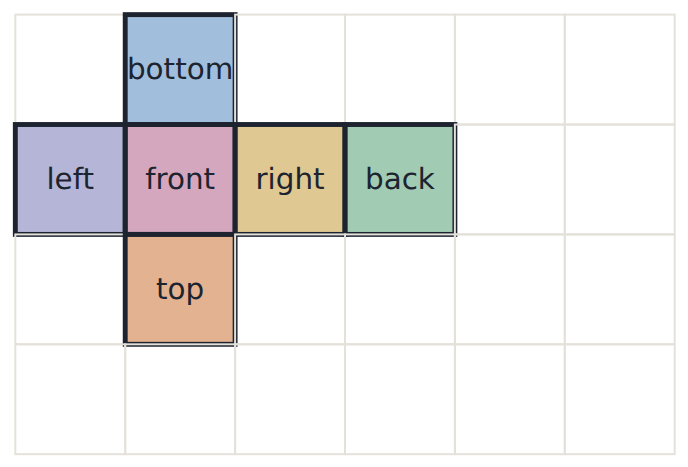
Try firstA net of six squares has four in a row, one above and one below. Does it fold into a cube? How can you tell?

Check your answer

Yes. The row of four wraps round the sides, and the extra two squares are the top and the bottom, so every face is covered once.

A net is a solid unfolded flat. A cube's net is six squares that fold to cover all six faces once; six squares alone is not enough, so test by folding.

A triangular prism's net is two triangles (the ends) and three rectangles (one for each side of the triangle). Its area is the surface area.

A cross of six squares folds into a cube: each square lands on a different face.
From a row to a net · Sound on for the voiceover
Open the lesson →

11. Views of a solid

Try firstA front view shows 3 squares. Does the pile have 3 cubes? Why or why not?

Check your answer

Not necessarily. The front view shows only the tallest pile in each column; there could be more cubes behind.

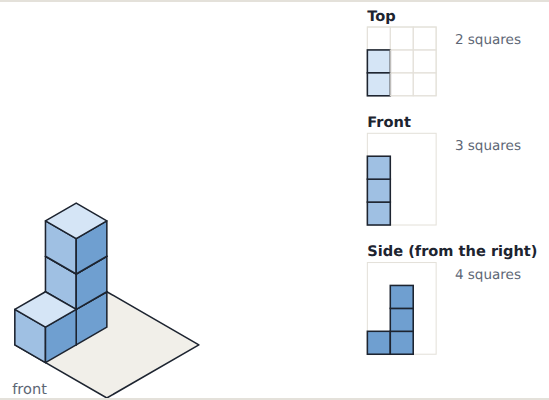
A view is what you see from one side. The top view (plan) looks down; the front and side views (elevations) look across. They show the tallest pile in each column, and hide cubes behind or beneath.

A top view with a number on each pile shows every cube. A net shows every face at its true size, but not what the solid looks like when built.

Three drawings of the same cubes: top, front and side. The tall pile hides the one behind it.
Build, then look · Sound on for the voiceover
Open the lesson →

21. Coordinates in 3D

Try firstA drone is 8 m east, 3 m north and 20 m up from its base, with x east, y north and z up. Write its position. Then it flies 5 m north: where is it now?

Check your answer

(8, 3, 20), then (8, 8, 20).

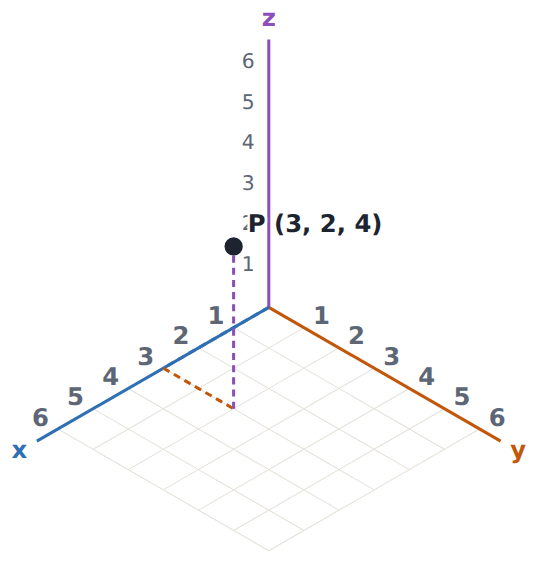
A third axis, z, points up from the x-y plane. A point in space is (x, y, z): along x, along y, then up. The order is always x, y, z; points with z = 0 are on the floor.

Real systems work the same way: east, north and up for a drone; across, back and floor in a building; latitude, longitude and altitude for a plane.

P (3, 2, 4): 3 along x, 2 along y, then 4 up the z-axis.
Three coordinates · Sound on for the voiceover
Open the lesson →

Transformations

12. Translations

Try firstA (2, 5) is translated 4 left and 3 down. Where is A′?

Check your answer

(−2, 2): x is 2 − 4 = −2 and y is 5 − 3 = 2.

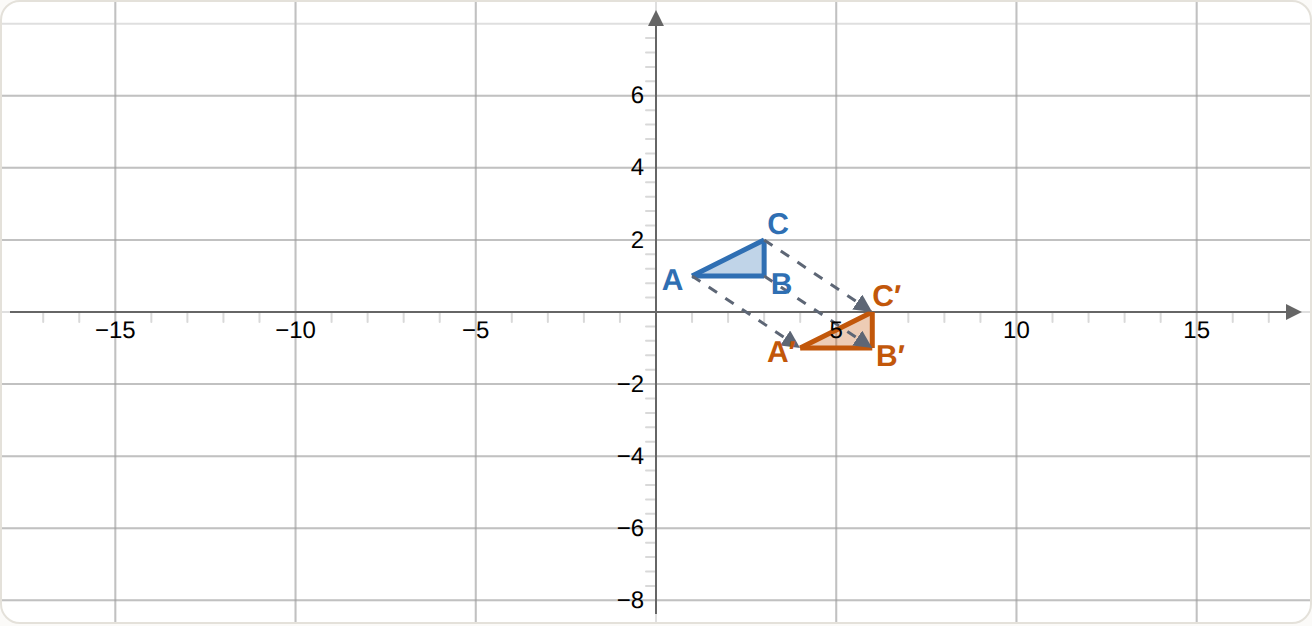
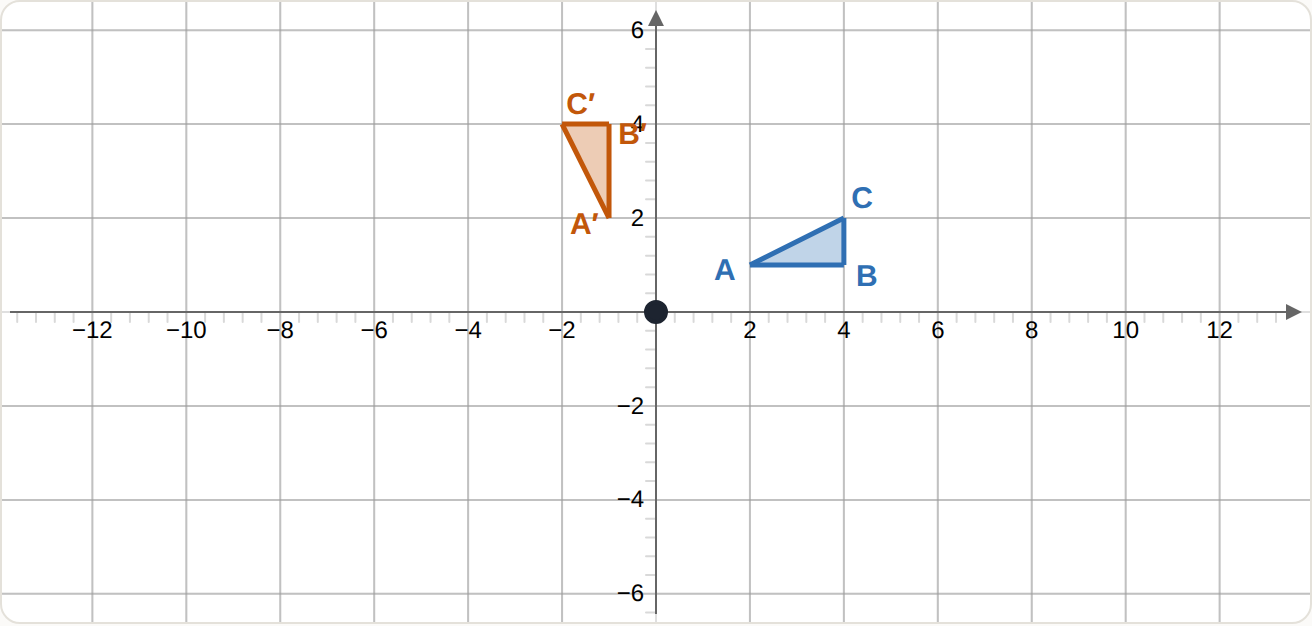
A translation slides every point of a shape the same distance in the same direction. The object becomes the image, and A becomes A′.

Right and up add; left and down take away. A translation of 3 right and 2 down changes $(x, y)$ to $(x + 3, y - 2)$.

The triangle moves 3 right and 2 down: every corner changes by (+3, -2).
The triangle moves 3 right and 2 down: every corner changes by (+3,−2)(+3, -2).
Slide, and read the change · Sound on for the voiceover
Open the lesson →

13. Reflections

Try firstThe point (5, −2) is reflected in the x-axis. Where is the image?

Check your answer

(5, 2): y changes sign.

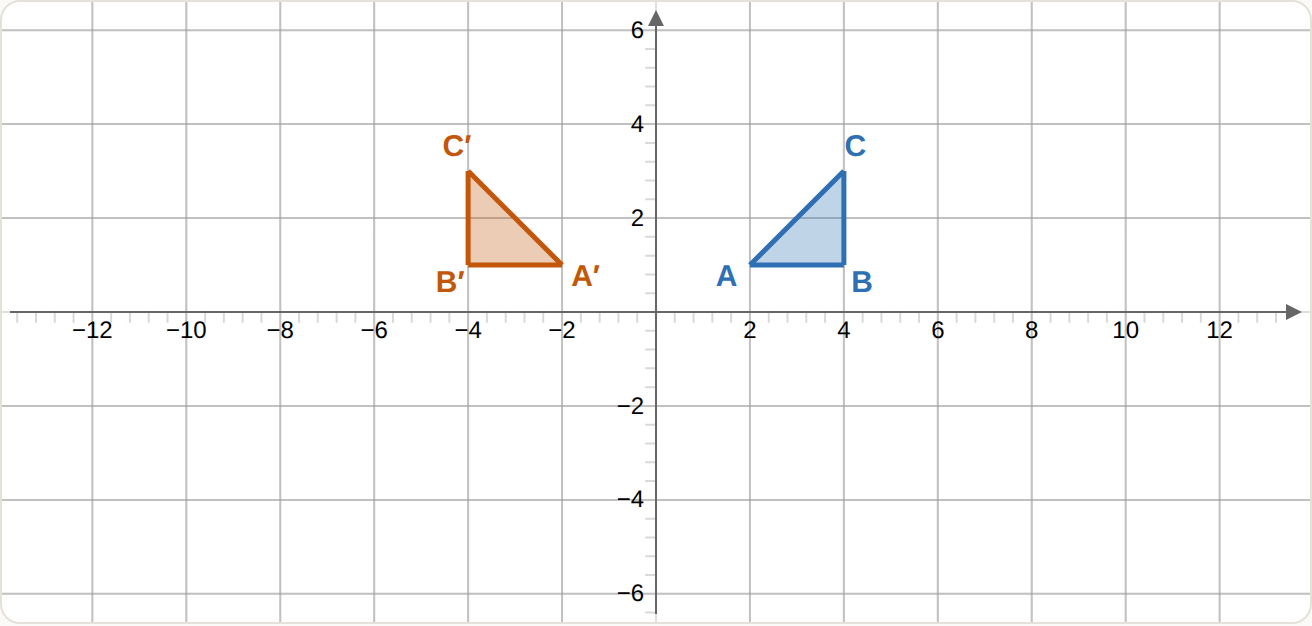
A reflection flips a shape over a mirror line; each point and its image are the same distance from the mirror, on opposite sides.

In the x-axis, $(x, y) \to (x, -y)$. In the y-axis, $(x, y) \to (-x, y)$.

The triangle reflected in the y-axis: (2, 1) becomes (-2, 1). The y-axis is halfway between each point and its image.
The triangle reflected in the y-axis: (2,1)(2, 1) becomes (−2,1)(-2, 1). The y-axis is halfway between each point and its image.
Two mirrors · Sound on for the voiceover
Open the lesson →

14. Rotations

Try firstThe point (2, 3) turns 180° about the origin. Where is the image?

Check your answer

(−2, −3): both signs change.

A rotation turns a shape about a centre by an angle in a direction (clockwise or anticlockwise). The shape keeps its size.

About the origin, anticlockwise: 90° changes $(x, y)$ to $(-y, x)$; 180° changes it to $(-x, -y)$; 270° changes it to $(y, -x)$.

A quarter turn anticlockwise about the origin: (2, 1) becomes (-1, 2).
A quarter turn anticlockwise about the origin: (2,1)(2, 1) becomes (−1,2)(-1, 2).
Turning about the origin · Sound on for the voiceover
Open the lesson →

Congruence and similarity

16. Congruent triangles

Try firstTwo triangles have AB = PQ = 7 cm, BC = QR = 5 cm and angle B = angle Q = 60°. Are they congruent? Which test?

Check your answer

Yes, by SAS: angle B is between AB and BC.

Congruent triangles are the same shape and size. Each test fixes a triangle: SSS, SAS (the angle between the sides), ASA or AAS, and RHS.

SSA (an angle not between the two sides) is not a test: it can give two different triangles. Equal angles alone give the same shape, not always the same size.

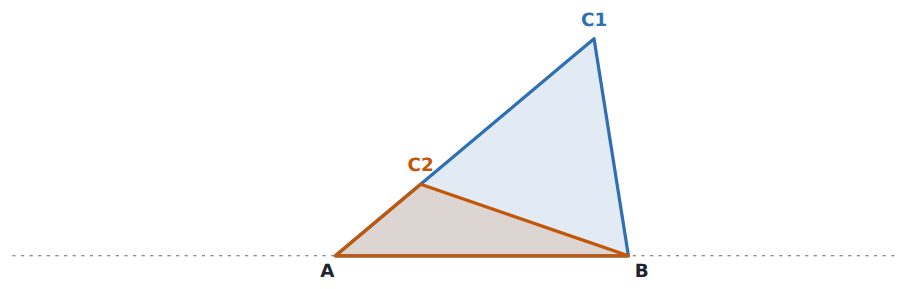
AB = 8, BC = 6 and angle A = 40°: two different triangles fit, so SSA is not a congruence test.
When SSA fails · Sound on for the voiceover
Open the lesson →

17. Similar shapes

Try firstA 2 m by 3 m garden bed is enlarged so the 2 m side becomes 5 m. How long is the 3 m side now?

Check your answer

k = 5 ÷ 2 = 2.5, so 3 × 2.5 = 7.5 m.

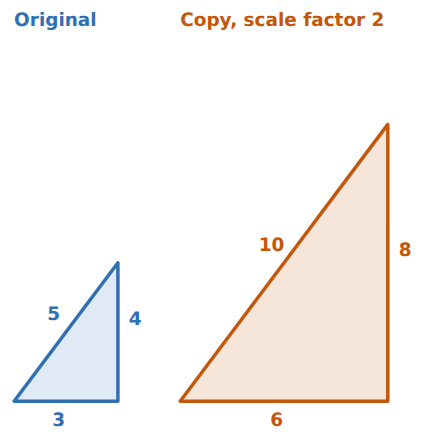
Similar shapes are the same shape, maybe a different size. Every length is multiplied by the same scale factor k = copy ÷ original, and the angles stay the same. Congruent is similar with k = 1.

Triangles are similar by AA, SSS (sides in one ratio) or SAS (two sides in one ratio, the angle between them equal). For other shapes, check both the angles and the ratios of the sides.

A 3, 4, 5 triangle and a copy with scale factor 2: sides 6, 8, 10, the same angles.
A scale factor · Sound on for the voiceover
Open the lesson →

18. Proving quadrilateral properties

Try firstKite ABCD has AB = AD and CB = CD. Prove that angle B = angle D.

Check your answer

Triangles ABC and ADC: AB = AD, CB = CD, AC shared, so they are congruent (SSS). Angle B and angle D match, so they are equal.

A proof gives a reason for every step and works for every shape of the kind; one measured drawing is only an example.

To prove a quadrilateral property: find two triangles (often either side of a diagonal), give the equal parts with reasons, name the congruence test, then use matching parts of congruent triangles. This proves, for example, that a rectangle's diagonals are equal.

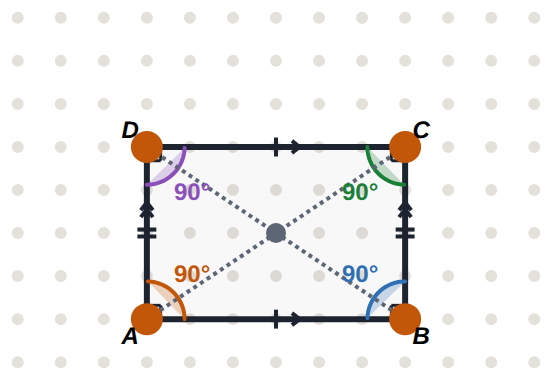
A rectangle and its diagonals AC and BD: equal, and they cut each other in half.
Diagonals of a rectangle · Sound on for the voiceover
Open the lesson →

19. Problems with quadrilaterals

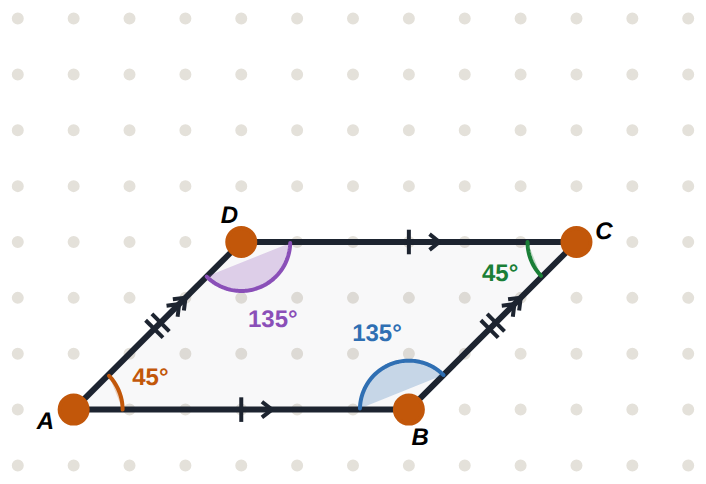
Try firstIn parallelogram ABCD, angle B = 3 × angle A. Find all four angles.

Check your answer

A + 3A = 180, so A = 45°. B = 135°, C = 45°, D = 135°.

Use the properties, with a reason for each step. A parallelogram's opposite angles are equal and its neighbouring (co-interior) angles add to 180°. A kite has one pair of equal opposite angles. A rectangle's diagonals are equal and cut each other in half; a rhombus's cut each other in half at 90°.

Every quadrilateral's angles add to 360°: use it to check.

A parallelogram: opposite angles are equal (45° and 45°, 135° and 135°), and neighbouring angles add to 180°.
Angles in a parallelogram · Sound on for the voiceover
Open the lesson →

Algorithms

15. Algorithms for classifying shapes

Try firstWhy must a classifier ask 'are all three sides equal?' before 'are two sides equal?'

Check your answer

An equilateral triangle has two equal sides too, so the wider question would give it the wrong name.

An algorithm is a precise series of steps and decisions. A classification algorithm asks yes/no questions about attributes and ends in one name for each shape.

Put the most specific question first, make sure every branch ends in a name, and test it on one shape of every class. A flowchart, a decision tree and numbered steps show the same algorithm.

Following an algorithm · Sound on for the voiceover
Open the lesson →

20. Algorithms for congruence

Try firstWhy must an algorithm for congruence not answer 'congruent' when two sides and any angle are equal?

Check your answer

If the angle is not between the sides (SSA), two different triangles can fit, so they might not be congruent.

An algorithm for two triangles asks about their equal parts in order: the congruence tests first (SSS, SAS, ASA or AAS, RHS), then similarity (AA, sides in the same ratio), then not enough to tell.

Test it on one pair of every kind, including SSA (which must not be called congruent). When you fix it, test every pair again.

Following the algorithm · Sound on for the voiceover
Open the lesson →