Data detective reference
Reading, counting, charting, cleaning and testing data in Python, then pandas and Gradio.
Print a cheat sheet (the whole course or one unit, with a picture of what each command draws)
Code structure
for i in range(4):
    pass
Example
for i in range(5):
    forward(15)
    penup()
    forward(10)
    pendown()
Repeat the indented lines this many times.

id: for-loop
while True:
    pass
Example
r = 10
while r < 60:
    circle(r)
    r = r + 15
Repeat the indented lines for as long as the condition is true.

id: while-loop
name = input("What is your name? ")
print("Hello, " + name)
Example
name = input("What is your name? ")
print("Hello, " + name)
Ask a question, store the typed answer, and use it in a reply.

id: ask-and-reply
text = input("How many? ")
if text.isdigit():
    number = int(text)
    pass
else:
    print("Please type a number.")
Example
text = input("How many tickets? ")
if text.isdigit():
    print("That will be $" + str(int(text) * 12) + ".")
else:
    print("Please type a number.")
Check typed text with isdigit before turning it into a number.

id: check-then-convert
total = 0
while total < 10:
    total += int(input("Add: "))
Example
total = 0
while total < 10:
    total += int(input("Add: "))
    print("Total: " + str(total))
print("Done")
Start the total at 0 once, then add to it on every pass.
id: running-total
while True:
    choice = input("1 add, 2 quit: ")
    if choice == "1":
        pass
    elif choice == "2":
        break
    else:
        print("Please choose 1 or 2.")
Example
total = 0
while True:
    choice = input("1 add $5, 2 pay: ")
    if choice == "1":
        total += 5
    elif choice == "2":
        break
    else:
        print("Please choose 1 or 2.")
print("Pay $" + str(total))
A menu that keeps showing until a break runs.
id: menu-loop
if x > 0:
    pass
else:
    pass
Example
for x in [-90, -30, 30, 90]:
    penup()
    goto(x, 0)
    if x > 0:
        dot(30, "red")
    else:
        dot(30, "blue")
hideturtle()
Do one thing or the other, depending on a condition.

id: if-else
for i in range(8):
    if i % 2 == 0:
        pass
    else:
        pass
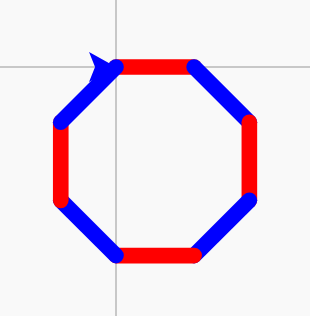
Example
for i in range(8):
    if i % 2 == 0:
        pencolor("red")
    else:
        pencolor("blue")
    pensize(6)
    forward(30)
    right(45)
i % 2 == 0 is true on every second pass.
id: every-other
size = 50
Example
length = 120
forward(length)
left(90)
forward(length / 2)
Give a value a name, so you can reuse and change it.

id: variable
sides = 5
for i in range(sides):
    forward(60)
    right(360 / sides)
Example
sides = 6
for i in range(sides):
    forward(60)
    right(360 / sides)
Name the number of sides once; the turn is worked out from it.

id: named-turn
for i in range(20):
    forward(i * 5)
    right(90)
Example
for i in range(30):
    forward(i * 5)
    right(90)
Use the counter i to make each pass different.

id: counter-step
size = 5
for i in range(20):
    forward(size)
    right(90)
    size = size + 5
Example
size = 5
for i in range(30):
    forward(size)
    right(90)
    size = size + 5
Change a value every pass: read the old one, store a new one.

id: grow-value
colours = ["red", "blue", "green"]
Keep many values in order under one name. The first item is place 0.
id: list
for c in colours:
    pass
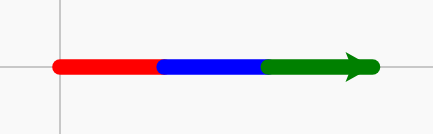
Example
pensize(6)
for c in ["red", "blue", "green"]:
    pencolor(c)
    forward(40)
Work through a list, one item at a time.
id: for-each-item
def shape():
    pass

shape()
Example
def zigzag():
    left(45)
    forward(30)
    right(90)
    forward(30)
    left(45)

zigzag()
zigzag()
zigzag()
Name a group of steps, then run it by calling its name.

id: def-function
print("Hello")
Show text or a value in the output box.
id: print
import random

n = random.randint(1, 10)
Pick a random whole number between two values.
id: random-number
Text and collections
command = command.strip().lower()
strip() removes spaces at the ends; lower() and upper() change the capitals. Each gives back new text.
id: strip-and-lower
words = command.split()
Cut text into a list of words at the spaces: "go north".split() is ["go", "north"].
id: split
if item in bag:
    pass
True if the item is in the list (or the key is in the dictionary, or the letters are in the text).
id: in
", ".join(bag)
Join a list of texts into one, with the text in quotes between each: "lamp, key".
id: join
bag.remove("lamp")
Take an item out of a list. It stops with a ValueError if the item is not there, so check with in first.
id: remove-from-a-list
items.sort()
Put a list in order (A to Z, or smallest first). It changes the list itself.
id: sort
try:
    n = int(text)
except ValueError:
    print("That is not a number.")
Run lines that might fail. If the named error happens, the except lines run instead of the program stopping.
id: try-and-except
Data
import csv

with open("music.csv") as f:
    rows = list(csv.DictReader(f))
Each row of the file becomes a dictionary, keyed by the column names in the first line. Every value is text.
id: read-a-csv
counts = {}
for row in rows:
    key = row["genre"]
    if key in counts:
        counts[key] = counts[key] + 1
    else:
        counts[key] = 1
One count for each different value: add 1 if the key is there already, or start it at 1.
id: count-with-a-dictionary
print(label.ljust(12) + "#" * n)
"#" * 5 is #####. ljust pads the label to the same width, so the bars line up.
id: a-text-bar
assert clean_hours("5") == 5
A test case: nothing happens if it is true; the program stops with AssertionError if it is not.
id: test-with-assert
import pandas as pd

songs = pd.read_csv("music.csv")
Reads the whole file into a table (a DataFrame). Numbers stay numbers.
id: read-a-csv-with-pandas
rows = songs[songs["genre"] == genre]
Keeps the rows where the test is true, as a smaller table.
id: filter-a-table
import gradio as gr

def answer(choice):
    return "You chose " + choice

gr.Interface(fn=answer, inputs=gr.Dropdown(["pop", "rock"]), outputs="text").launch()
Gradio calls your function with what was chosen, and shows what it returns.
id: an-app-with-gradio
{"q": "What is 7 x 8?", "choices": ["54", "56", "64"], "answer": "56"}

inputs.append(gr.Radio(q["choices"], label=q["q"]))
A question as a dictionary, and a Radio input made from it: the student picks one of the choices, and the function gets that text.
id: a-quiz-question
import requests

try:
    reply = requests.get("https://api.open-meteo.com/v1/forecast", params={"latitude": -35.28, "longitude": 149.13, "daily": "temperature_2m_max"}, timeout=10).json()
except requests.RequestException:
    print("No connection")
Asks an API at that address (params become the ?query string) and turns the JSON reply into dictionaries and lists. Plan for no connection.
id: ask-an-api