terminating and recurring
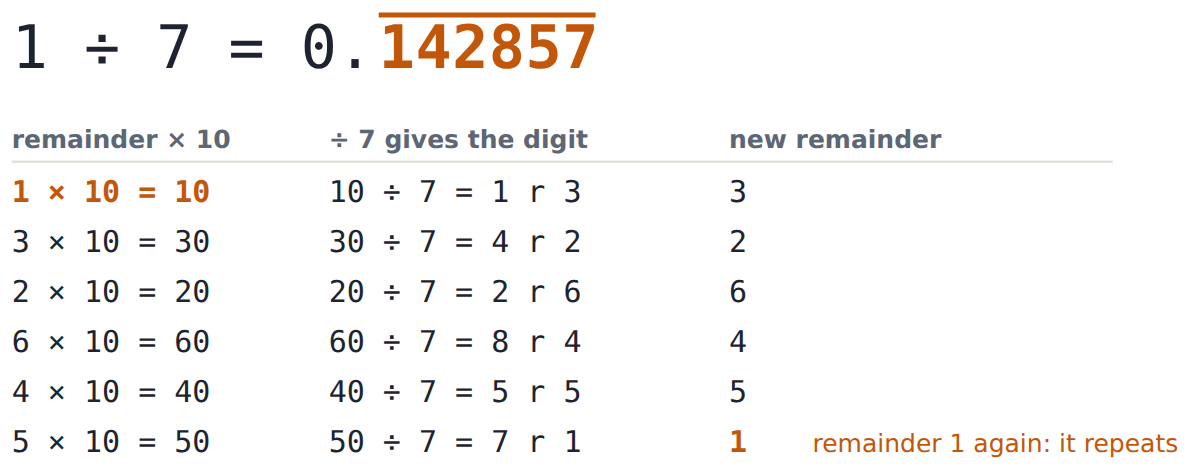
In long division a remainder of 0 means the decimal stops; a remainder that comes back means the digits repeat. A bar (or dots) marks the repeating block.
Irrational numbers and index laws · The words and methods from the lessons, with an example of each.
In long division a remainder of 0 means the decimal stops; a remainder that comes back means the digits repeat. A bar (or dots) marks the repeating block.
Simplify first, then break the denominator into primes. Any prime other than 2 or 5 makes it recur, because 10 = 2 × 5.
Rational numbers are fractions: their decimals stop or repeat. Irrational numbers never stop and never repeat. √16 = 4 is rational.

Find the perfect squares either side, then square decimals to get closer. A rounded value is an approximation.
Write the powers out as factors to see why. Only powers of the same base combine.
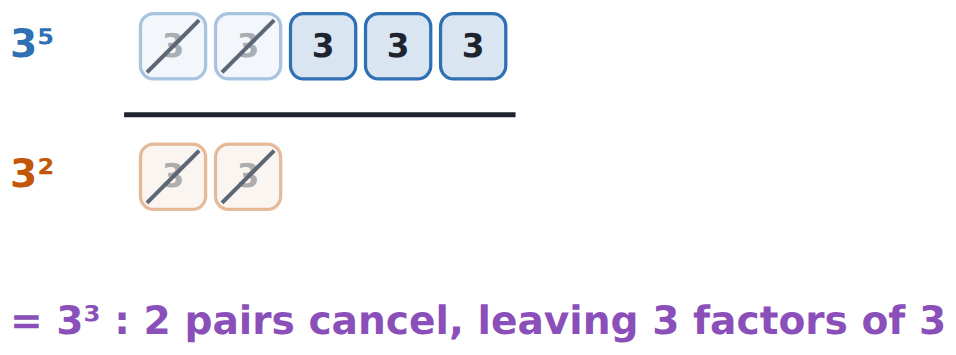
aⁿ ÷ aⁿ = 1, and the quotient law calls it a⁰.