Prove it with a challenge
Students build a challenge-and-response lock so that a heard answer cannot be used again, then add a lockout after three wrong answers.
Classroom resources
Load these into Waypoints Prepare: choose Load URL and paste the copied address, or download the file and import it. In Prepare, the worksheet's Teacher edition shows the answers; the student copy hides them.
Students will be able to
- I can describe the four steps of a challenge and response.
- I can explain why an answer heard once does not open the lock again.
- I can say what never crosses the air.
Timing
Predict and Run 10 min · Investigate 10 min · Modify 8 min · Make 18 min
Before class
The idea: to prove you know a secret without saying it, the other side sets a random question, the challenge, and you answer it using the secret. A fresh challenge each time means an old answer fits only the old challenge.
Everyday picture: a bank clerk who asks for a random character of your password each time. Where it breaks: if the same question comes up, the answer works again; the challenge must be random and not repeat.
Honest limits: the answer function here, (n × key + 3) mod 100, is a toy: someone who collects enough challenges and answers can work out the key, and with only 90 possible challenges they repeat soon. Real systems use a hash function (a one-way mix) and huge challenges. Tell students the toy is for learning the shape of the idea.
Same program on both micro:bits: the simulator runs two copies. The one where A is pressed acts as the key; the other acts as the lock.
Running the lesson
- Predict: ask for the working before the options.
- Investigate: ask what a listener has after hearing one full exchange (a challenge and its answer), and whether it helps with the next one.
The hard part (on purpose)
Why a fixed password fails once heard, and a fresh challenge doesn't. Ask what a listener could reuse, and whether the answer ever repeats.
When students get stuck
| What you will see | A question to ask | The fix |
|---|---|---|
| The lock always shows a cross. | Do both micro:bits have the same secretKey? Is the answer function the same? | Use the same secretKey and answer function on both. |
| The tick appears on the wrong micro:bit. | Which micro:bit checks the answer? | The micro:bit that picked the challenge also checks the answer; the knocker only answers. |
Answers to the checks
- Predict: The key micro:bit knocks. The lock picks the challenge 50. The answer is (n × 7 + 3) remainder 100. What answer goes through the air?
53. 50 × 7 + 3 = 353, and the remainder after dividing by 100 is 53. - Working out an answer: The lock picks the challenge 20. What answer opens the lock? (n × 7 + 3, remainder after dividing by 100.)
43
20 × 7 + 3 = 143, and the remainder after dividing by 100 is 43. - An answer heard before: Yesterday the lock's challenge was 50 and the answer 53. Today the lock picks a new challenge. Why is 53 unlikely to open it today?
The new challenge is almost certainly different, so its answer is different
The answer depends on the challenge. A new challenge gives a new answer, so an old answer fits only the old challenge. - What crosses the air: For each item, does it cross the air in the challenge-and-response?
The knock → Crosses the air; The challenge → Crosses the air; The answer → Crosses the air; The secret key → Never crosses the air
Solutions
One possible solution for each task. Other correct programs are fine.
Modify
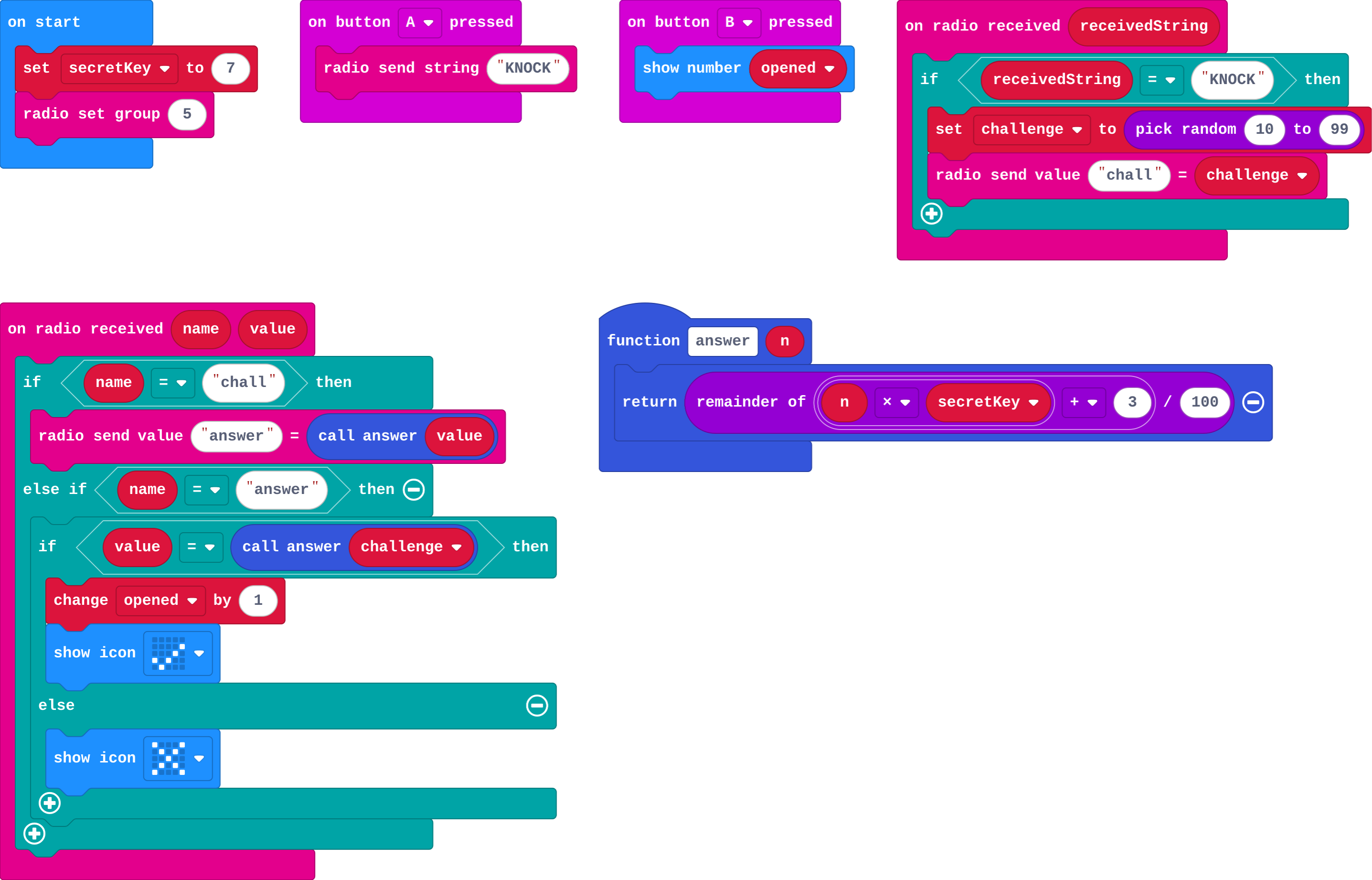
Show as code
let secretKey = 7
let challenge = 0
let opened = 0
function answer(n: number): number {
    return (n * secretKey + 3) % 100
}
radio.setGroup(5)
input.onButtonPressed(Button.A, function () {
    radio.sendString("KNOCK")
})
input.onButtonPressed(Button.B, function () {
    basic.showNumber(opened)
})
radio.onReceivedString(function (receivedString) {
    if (receivedString == "KNOCK") {
        challenge = randint(10, 99)
        radio.sendValue("chall", challenge)
    }
})
radio.onReceivedValue(function (name, value) {
    if (name == "chall") {
        radio.sendValue("answer", answer(value))
    } else if (name == "answer") {
        if (value == answer(challenge)) {
            opened += 1
            basic.showIcon(IconNames.Yes)
        } else {
            basic.showIcon(IconNames.No)
        }
    }
})
Make
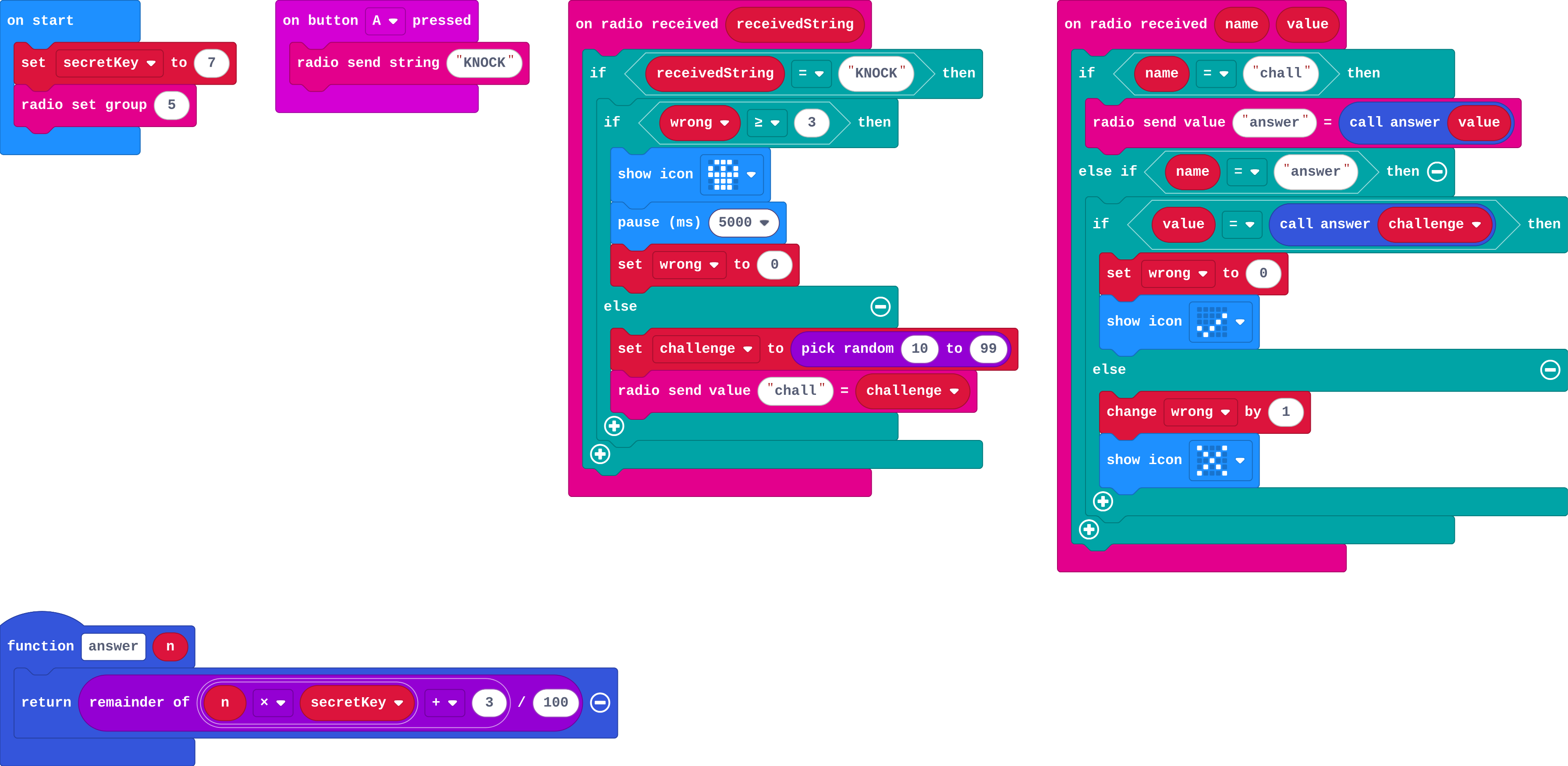
Show as code
let secretKey = 7
let challenge = 0
let wrong = 0
function answer(n: number): number {
    return (n * secretKey + 3) % 100
}
radio.setGroup(5)
input.onButtonPressed(Button.A, function () {
    radio.sendString("KNOCK")
})
radio.onReceivedString(function (receivedString) {
    if (receivedString == "KNOCK") {
        if (wrong >= 3) {
            basic.showIcon(IconNames.Skull)
            basic.pause(5000)
            wrong = 0
        } else {
            challenge = randint(10, 99)
            radio.sendValue("chall", challenge)
        }
    }
})
radio.onReceivedValue(function (name, value) {
    if (name == "chall") {
        radio.sendValue("answer", answer(value))
    } else if (name == "answer") {
        if (value == answer(challenge)) {
            wrong = 0
            basic.showIcon(IconNames.Yes)
        } else {
            wrong += 1
            basic.showIcon(IconNames.No)
        }
    }
})
Stretch and support
Stretch: Make the challenge 3 digits and store it as a number. Why does a longer challenge repeat less often?
Support: Give the lockout in outline: students fill in the conditions.
Exit ticket
Why does a challenge and response protect a lock better than a fixed password?
The answer depends on a fresh challenge, so an answer that was heard before no longer fits.
What each step is for
- Investigate: A fixed answer works forever once it has been heard. An answer that depends on a fresh challenge works once. The key proves itself without ever being sent.
- Modify: The lock can keep a record of what happened, such as how many times it opened.
Where it leads
Next: capture-the-flag puzzles, then defend a whole system.