Tournament
An optional, harder extension of the Radio duel. Students keep a two-place scoreboard list, move a round into a function so rounds carry on, and end the tournament at three wins.
Classroom resources
Load these into Waypoints Prepare: choose Load URL and paste the copied address, or download the file and import it. In Prepare, the worksheet's Teacher edition shows the answers; the student copy hides them.
Students will be able to
- I can keep a scoreboard in a list and update the right place.
- I can move a sequence into a function and call it from two places.
- I can end a game with a target, a message and a reset.
Timing
Predict, Run, Investigate 10 min · Milestone 1 10 min · Milestone 2 15 min · Milestone 3 20 min · Class tournament 5 min
Before class
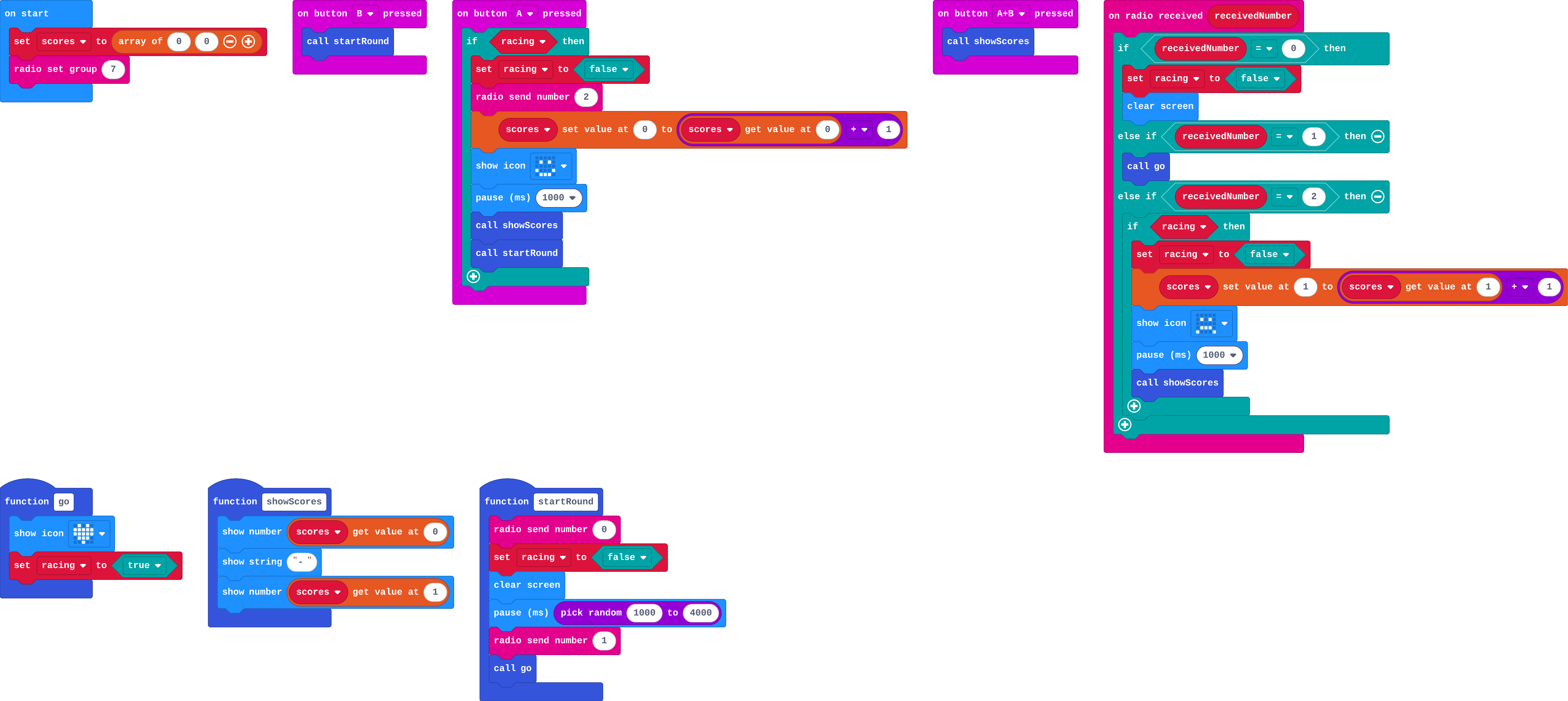
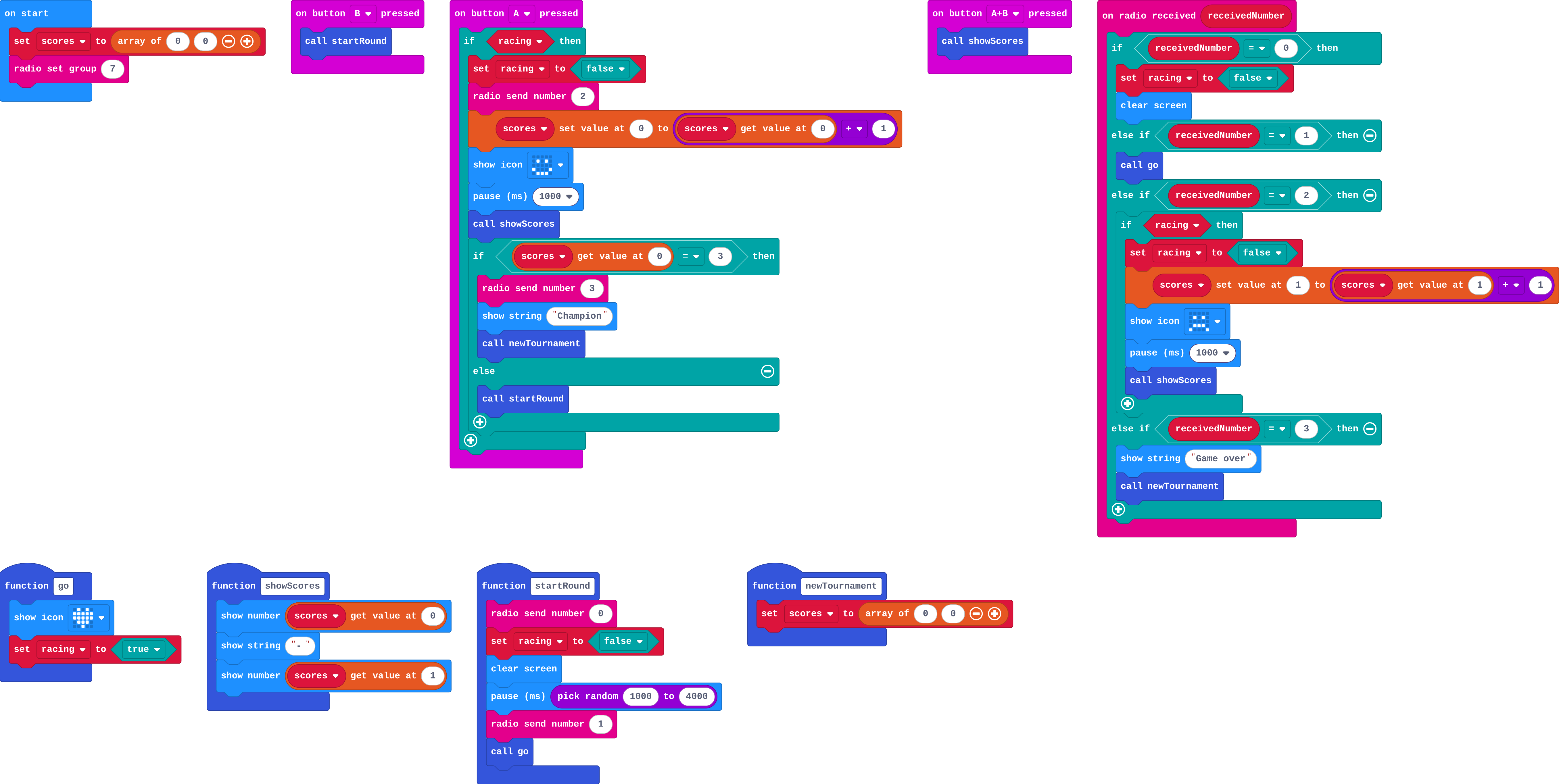
This lesson is optional: it is for students who finished the Radio duel and want a harder challenge. It needs nothing new. The scoreboard is a list of two numbers: place 0 is this micro:bit's player, place 1 is the other player. Because both micro:bits run the same program, each one sees the match from its own side (2 - 1 on one is 1 - 2 on the other). Adding a point uses set value at 0 of scores to (get value at 0 of scores + 1). Milestone 2 moves the round into a function startRound, so the winner's micro:bit can start the next round by itself. Milestone 3 adds message 3 (champion) and a reset.
Running the lesson
- Predict: 2 - 1. Ask which place is 'you'.
- Investigate: the 'two sides' question is the key idea: same program, different point of view.
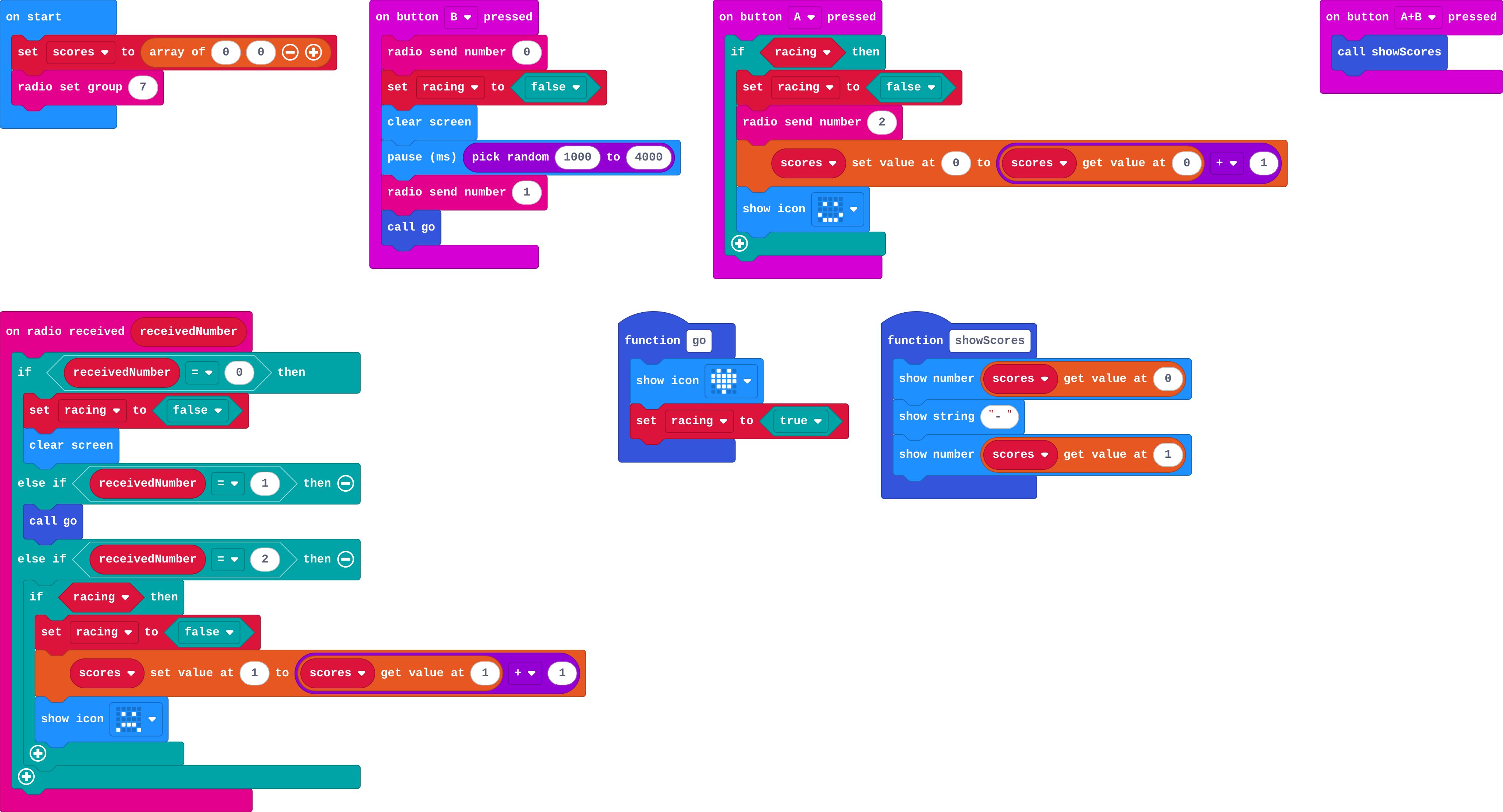
- Milestone 1: two set value blocks, one in A (win) and one when 2 arrives (loss).
- Milestone 2: moving blocks into a function, then calling it twice, is the same move as Milestone 1 of the duel.
- Milestone 3: goals only. Ask pairs to agree what message 3 means before building.
- Class tournament: real micro:bits make this a great end-of-unit event.
The hard part (on purpose)
Each micro:bit keeps itself at place 0, so the two scoreboards are mirrored. Ask which place a win and a loss each add to.
When students get stuck
| What you will see | A question to ask | The fix |
|---|---|---|
| Both scoreboards count the same player's wins. | Which place does a loss add to? | A win adds at place 0; a loss (2 arrives) adds at place 1. |
| Rounds stop after the first one. | Where is startRound called after a win? | Call startRound at the end of the winning branch in A. |
| The scores do not reset after a champion. | Do both sides reset? | Set scores to [0, 0] on the champion's side and when 3 arrives. |
Answers to the checks
- Predict: scores is [2, 1]. You press A+B. What does the micro:bit show?
2, then -, then 1. showScores shows place 0 (your score), a dash, then place 1 (the other player's). - The scoreboard: Match each block with what it does to the scoreboard.
get value at 0 from scores → B. your wins; get value at 1 from scores → A. the other player's wins; set value at 0 of scores to (scores[0] + 1) → C. adds one to your wins - Two sides of one match: You lead 2 to 1. What does your partner's scoreboard show?
1 - 2
Your partner's micro:bit runs the same program, but its place 0 is your partner. From their side it is 1 - 2.
Solutions
One possible solution for each task. Other correct programs are fine.
Milestone 1: keep score
Show as code
let scores = [0, 0]
let racing = false
radio.setGroup(7)
function go () {
    basic.showIcon(IconNames.Heart)
    racing = true
}
function showScores () {
    basic.showNumber(scores[0])
    basic.showString("-")
    basic.showNumber(scores[1])
}
input.onButtonPressed(Button.B, function () {
    radio.sendNumber(0)
    racing = false
    basic.clearScreen()
    basic.pause(randint(1000, 4000))
    radio.sendNumber(1)
    go()
})
input.onButtonPressed(Button.A, function () {
    if (racing) {
        racing = false
        radio.sendNumber(2)
        scores[0] = scores[0] + 1
        basic.showIcon(IconNames.Happy)
    }
})
input.onButtonPressed(Button.AB, function () {
    showScores()
})
radio.onReceivedNumber(function (receivedNumber) {
    if (receivedNumber == 0) {
        racing = false
        basic.clearScreen()
    } else if (receivedNumber == 1) {
        go()
    } else if (receivedNumber == 2) {
        if (racing) {
            racing = false
            scores[1] = scores[1] + 1
            basic.showIcon(IconNames.Sad)
        }
    }
})
Milestone 2: the next round
Show as code
let scores = [0, 0]
let racing = false
radio.setGroup(7)
function go () {
    basic.showIcon(IconNames.Heart)
    racing = true
}
function showScores () {
    basic.showNumber(scores[0])
    basic.showString("-")
    basic.showNumber(scores[1])
}
function startRound () {
    radio.sendNumber(0)
    racing = false
    basic.clearScreen()
    basic.pause(randint(1000, 4000))
    radio.sendNumber(1)
    go()
}
input.onButtonPressed(Button.B, function () {
    startRound()
})
input.onButtonPressed(Button.A, function () {
    if (racing) {
        racing = false
        radio.sendNumber(2)
        scores[0] = scores[0] + 1
        basic.showIcon(IconNames.Happy)
        basic.pause(1000)
        showScores()
        startRound()
    }
})
input.onButtonPressed(Button.AB, function () {
    showScores()
})
radio.onReceivedNumber(function (receivedNumber) {
    if (receivedNumber == 0) {
        racing = false
        basic.clearScreen()
    } else if (receivedNumber == 1) {
        go()
    } else if (receivedNumber == 2) {
        if (racing) {
            racing = false
            scores[1] = scores[1] + 1
            basic.showIcon(IconNames.Sad)
            basic.pause(1000)
            showScores()
        }
    }
})
Milestone 3: champion
Show as code
let scores = [0, 0]
let racing = false
radio.setGroup(7)
function go () {
    basic.showIcon(IconNames.Heart)
    racing = true
}
function showScores () {
    basic.showNumber(scores[0])
    basic.showString("-")
    basic.showNumber(scores[1])
}
function startRound () {
    radio.sendNumber(0)
    racing = false
    basic.clearScreen()
    basic.pause(randint(1000, 4000))
    radio.sendNumber(1)
    go()
}
function newTournament () {
    scores = [0, 0]
}
input.onButtonPressed(Button.B, function () {
    startRound()
})
input.onButtonPressed(Button.A, function () {
    if (racing) {
        racing = false
        radio.sendNumber(2)
        scores[0] = scores[0] + 1
        basic.showIcon(IconNames.Happy)
        basic.pause(1000)
        showScores()
        if (scores[0] == 3) {
            radio.sendNumber(3)
            basic.showString("Champion")
            newTournament()
        } else {
            startRound()
        }
    }
})
input.onButtonPressed(Button.AB, function () {
    showScores()
})
radio.onReceivedNumber(function (receivedNumber) {
    if (receivedNumber == 0) {
        racing = false
        basic.clearScreen()
    } else if (receivedNumber == 1) {
        go()
    } else if (receivedNumber == 2) {
        if (racing) {
            racing = false
            scores[1] = scores[1] + 1
            basic.showIcon(IconNames.Sad)
            basic.pause(1000)
            showScores()
        }
    } else if (receivedNumber == 3) {
        basic.showString("Game over")
        newTournament()
    }
})
Run a class tournament
Open task: any program that does what the step asks.
Stretch and support
Stretch: Keep a list of round times as well, and show the fastest reaction of the tournament on the champion's micro:bit.
Support: Students who find this heavy can stop after Milestone 1: a working scoreboard is a good result.
Exit ticket
You win a round. Why does your scoreboard add at place 0 while your partner's adds at place 1?
Both run the same program, and each keeps its own player at place 0. Your win is a loss on your partner's side.
What each step is for
- Investigate: Both micro:bits run the same program, so each keeps its own player at place 0: the two scoreboards show the same match from opposite sides.
- Milestone 1: keep score: Each event updates the right place in the list: a win adds to place 0, a loss to place 1.
- Milestone 2: the next round: Moving a sequence into a function lets a second event reuse it, so the game can carry on without a button press.
- Milestone 3: champion: Ending a tournament joins every idea: a list item compared with a target, a new message in the code, and a function that resets the state.
Where it leads
This ends micro:bit Foundations. Robotics challenges comes next: each idea in the simulator, then on a real MOVE Motor. Class ideas: a class knockout bracket on the board; a rematch where students change one rule and explain why it is fairer.