Fake-outs and levels
An optional, harder extension of the Reaction timer. Students add decoy signals, levels with target times kept in a list, and lives, managing several pieces of state at once.
Classroom resources
Load these into Waypoints Prepare: choose Load URL and paste the copied address, or download the file and import it. In Prepare, the worksheet's Teacher edition shows the answers; the student copy hides them.
Students will be able to
- I can use two true/false variables to tell different moments apart.
- I can use a variable as the place in a list, so a rule gets harder.
- I can manage lives, levels and an end to the game.
Timing
Predict, Run, Investigate 10 min · Milestone 1 10 min · Milestone 2 15 min · Milestone 3 20 min · Make it yours 5 min
Before class
This lesson is optional: it is for students who finished the Reaction timer and Radio duel and want a harder challenge. It needs nothing new, only more of the same ideas at once. A decoy (a cross instead of the heart) appears about one round in three (pick random 0 to 2 = 0); a second true/false variable, decoy, remembers that moment. Levels use a list of target times, targets: the current level is the place in the list, so reaction < targets[level] gets harder as the level rises. When the level reaches the length of the list, the player has won. Lives count mistakes.
Running the lesson
- Predict: about one in three. Ask why 0 to 2 gives a third.
- Investigate: the list holds the rules of the game. The last question previews Milestone 3's win condition.
- Milestone 1: else if decoy. Read A aloud: 'if waiting, time it; else if a cross is showing, caught out; else too early'.
- Milestone 2: targets[level] is the key idea: a variable chooses the place in the list.
- Milestone 3: goals only. Encourage students to plan on paper first: when do lives go down, when does the game end?
- Make it yours: let students swap games and play each other's.
The hard part (on purpose)
Which check comes first in the A button, and a list of targets by level. Ask them to say the order of the questions before testing.
When students get stuck
| What you will see | A question to ask | The fix |
|---|---|---|
| Pressing on a cross shows the too-early cross, not the skull. | Which is checked first in A: waiting, decoy, or else? | Order: if waiting … else if decoy … else. |
| The level goes up even when slow. | Which way round is the comparison? | Use reaction < targets[level]: faster than the target. |
| Something goes wrong after the last level. | Which places exist in targets? | When level equals the length of targets, the player has won: show Champion and start again. |
Answers to the checks
- Predict: Over many rounds, how often does a cross appear instead of the heart?
About 1 round in 3. pick random 0 to 2 gives 0, 1 or 2 equally often, and only 0 shows the cross. - Targets per level: targets is 800, 600, 450, 350, 300. What must you beat at each level?
800, 450, 300
The level number is the place in the list, counted from 0. - After the last level: There are 5 targets. You beat level 4. What must the game do next?
Stop: there is no place 5, so you have won (level equals the length of the list)
Places run from 0 to 4. When level reaches 5, the length of the list, there are no targets left: the player has won.
Solutions
One possible solution for each task. Other correct programs are fine.
Milestone 1: fake-outs
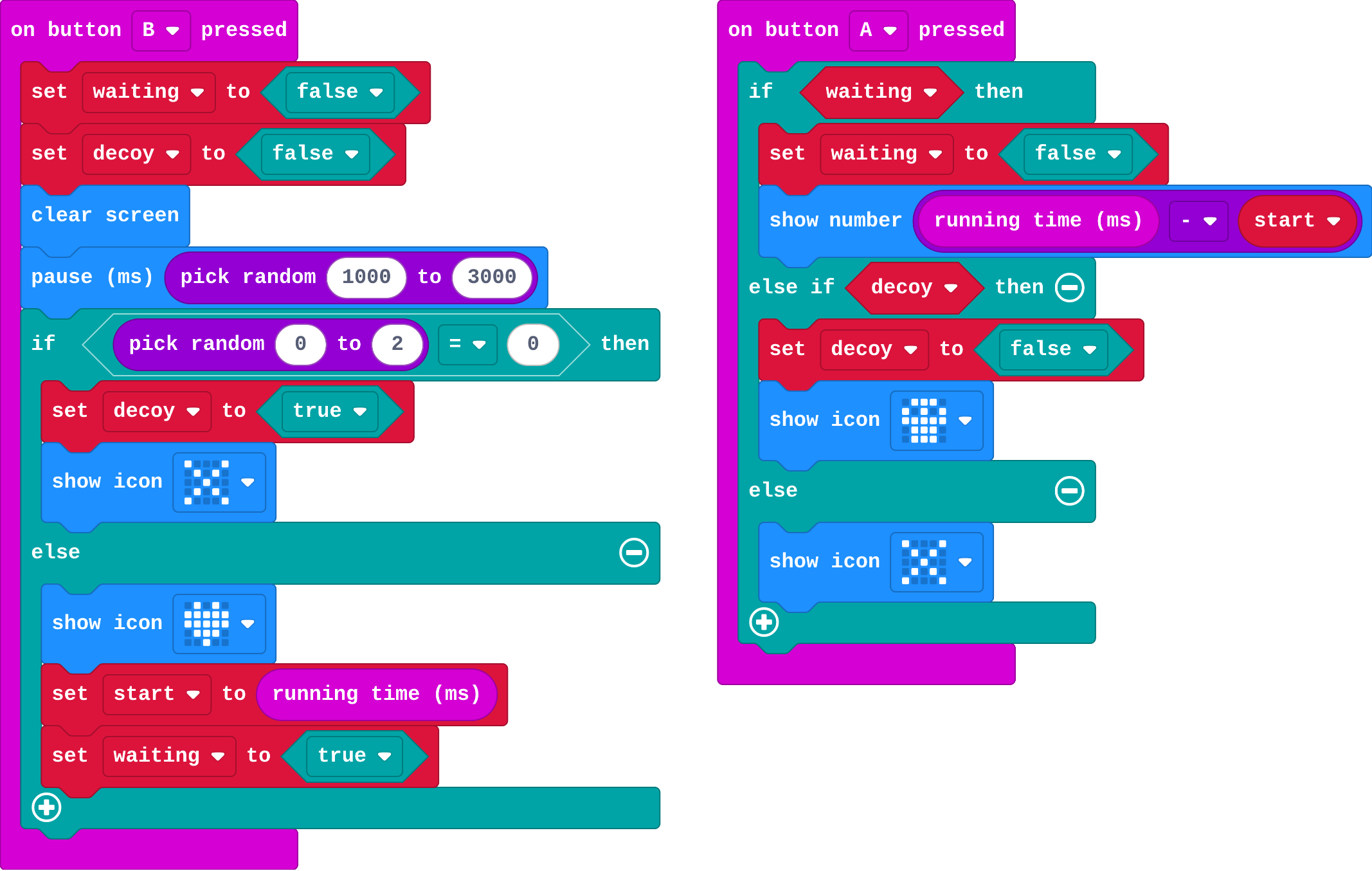
Show as code
let start = 0
let waiting = false
let decoy = false
input.onButtonPressed(Button.B, function () {
    waiting = false
    decoy = false
    basic.clearScreen()
    basic.pause(randint(1000, 3000))
    if (randint(0, 2) == 0) {
        decoy = true
        basic.showIcon(IconNames.No)
    } else {
        basic.showIcon(IconNames.Heart)
        start = input.runningTime()
        waiting = true
    }
})
input.onButtonPressed(Button.A, function () {
    if (waiting) {
        waiting = false
        basic.showNumber(input.runningTime() - start)
    } else if (decoy) {
        decoy = false
        basic.showIcon(IconNames.Skull)
    } else {
        basic.showIcon(IconNames.No)
    }
})
Milestone 2: levels
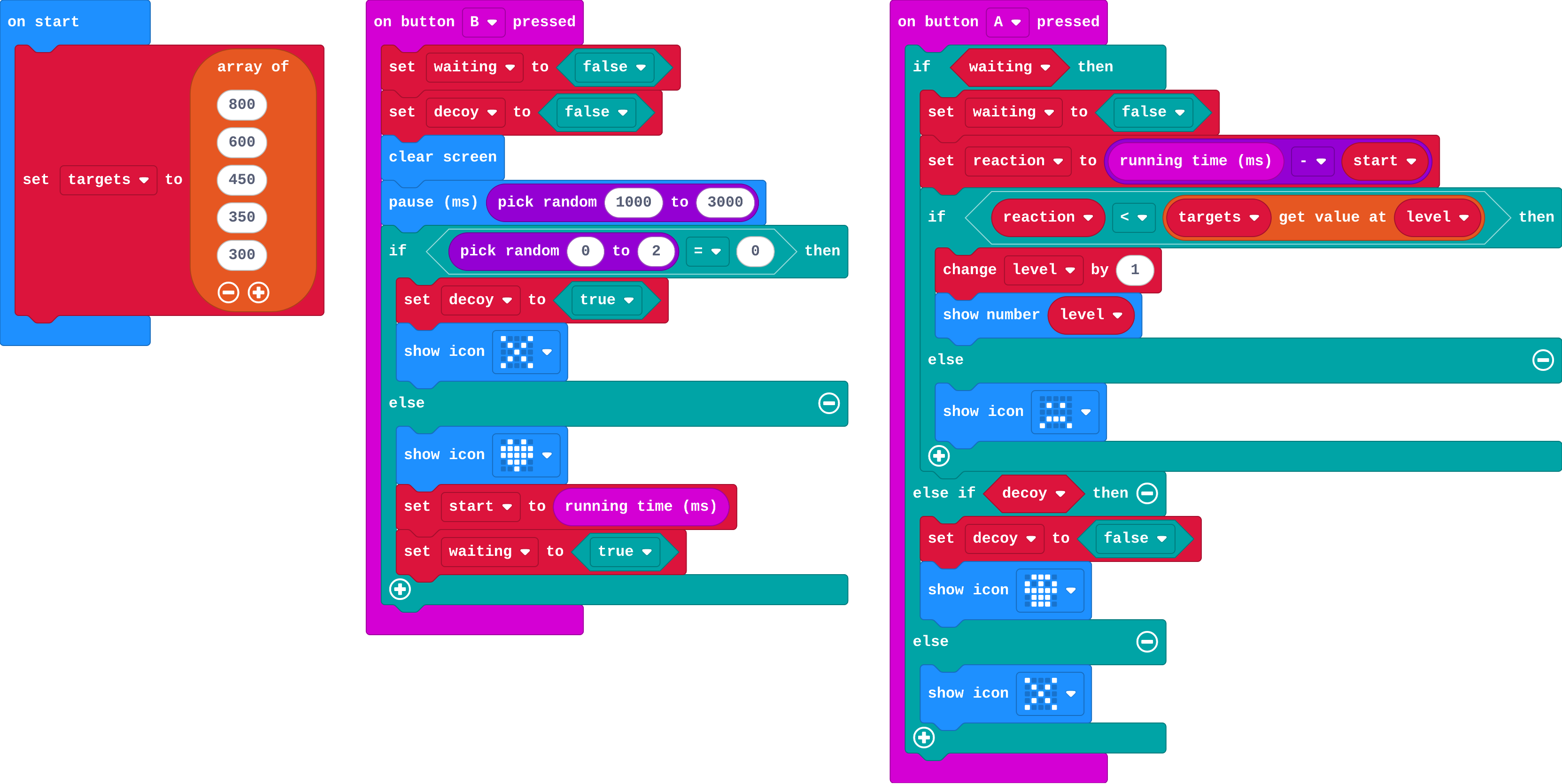
Show as code
let start = 0
let waiting = false
let decoy = false
let reaction = 0
let level = 0
let targets = [800, 600, 450, 350, 300]
input.onButtonPressed(Button.B, function () {
    waiting = false
    decoy = false
    basic.clearScreen()
    basic.pause(randint(1000, 3000))
    if (randint(0, 2) == 0) {
        decoy = true
        basic.showIcon(IconNames.No)
    } else {
        basic.showIcon(IconNames.Heart)
        start = input.runningTime()
        waiting = true
    }
})
input.onButtonPressed(Button.A, function () {
    if (waiting) {
        waiting = false
        reaction = input.runningTime() - start
        if (reaction < targets[level]) {
            level += 1
            basic.showNumber(level)
        } else {
            basic.showIcon(IconNames.Sad)
        }
    } else if (decoy) {
        decoy = false
        basic.showIcon(IconNames.Skull)
    } else {
        basic.showIcon(IconNames.No)
    }
})
Milestone 3: lives
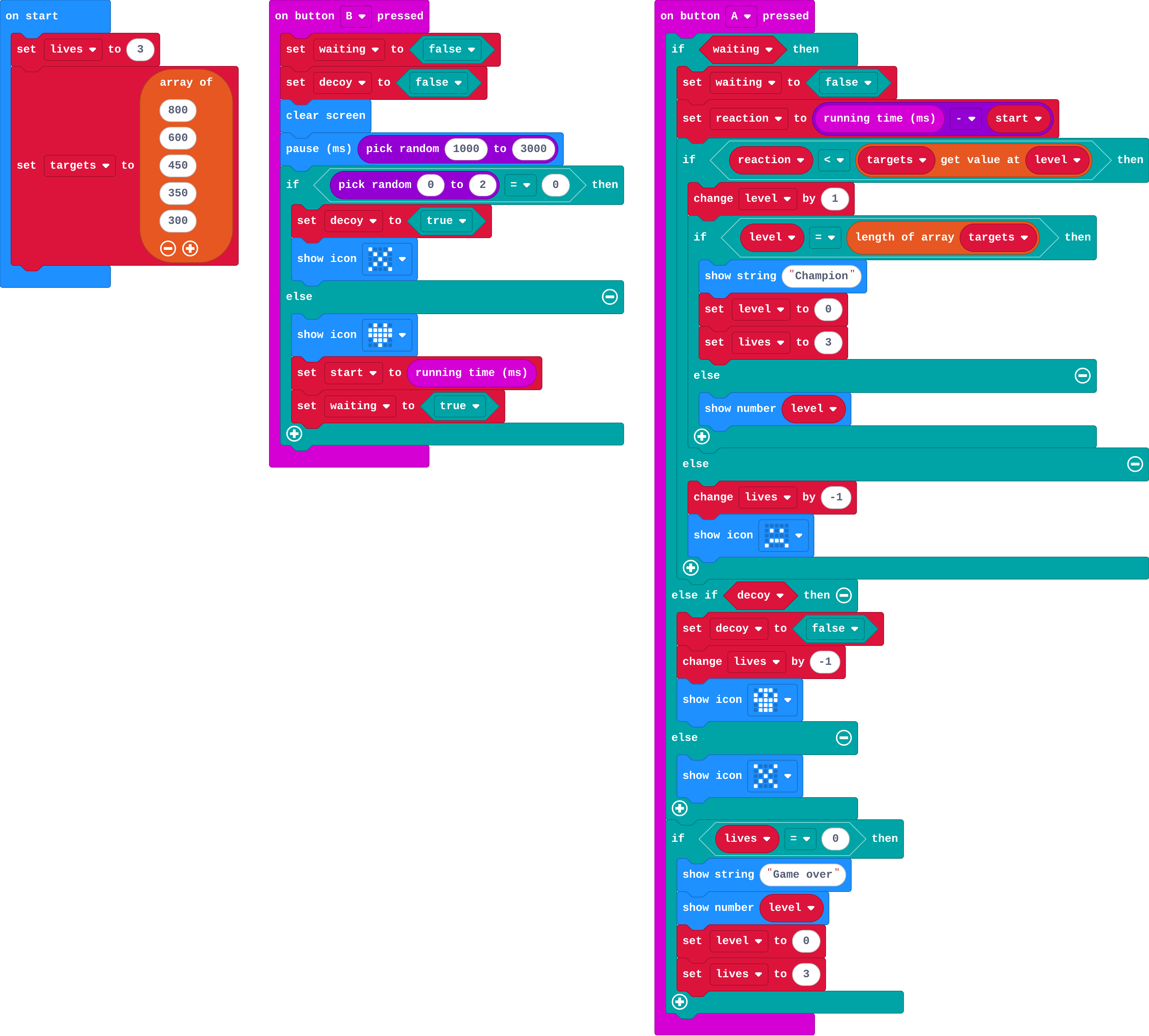
Show as code
let start = 0
let waiting = false
let decoy = false
let reaction = 0
let level = 0
let lives = 3
let targets = [800, 600, 450, 350, 300]
input.onButtonPressed(Button.B, function () {
    waiting = false
    decoy = false
    basic.clearScreen()
    basic.pause(randint(1000, 3000))
    if (randint(0, 2) == 0) {
        decoy = true
        basic.showIcon(IconNames.No)
    } else {
        basic.showIcon(IconNames.Heart)
        start = input.runningTime()
        waiting = true
    }
})
input.onButtonPressed(Button.A, function () {
    if (waiting) {
        waiting = false
        reaction = input.runningTime() - start
        if (reaction < targets[level]) {
            level += 1
            if (level == targets.length) {
                basic.showString("Champion")
                level = 0
                lives = 3
            } else {
                basic.showNumber(level)
            }
        } else {
            lives += -1
            basic.showIcon(IconNames.Sad)
        }
    } else if (decoy) {
        decoy = false
        lives += -1
        basic.showIcon(IconNames.Skull)
    } else {
        basic.showIcon(IconNames.No)
    }
    if (lives == 0) {
        basic.showString("Game over")
        basic.showNumber(level)
        level = 0
        lives = 3
    }
})
Make it yours
Open task: any program that does what the step asks.
Stretch and support
Stretch: Make the decoy chance grow with the level: pick random 0 to (4 − level), so higher levels trick you more often.
Support: Students who find this heavy can stop after Milestone 2; the levels alone make a good game.
Exit ticket
level is 2 and targets is 800, 600, 450, 350, 300. What time must you beat, and why?
450 ms: level 2 is the place in the list, counted from 0.
What each step is for
- Investigate: A list can hold the rules of a game: one target per level, found by using the level number as the place.
- Milestone 1: fake-outs: A second true/false variable remembers a second kind of moment, and else if tells the moments apart.
- Milestone 2: levels: Comparing with a list item, chosen by a variable, lets the same rule get harder as the variable grows.
- Milestone 3: lives: Writing the end of the game from goals alone shows whether a student can manage several pieces of state at once.
Where it leads
The other optional lesson, Tournament, takes the Radio duel further with a scoreboard list. Class ideas: a class high-level board; students design a sixth level and argue what its target should be.