← Year 8 Physics

Year 8 Physics: recap

Answer each question in your head or on paper first, then check it.

Energy transfer and transformation

1. Moving or stored?

Try firstName one example each of chemical, gravitational and elastic potential energy.

Check your answer

For example: a battery or food (chemical), a ball held up high (gravitational), a stretched slingshot (elastic).

Kinetic energy is energy of activity: movement, heat, sound, light and electricity. Potential energy is stored: chemical (food, fuel, batteries), gravitational (things up high) and elastic (things stretched or squashed).

Energy can change from one family to the other and back, as on a roller coaster, but the total stays the same.
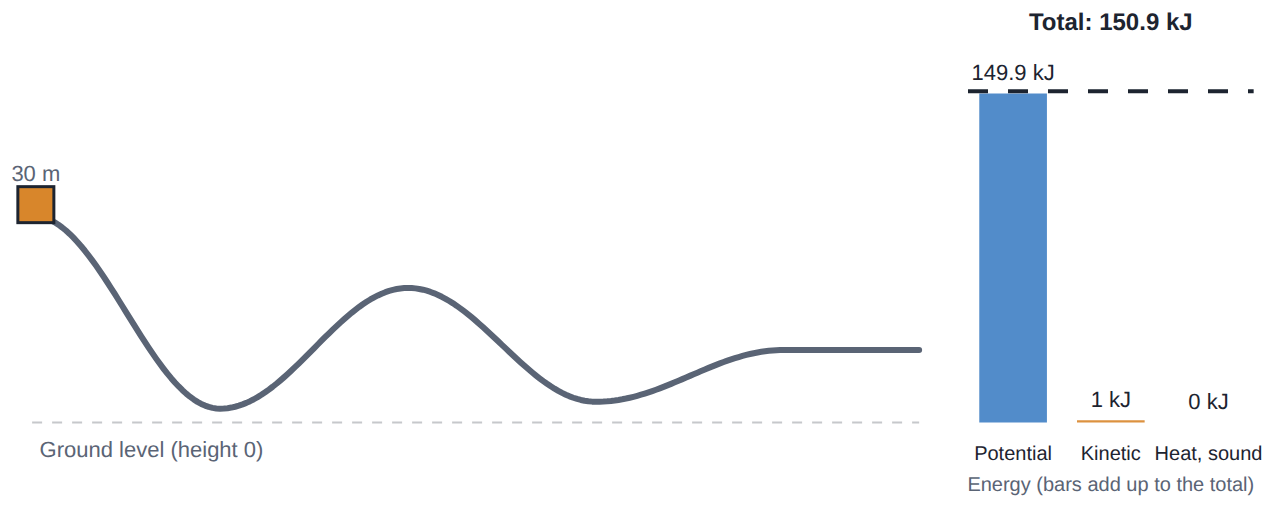
A roller coaster car at the top of the first hill: almost all of its energy is gravitational potential (blue). As it rolls down, that becomes kinetic (orange).
Kinetic and potential energy · Sound on for the voiceover
Open the lesson →

2. Transfer or transformation?

Try firstA wind-up toy runs across the floor. Is 'spring to moving wheels' a transfer or a transformation? Name a by-product.

Check your answer

A transformation (elastic potential to kinetic). By-products: heat (friction) and sound.

In a transfer, the same type of energy moves to a new place (heat into your hands). In a transformation, energy changes type (chemical → electrical → light in a torch).

Almost every transformation also makes some by-product heat that isn't wanted. It isn't destroyed: it spreads into the surroundings.

Transfer and transformation · Sound on for the voiceover
Open the lesson →

3. Follow the energy

Try firstDraw a flow diagram for a battery-powered fan, with one by-product.

Check your answer

Battery (chemical) → wires (electrical) → spinning blades (kinetic), with a by-product of heat (and sound) from the motor.

Real systems pass energy through many stages. A flow diagram shows each stage as a box, each transfer or transformation as an arrow, and every by-product (mostly heat and sound) as a side arrow.

Tracing all the outputs shows where energy goes. By-products go to the surroundings; they're never destroyed.

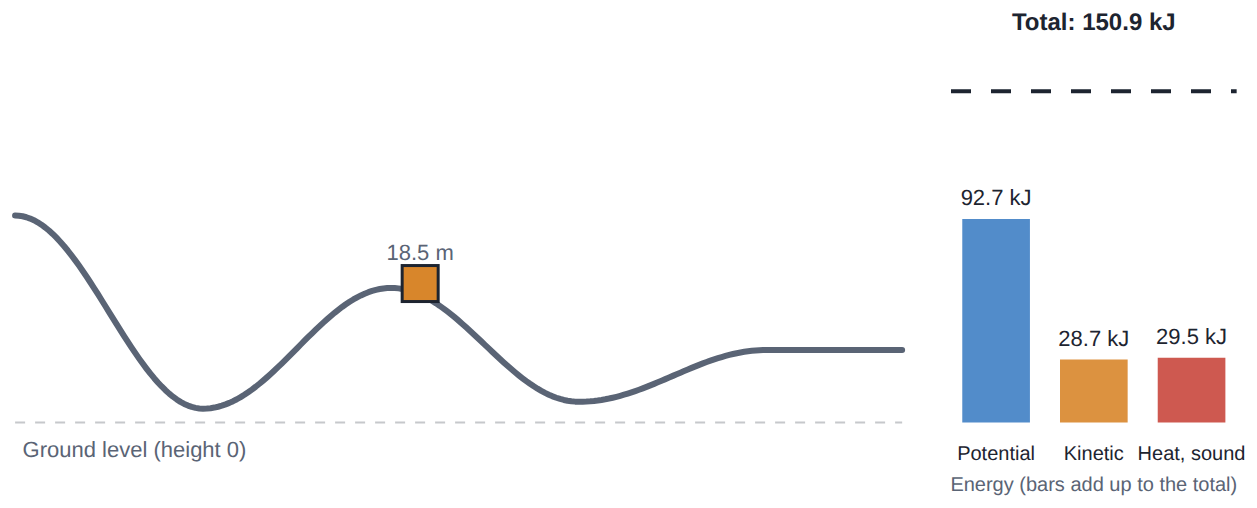
A roller coaster with friction: the red bar grows as some of the car's energy becomes heat and sound along the track.
Following energy through a system · Sound on for the voiceover
Open the lesson →