← Year 7 Physics

Year 7 Physics: recap

Answer each question in your head or on paper first, then check it.

Forces and motion

1. How big, which way?

Try firstA box sits on the floor. Name the two forces on it and describe their arrows.

Check your answer

Weight, pointing down, and support from the floor, pointing up; the same length because they are equal.

A force has a size (N) and a direction, drawn as an arrow: longer for bigger, pointing the way the force acts.

A force diagram shows every force on one object, each named: weight, support, friction, air resistance, pushes and pulls.
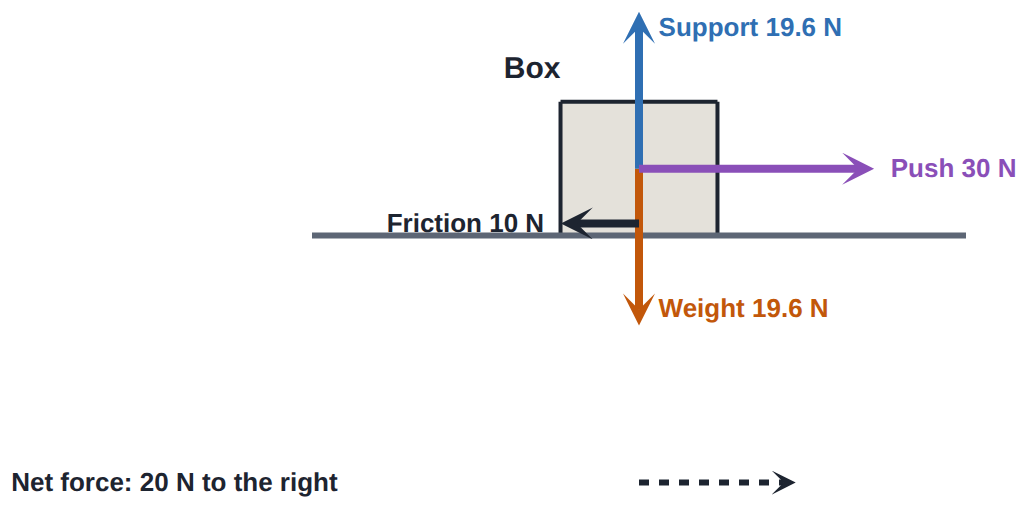
A force diagram: each force on the box as a named arrow, its length showing the size.
Forces as arrows · Sound on for the voiceover
Open the lesson →

2. Does balanced mean no forces?

Try firstA cyclist rides at a steady 20 km/h on a flat road. Are the forces on her balanced? Explain.

Check your answer

Yes: she isn't speeding up or slowing down, so her forward force equals the backward forces (air resistance and friction).

Balanced forces are equal and opposite: the net force is zero. They are still acting; they cancel. The motion doesn't change: still stays still, moving keeps a steady speed.

Unbalanced forces change the motion, in the direction of the net force.

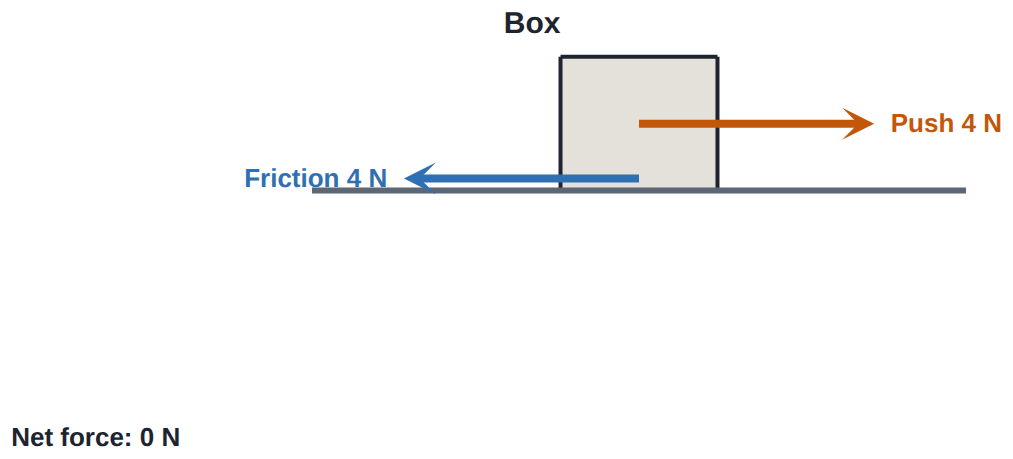
Push 4 N, friction 4 N: balanced, so the net force is 0 N and the motion doesn't change.
Balanced forces · Sound on for the voiceover
Open the lesson →

3. What does an unbalanced force do?

Try firstA netball flies towards the ring and bounces back off the backboard. Give the change in motion and the force that caused it.

Check your answer

It reversed direction (and slowed, then sped up the other way). The backboard pushed it back: an unbalanced force away from the board.

An unbalanced force changes an object's motion, in the direction of the net force: it can start, speed up, slow down, stop, reverse or turn an object.

A force against the motion doesn't only stop things: if it keeps acting, the object turns round and speeds up the other way. A steady speed round a bend is a change in direction, so it needs an unbalanced force too.

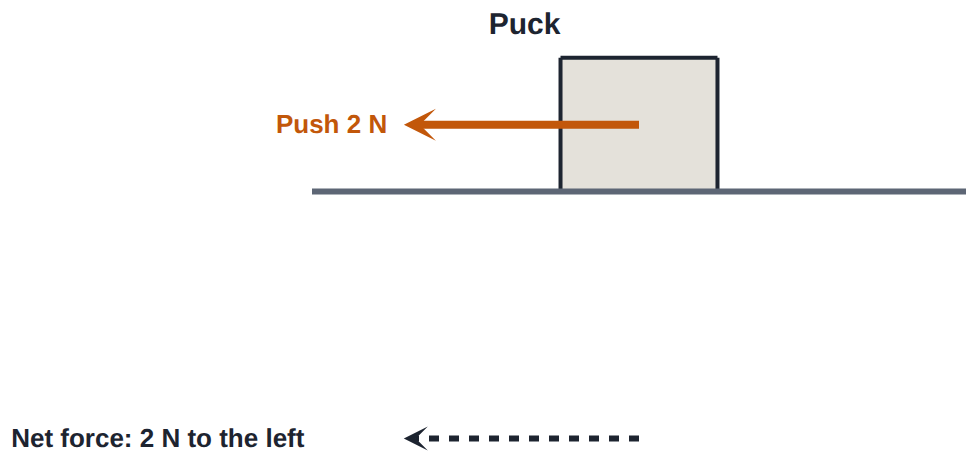
Net force 2 N to the left: the motion changes towards the left, whichever way the puck was moving.
What an unbalanced force does · Sound on for the voiceover
Open the lesson →

4. Would you weigh less on the Moon?

Try firstA 2 kg rock on Earth (g = 9.8 N/kg). What are its mass and its weight on the Moon (g = 1.6 N/kg)?

Check your answer

Mass 2 kg (unchanged); weight 2 × 1.6 = 3.2 N.

Mass (kg) is how much matter an object has; it is the same everywhere. Weight (N) is the force of gravity on it: weight = mass × g.

g is 9.8 N/kg on Earth, 1.6 on the Moon, 3.7 on Mars, 24.8 on Jupiter.

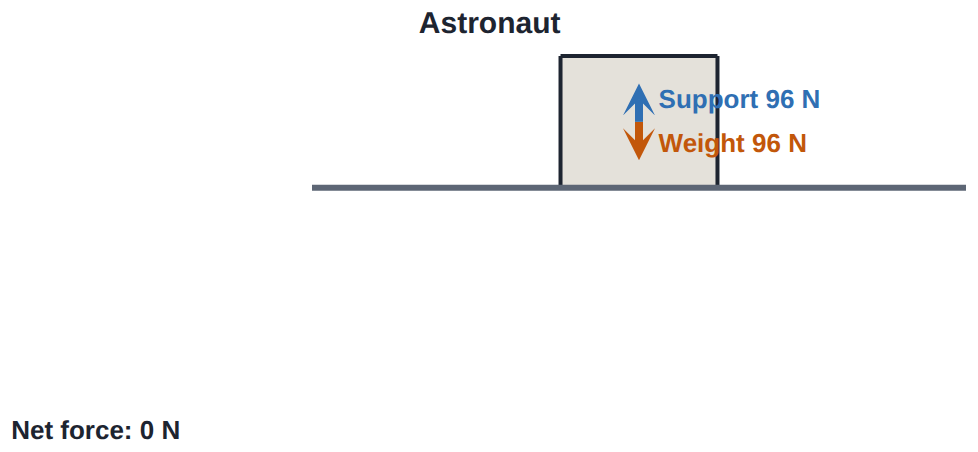
On the Moon: mass 60 kg, weight 96 N (on Earth the same astronaut weighs 588 N).
Mass and weight · Sound on for the voiceover
Open the lesson →

5. Same push, different mass

Try firstThe same push is given to a 3 kg box and a 6 kg box. Which accelerates more, and by how much compared with the other?

Check your answer

The 3 kg box. It accelerates twice as much, because it has half the mass.

For the same unbalanced force, a larger mass gives a smaller acceleration. For the same mass, a larger unbalanced force gives a larger acceleration.

Open the lesson →