← Years 9 and 10 Chemistry

Years 9 and 10 Chemistry: recap

Answer each question in your head or on paper first, then check it.

Inside the atom

1. What's inside an atom?

Try firstOxygen has atomic number 8 and mass number 16. How many protons, neutrons and electrons does a neutral oxygen atom have?

Check your answer

8 protons, 8 neutrons (16 − 8), 8 electrons.

An atom has a tiny, dense nucleus of protons (+1, mass 1) and neutrons (0, mass 1), with electrons (−1, almost no mass) around it.

Atomic number = protons, and it decides the element. Mass number = protons + neutrons. A neutral atom has as many electrons as protons.
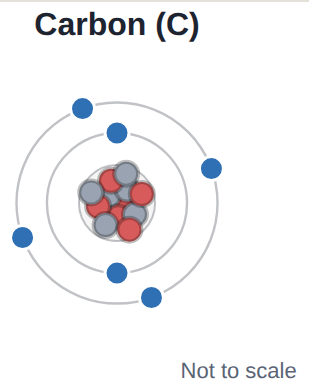
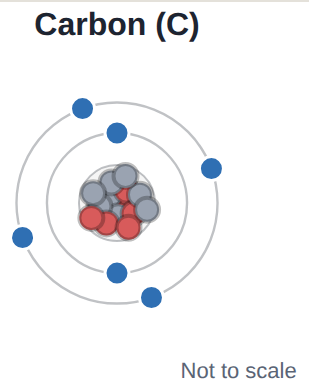
Carbon-12 as a Bohr model: 6 protons and 6 neutrons in the nucleus, 6 electrons in shells (not to scale).
Inside an atom · Sound on for the voiceover
Open the lesson →

2. Same element, different atoms?

Try firstUranium-235 and uranium-238 both have 92 protons. How many neutrons does each have, and are they the same element?

Check your answer

143 and 146 neutrons. Both are uranium (92 protons): they are isotopes.

Isotopes are atoms of the same element (same number of protons) with different numbers of neutrons, so they have different mass numbers: carbon-12, carbon-13 and carbon-14.

They have the same electrons, so they react in the same way. Some isotopes are stable; others are unstable (radioactive) and their nuclei decay.

Carbon-14: 6 protons and 8 neutrons. Two more neutrons than carbon-12, but still carbon.
Isotopes · Sound on for the voiceover
Open the lesson →

3. What comes out of a decaying nucleus?

Try firstCobalt-60 (27 protons) decays by beta decay and gives out gamma rays. What is it now, and which of the radiation would get through 1 cm of aluminium?

Check your answer

Nickel-60 (28 protons, mass number still 60). Only the gamma rays get through the aluminium.

An unstable nucleus decays by giving out alpha (2 protons and 2 neutrons), beta (a fast electron made when a neutron turns into a proton) or gamma (energy only).

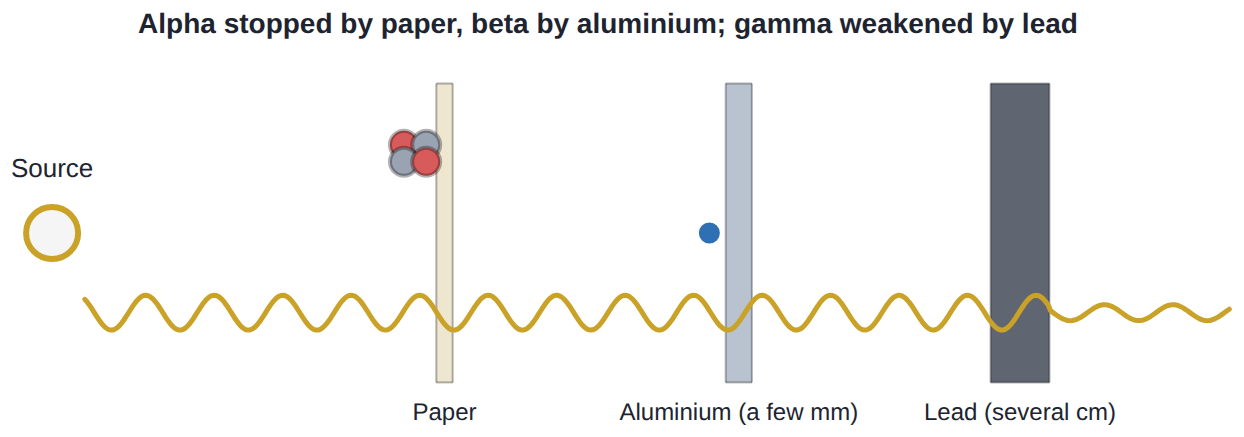
Alpha: atomic number −2, mass number −4. Beta: atomic number +1, mass number the same. Gamma: no change. Alpha is stopped by paper, beta by a few millimetres of aluminium, and gamma is only reduced by thick lead.

Alpha is stopped by paper and beta by a few millimetres of aluminium; gamma gets through, weakened by thick lead.
Alpha, beta and gamma · Sound on for the voiceover
Open the lesson →

4. How long does radioactivity last?

Try firstIodine-131 has a half-life of 8 days. A hospital receives 40 g. How much is left after 24 days?

Check your answer

5 g (40 → 20 → 10 → 5: three half-lives).

Each unstable nucleus decays at random, but a large sample halves in a fixed time: its half-life. After 1 half-life, 1/2 is left; after 2, 1/4; after 3, 1/8.

Half-life doesn't change with heat or chemistry. Short half-lives suit medicine (fluorine-18, about 2 hours); long ones suit dating (carbon-14, 5730 years).

100 iodine-131 nuclei after 3 half-lives (24 days): about an eighth are left. The number halves every 8 days.
Half-life · Sound on for the voiceover
Open the lesson →

5. From uranium to lead

Try firstRadium-226 (atomic number 88) decays by alpha emission. What are the new atomic and mass numbers?

Check your answer

Atomic number 86, mass number 222: radon-222.

A decay chain ends only at a stable nucleus. Alpha decay lowers the atomic number by 2 and the mass number by 4; beta decay raises the atomic number by 1 and leaves the mass number unchanged.

Open the lesson →

Equations and conservation of mass

6. What goes in, what comes out?

Try firstIron reacts with oxygen and water to make rust (hydrated iron oxide). Write the word equation and label the reactants and products.

Check your answer

iron + oxygen + water → hydrated iron oxide (rust). Reactants: iron, oxygen, water. Product: hydrated iron oxide.

In a chemical reaction the reactants are used up and new substances, the products, are made. A word equation names them: reactants → products ("react to make").

Include every reactant and product: methane + oxygen → carbon dioxide + water. A word equation shows no amounts and no atoms.

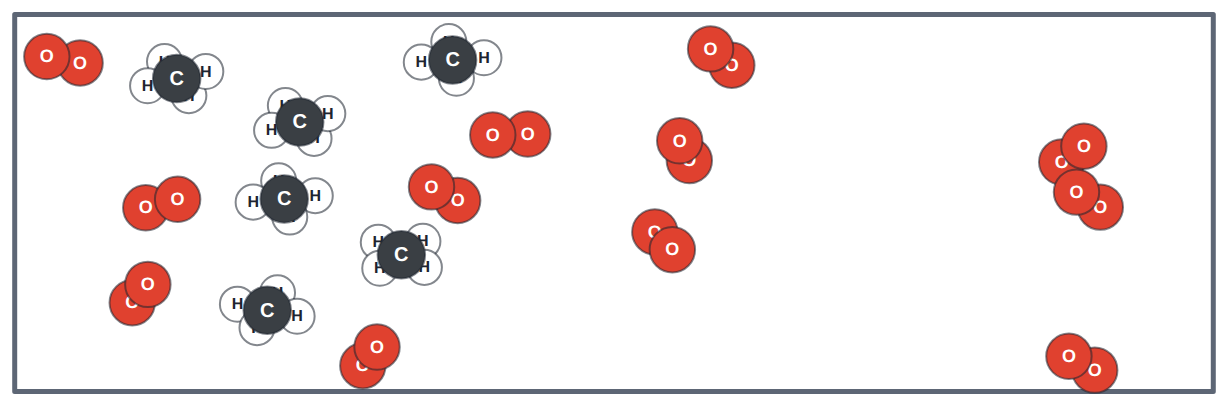
Methane and oxygen (the reactants) reacting to make carbon dioxide and water (the products).
Reactants and products · Sound on for the voiceover
Open the lesson →

7. Where do the atoms go?

Try firstWhen charcoal burns in a sealed jar, does the total mass change? Why?

Check your answer

No: the carbon and oxygen atoms are rearranged into carbon dioxide, which stays in the jar. Same atoms, same mass.

In a chemical reaction the atoms are rearranged into new particles; none are made or destroyed. The same atoms means the same mass: conservation of mass.

A balanced equation shows the same number of each type of atom on both sides. Balance by changing the numbers in front, never the formulas.

Hydrogen and oxygen before they react: the same atoms will be rearranged into water.
Rearranging atoms · Sound on for the voiceover
Open the lesson →

8. How do you balance an equation?

Try firstBalance: H₂ + Cl₂ → HCl. How do you know it's balanced?

Check your answer

H₂ + Cl₂ → 2 HCl. Two hydrogen and two chlorine atoms on each side.

A balanced equation has the same number of each kind of atom on both sides, because atoms are only rearranged.

Change only the coefficients (numbers in front); the subscripts define the substance. Same atoms on both sides means the same mass: conservation of mass.

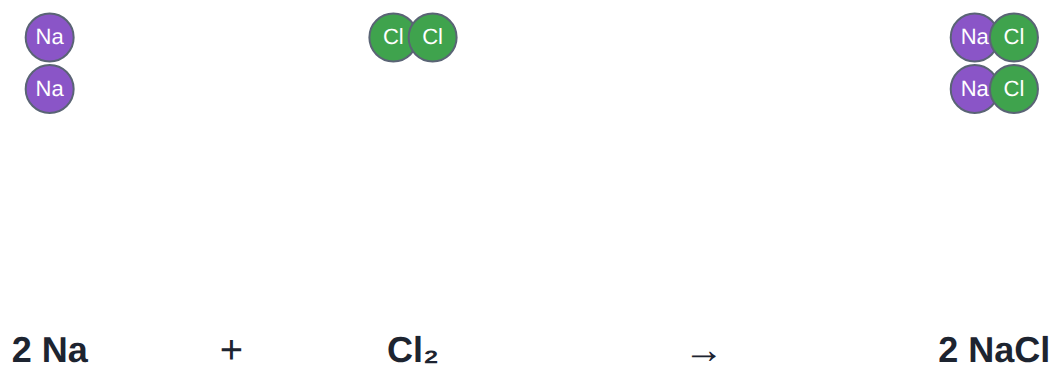
2 Na + Cl₂ → 2 NaCl: two sodium atoms and two chlorine atoms on each side.
Balancing an equation · Sound on for the voiceover
Open the lesson →

9. Where does the mass go?

Try firstA student weighs a candle before and after burning it in an open dish and finds it lighter. Is mass conserved?

Check your answer

Yes. The missing mass left as carbon dioxide and water vapour. Weighing the candle and the oxygen used against the gases would show the same total.

Atoms are rearranged, not made or destroyed, so total mass is conserved. In an open system the mass can seem to change when a gas escapes or enters. A balanced equation has the same atoms on both sides.

Open the lesson →

Atoms and the periodic table

10. How are the electrons arranged?

Try firstWrite the electron arrangement of aluminium (13 electrons). How many outer electrons does it have?

Check your answer

2, 8, 3: three outer electrons.

Electrons fill shells in order: 2, then 8, then 8. The outermost occupied shell is the outer shell, and its electrons decide how the element reacts.

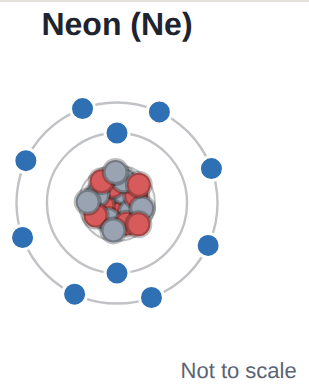
Neon: 10 electrons in shells 2, 8. Both shells are full.
Electron shells · Sound on for the voiceover
Open the lesson →

11. Why do elements in a group behave alike?

Try firstBromine is in group 17. Predict how many outer electrons it has and how it reacts. Explain.

Check your answer

Seven outer electrons; it gains one easily, so it is a reactive non-metal, like chlorine.

Elements in the same group have the same number of outer-shell electrons, so they react in similar ways.

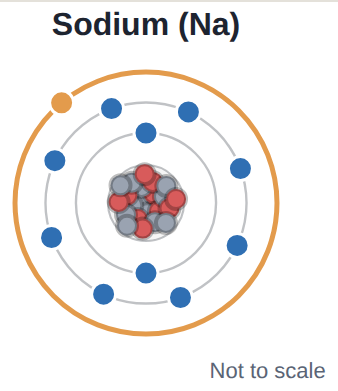
Group 1: one outer electron, easily lost: very reactive metals. Group 17: seven, one short of full: reactive non-metals. Group 18: full outer shell: hardly react.

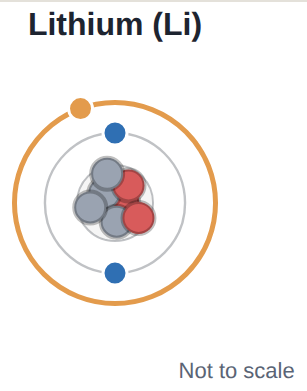
Lithium (2, 1): one outer electron (orange), like every element in group 1.
Groups and outer electrons · Sound on for the voiceover
Open the lesson →

13. Use the table to predict

Try firstPredict the number of outer electrons and the ion formed by calcium, which is in group 2, period 4.

Check your answer

Two outer electrons; it loses them to form a Ca²⁺ ion.

Group gives the outer electrons; period gives the shells. Outer electrons decide reactivity and bonding, so the table is a predictive model, not a list.

Open the lesson →

Reaction rates

14. What kind of reaction is it?

Try firstClassify magnesium + zinc sulfate → magnesium sulfate + zinc, and say why it happens.

Check your answer

Displacement: magnesium is more reactive than zinc, so it takes zinc's place.

Synthesis: substances join into one (A + B → AB). Decomposition: one substance breaks into simpler ones (AB → A + B). Displacement: a more reactive element takes a less reactive one's place (A + BC → AC + B).

Spot the pattern to classify a reaction and predict its products. Displacement only goes from more reactive to less reactive.

Zinc and copper oxide: zinc, the more reactive metal, takes the oxygen and leaves copper behind. A displacement reaction.
Three kinds of reaction · Sound on for the voiceover
Open the lesson →

15. Why does heat speed up reactions?

Try firstWhy does crushing a tablet make it dissolve and react faster in water?

Check your answer

Crushing increases the surface area, so more particles are exposed and collisions happen more often.

Particles react only when they collide with at least the activation energy.

  • Temperature: particles collide more often and harder (the biggest effect).
  • Concentration and surface area: more collisions each second.
  • Catalyst: lowers the activation energy; not used up.
Hydrogen and chlorine molecules colliding: only collisions with enough energy react.
Collision theory · Sound on for the voiceover
Open the lesson →