← Year 8 Biology

Year 8 Biology: recap

Answer each question in your head or on paper first, then check it.

Cells

1. How small is a cell?

Try firstWhy couldn't anyone in 1500 have known that plants are made of cells?

Check your answer

Cells are smaller than the eye can see (about 0.01 to 0.1 mm), and microscopes strong enough to magnify them hadn't been invented.

Most cells are about 0.01 to 0.1 mm across, smaller than the eye can see (about 0.1 mm). Your body has about 37 trillion of them.

A microscope magnifies: a cell 0.02 mm wide magnified 400 times looks 8 mm wide. Cells were discovered only once microscopes were invented, in the 1600s.
An animal cell and a plant cell, drawn about 1000 times bigger than life. Real ones are about 0.02 to 0.1 mm across.
Cellular scale · Sound on for the voiceover
Open the lesson →

2. Is everything alive made of cells?

Try firstName a single-celled organism and a multicellular one that isn't an animal.

Check your answer

For example: a bacterium (single-celled) and a gum tree or mushroom (multicellular).

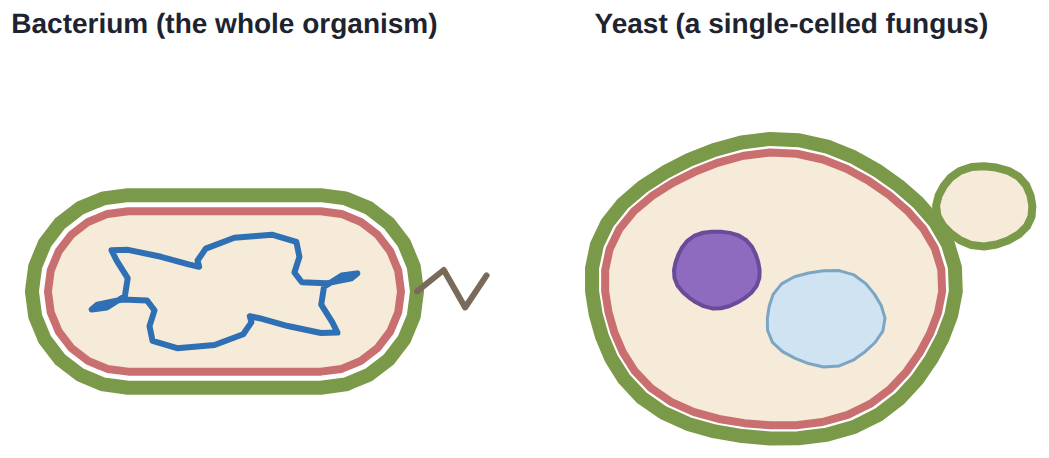
Cell theory: all living things are made of one or more cells, and the cell is the smallest unit of life. Plants, fungi and bacteria are cells too. Single-celled organisms are one cell; multicellular organisms are many.

A bacterium and a yeast cell: single-celled living things.
Living things are made of cells · Sound on for the voiceover
Open the lesson →

3. What does every cell have?

Try firstWhat does the cell membrane do?

Check your answer

It controls what enters and leaves the cell.

Plant and animal cells share the nucleus (holds the DNA, controls the cell), the cell membrane (controls what enters and leaves) and the cytoplasm (where reactions happen).

An animal cell and a plant cell: both have a nucleus, membrane and cytoplasm; the plant cell adds a wall, chloroplasts and a vacuole.
Parts of a cell · Sound on for the voiceover
Open the lesson →

4. What makes a plant cell different?

Try firstName two parts a leaf cell has that a cheek cell lacks, and say what each does.

Check your answer

Any two of: cell wall (support), chloroplasts (photosynthesis), large vacuole (keeps the cell firm, stores sap).

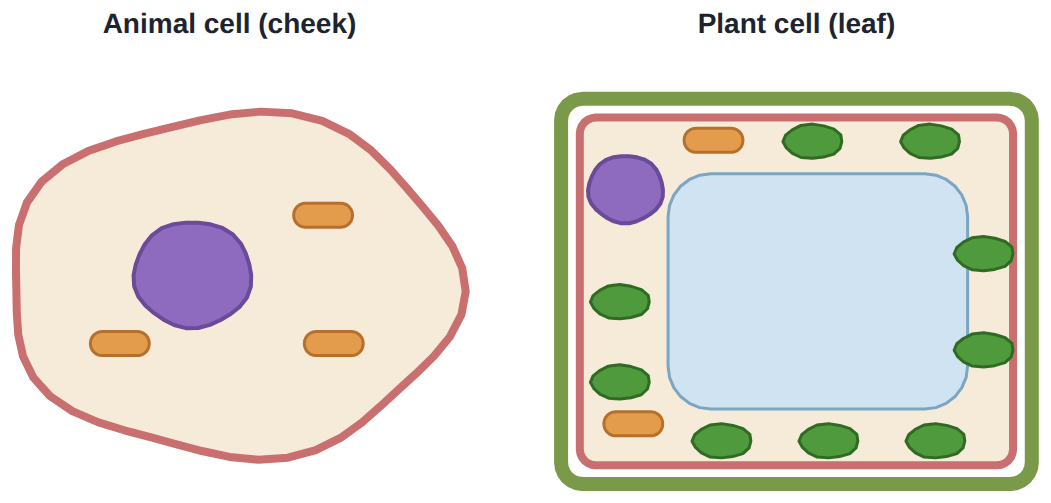
Plant cells have three parts animal cells don't: a cell wall for support, chloroplasts for photosynthesis and a large vacuole that keeps the cell firm.

Both have mitochondria (release energy) and ribosomes (make proteins). How many of each a cell has depends on its job.

An animal cell and a plant cell. Only the plant cell has a cell wall (green outline), chloroplasts and a large vacuole (pale blue); both have mitochondria (orange).
Plant and animal cells · Sound on for the voiceover
Open the lesson →

From cells to organs

5. Why are cells different shapes?

Try firstGive one feature of a nerve cell and explain how it helps.

Check your answer

A long axon, so it can carry signals a long way through the body.

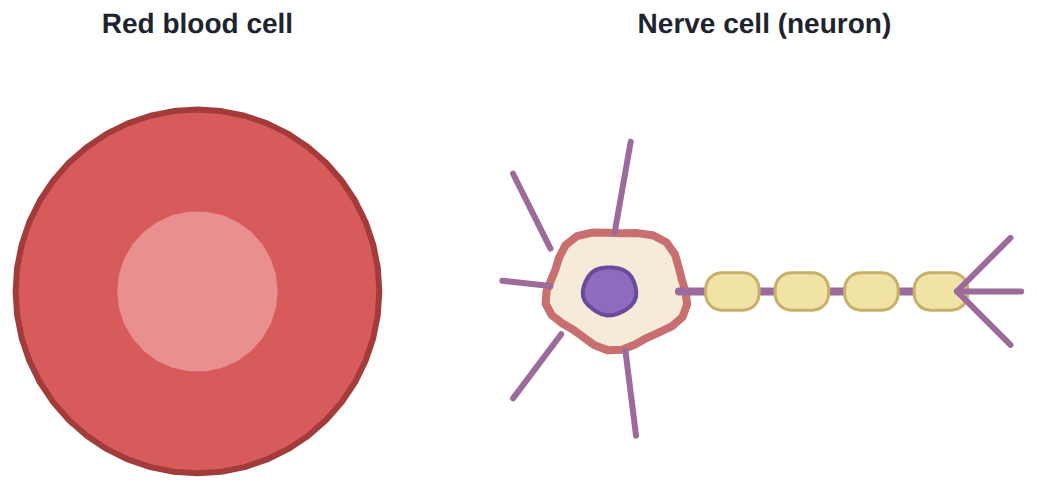
Cells with the same DNA specialise: each develops a shape and parts that suit its job. Red blood cells have no nucleus (more haemoglobin); nerve cells have long axons; muscle cells have many mitochondria; root hair cells have a long extension.

A red blood cell (no nucleus, biconcave) and a nerve cell (a long axon): shapes that suit their jobs.
Specialised cells · Sound on for the voiceover
Open the lesson →

6. What is a tissue?

Try firstName one animal tissue and one plant tissue, and say the job each does.

Check your answer

For example: muscle tissue contracts to move the body; xylem carries water up the plant.

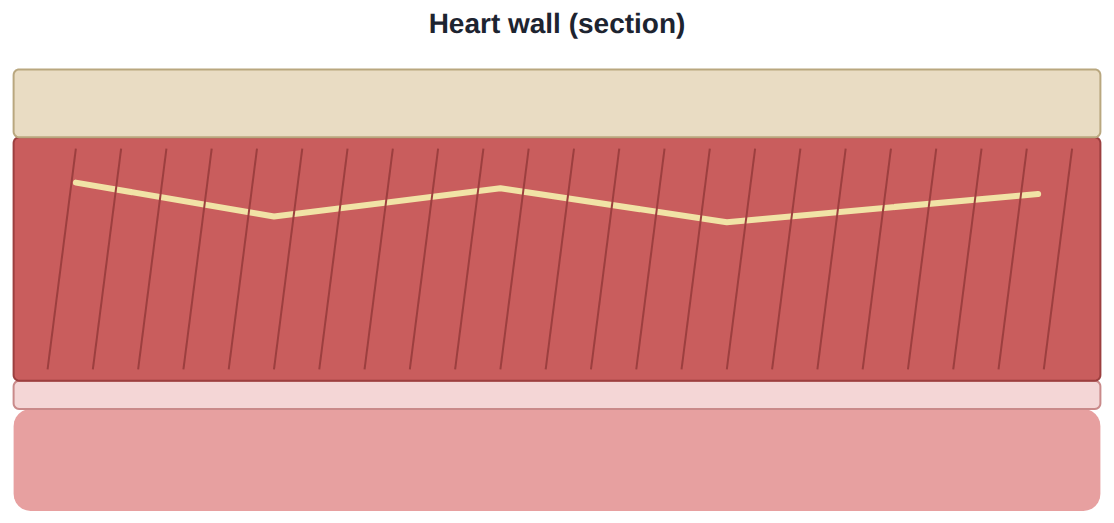
A tissue is a group of similar specialised cells working together to do one job. Muscle tissue contracts, epithelial tissue lines and protects, nervous tissue carries signals; in plants, xylem carries water and phloem carries sugar.

Together the cells do what one cell can't do alone. Several tissues working together make an organ.

A section of the heart wall: layers of tissue, each a group of similar cells doing one job.
Tissues · Sound on for the voiceover
Open the lesson →

7. What is an organ made of?

Try firstName two tissues in a leaf and say what each does.

Check your answer

For example: palisade mesophyll (photosynthesis) and xylem (brings water).

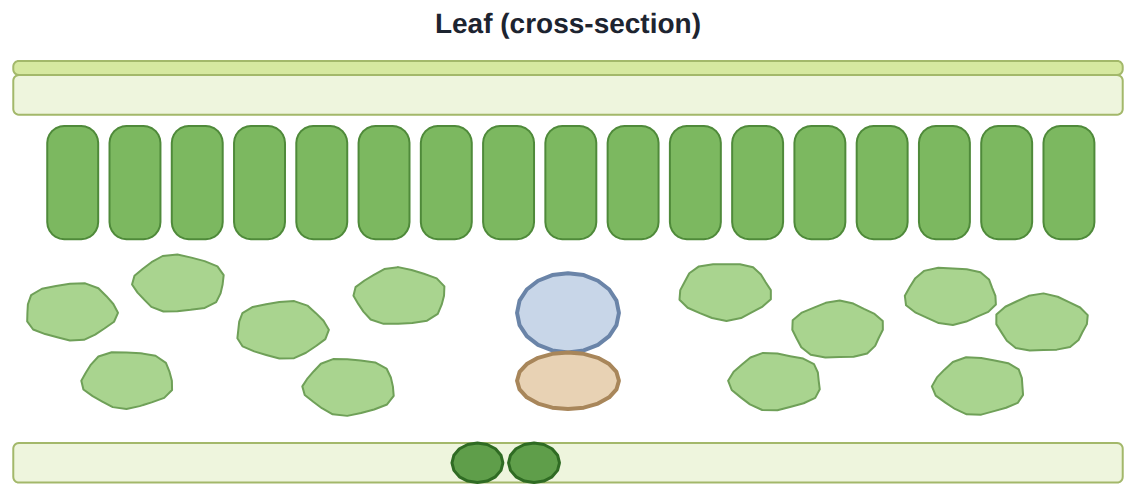
An organ is several tissues working together. A leaf has epidermis, mesophyll, xylem and phloem; the heart has cardiac muscle, lining, connective and nervous tissue. Cells → tissues → organs → systems → organism.

A leaf in cross-section: epidermis, two kinds of mesophyll, xylem and phloem, each a tissue.
A leaf is an organ · Sound on for the voiceover
Open the lesson →

8. Organ systems

Try firstSay in a sentence how a plant's vascular system and an animal's circulatory system are alike, and one way they differ.

Check your answer

Alike: both move materials to every cell. Different: the animal pumps blood with a heart, while the plant has no pump and water is pulled up the xylem as it evaporates from the leaves.

An organ system is a group of organs that work together to do a job the whole organism needs. If one organ fails, the system fails. The circulatory system and a plant's vascular system both move materials to every cell.

Open the lesson →