← Year 7 Biology

Year 7 Biology: recap

Answer each question in your head or on paper first, then check it.

Classification

1. Why sort living things?

Try firstA new beetle is found in a Queensland rainforest. Give two ways classifying it helps scientists.

Check your answer

Any two of: others can identify it from its features; one scientific name lets scientists everywhere talk about the same beetle; its group shows which beetles it is related to.

Scientists classify living things to identify them, to talk about them clearly (one name everyone understands) and to see how they are related.

Classification groups things by shared features, unlike a plain list. Every system is built for a purpose.

Why classify? · Sound on for the voiceover
Open the lesson →

2. Plant, animal or something else?

Try firstA slime grows on a dead log. It isn't green and it absorbs food from the wood. Which kingdom? Why?

Check your answer

Fungi: it can't make food from sunlight and it absorbs food from dead material.

Living things are grouped into kingdoms by observable features: animals (eat other living things), plants (make food from sunlight), fungi (absorb food from other material), protists (mostly one cell with a nucleus) and bacteria (one tiny cell, no nucleus).

Kingdoms sort by features; they don't always show who is related (fungi are closer to animals than to plants). Scientists now use DNA to group life into three domains, and change the system when evidence demands it.

Sorting into kingdoms · Sound on for the voiceover
Open the lesson →

3. Who is it? Using a key

Try firstWhy must each question in a dichotomous key be about an observable feature with a clear yes or no?

Check your answer

So that anyone checking the specimen gets the same answer and reaches the same name.

A dichotomous key identifies an organism with two-way choices about observable features. Answer each one about the specimen in front of you; one wrong choice leads to the wrong name.

Using a dichotomous key · Sound on for the voiceover
Open the lesson →

Food webs and ecosystems

4. Who eats whom?

Try firstIn a food web, why does the arrow point from the gum leaves to the koala?

Check your answer

Arrows show the direction energy flows: from the food (gum leaves) into the eater (koala).

A food web joins all the food chains in an ecosystem. Arrows point the way energy flows, from the food to the eater.

Producers make their own food; consumers eat other organisms; decomposers (fungi and bacteria) break down dead matter and wastes.

Arrows point from the food to the eater: the way energy flows.
Arrows in a food web · Sound on for the voiceover
Open the lesson →

5. Where does the energy go?

Try firstWhy does a food chain rarely have more than four or five levels?

Check your answer

Only about 10% of the energy passes to each level, so after four or five steps there is too little left to support another population.

Energy enters as sunlight and flows one way through a food web. About 10% passes to each level; the rest is used for living or lost as heat. Matter cycles: decomposers return atoms for producers to use again.

About 10% of the energy passes to each level: 20,000 kJ in the phytoplankton, 20 kJ in the penguin.
Energy along a food chain · Sound on for the voiceover
Open the lesson →

6. What if the dingo disappeared?

Try firstFoxes are controlled with baits in a reserve. Predict one effect two links away, and explain.

Check your answer

For example: fewer foxes → more bandicoots → fewer insects (more bandicoots eating them).

A biotic factor is a living part of an ecosystem. When one population changes, the effect passes along the food web, one link at a time: a cascade. Two opposite effects can make the result uncertain.

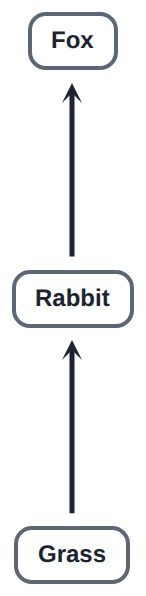
Remove the foxes: more rabbits survive, so they eat more grass. The change passes along the web.
A cascade · Sound on for the voiceover
Open the lesson →