← Algebra Foundations

Algebra Foundations: recap

Answer each question in your head or on paper first, then check it.

Expressions

1. Letters that vary

Try firstA taxi charges T = 2d + 4 dollars for d km. Name the variables and the constants, and say what the 4 means.

Check your answer

Variables: T and d. Constants: 2 and 4. The 4 is the fee to get in, paid even for 0 km.

In a formula, letters stand for quantities. A letter whose value can change is a variable; a number that stays the same is a constant.

In $P = 2l + 2w$, $P$, $l$ and $w$ are variables and the 2s are constants.

In an equation such as $3x + 2 = 14$, the letter is an unknown: one particular number ($x = 4$) makes it true.
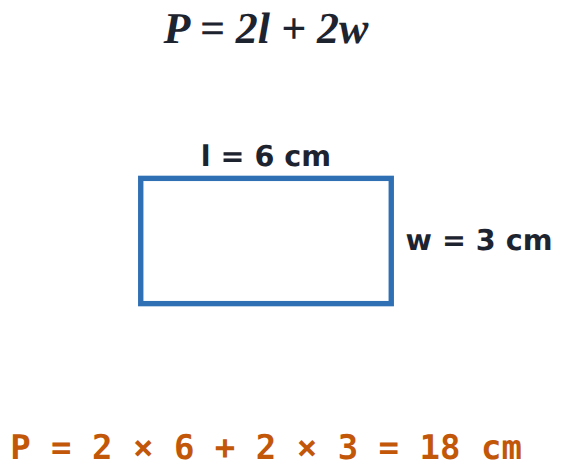
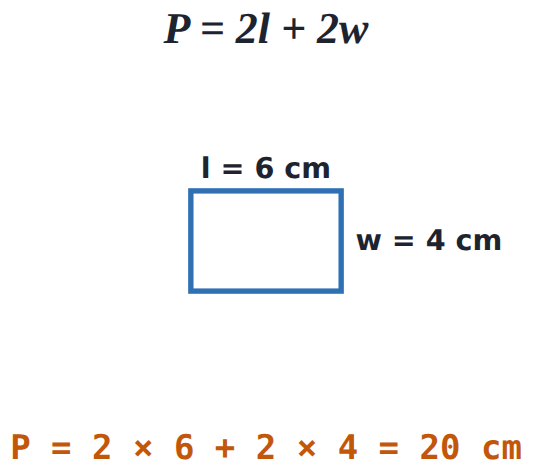
P = 2l + 2w: P, l and w are variables (each rectangle has its own); the 2s are constants (the same for every rectangle).
P=2l+2wP = 2l + 2w: PP, ll and ww are variables (each rectangle has its own); the 2s are constants (the same for every rectangle).
Variables change; constants stay the same · Sound on for the voiceover
Open the lesson →

2. Substituting into formulas

Try firstFind C = 8h + 15 when h = 3, and V = lwh when l = 2, w = 5, h = 3.

Check your answer

C = 8 × 3 + 15 = 39. V = 2 × 5 × 3 = 30.

To substitute, replace each letter with its value.

A number next to a letter means multiply: $2l$ means $2 \times l$. Two letters next to each other also multiply: $lw$ means $l \times w$. Write the × signs in before working anything out.

Then work it out in order: brackets first, then × and ÷, then + and −. Give the units.

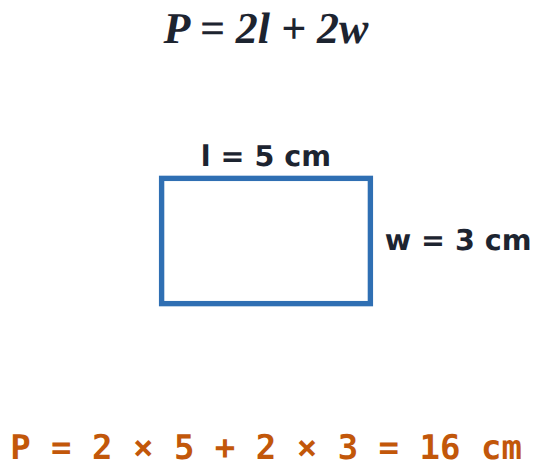
l = 5 and w = 3: write in the × signs, P = 2 \times 5 + 2 \times 3 = 10 + 6 = 16 cm.
l=5l = 5 and w=3w = 3: write in the × signs, P=2×5+2×3=10+6=16P = 2 \times 5 + 2 \times 3 = 10 + 6 = 16 cm.
Replace each letter with its value · Sound on for the voiceover
Open the lesson →

3. Finding an unknown

Try firstA gym costs T = 15w + 30 dollars for w weeks. Someone paid 120 dollars. How many weeks? Check your answer.

Check your answer

120 = 15w + 30, so 15w = 90 and w = 6. Check: 15 × 6 + 30 = 120.

When you know a formula's answer but not one of its letters, substitute the values you know. What is left is an equation with one unknown.

Solve it by undoing: undo the last operation first (+ and − before × and ÷).

Then check: put your answer back into the formula. It should give the value you started with.

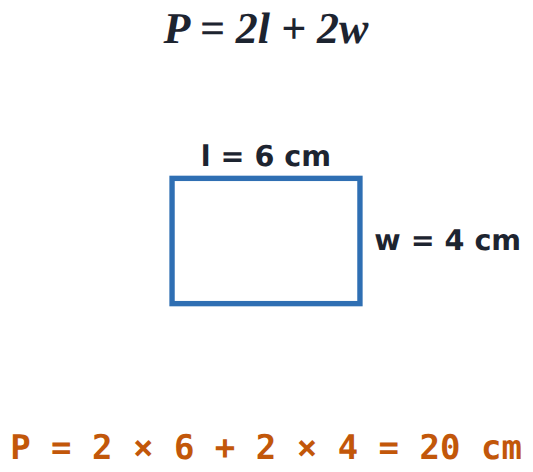
P = 20 and l = 6: 20 = 2 \times 6 + 2w, so 2w = 8 and w = 4. Check: 2 \times 6 + 2 \times 4 = 20.
P=20P = 20 and l=6l = 6: 20=2×6+2w20 = 2 \times 6 + 2w, so 2w=82w = 8 and w=4w = 4. Check: 2×6+2×4=202 \times 6 + 2 \times 4 = 20.
Substitute what you know, then solve for the rest · Sound on for the voiceover
Open the lesson →

4. Words into expressions

Try firstWrite an expression for: (a) 4 less than n; (b) 2 more than 5 times n; (c) n shared between 3.

Check your answer

(a) n − 4. (b) 5n + 2. (c) n/3.

Words about a number tell you what to do to it. More than means add; less than means subtract; times, twice and lots of mean multiply; divided by and shared between mean divide.

Write the operations in the order the words say them. "3 more than twice n" is twice n (2n) and then 3 more: $2n + 3$.

"Less than" starts from the number: 7 less than n is $n - 7$, not $7 - n$.

Check an expression by trying a number you can work out in words.

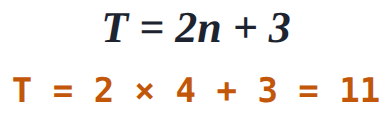
"3 more than twice n": twice n is 2n, then 3 more gives 2n + 3. With n = 4: 2 \times 4 + 3 = 11.
"3 more than twice nn": twice nn is 2n2n, then 3 more gives 2n+32n + 3. With n=4n = 4: 2×4+3=112 \times 4 + 3 = 11.
Say it in steps, then write each step · Sound on for the voiceover
Open the lesson →

5. When brackets are needed

Try firstWrite an expression for: (a) add 6 to n, then multiply by 3; (b) multiply n by 3, then add 6. Which one gives 15 when n = 3?

Check your answer

(a) 3(n + 6); (b) 3n + 6. (b): 3 × 3 + 6 = 15; (a) gives 27.

Brackets group a part so it is worked out first.

If a sentence says to do something to the whole result of an earlier step, put that earlier step in brackets. "Add 3 to n, then double the result" is $2(n + 3)$.

If the later step is adding or subtracting, brackets are not needed: "double n, then add 3" is $2n + 3$.

The two are different. With $n = 4$: $2(n + 3) = 14$ and $2n + 3 = 11$.

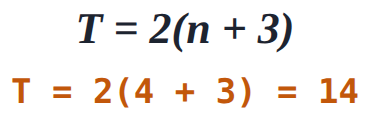
"Add 3 to n, then double the result": the brackets keep n + 3 together, so 2(n + 3). With n = 4: 2(4 + 3) = 14. Without brackets, 2n + 3 = 11.
"Add 3 to nn, then double the result": the brackets keep n+3n + 3 together, so 2(n+3)2(n + 3). With n=4n = 4: 2(4+3)=142(4 + 3) = 14. Without brackets, 2n+3=112n + 3 = 11.
Brackets keep a part together · Sound on for the voiceover
Open the lesson →

6. An expression for any case

Try firstA gym costs 30 dollars to join plus 15 dollars a week. Write what your letter stands for, an expression for the total, and the cost after 8 weeks.

Check your answer

Let w be the number of weeks. Total = 15w + 30. After 8 weeks: 15 × 8 + 30 = 150 dollars.

To write an expression for a situation: (1) say what the letter stands for: the number that changes, such as the number of guests; (2) multiply it by the amount for each one; (3) add anything paid only once.

A hall costing 60 dollars plus 5 dollars per guest, with $g$ guests, is $5g + 60$.

Test the expression with one case you can check in words, then use it for any number.

The letter stands for a number, not for the objects: in $3a$, $a$ is how many apples.

Let g be the number of guests. A hall costs 60 dollars plus 5 dollars per guest: C = 5g + 60. With 10 guests: 5 \times 10 + 60 = 110 dollars.
Let gg be the number of guests. A hall costs 60 dollars plus 5 dollars per guest: C=5g+60C = 5g + 60. With 10 guests: 5×10+60=1105 \times 10 + 60 = 110 dollars.
Say what the letter stands for, then write the expression · Sound on for the voiceover
Open the lesson →

Equations

7. Equations as a balance

Try firstIs x = 7 a solution of 3x − 5 = 16? Show how you know.

Check your answer

Yes. 3 × 7 − 5 = 21 − 5 = 16, which equals the right side.

An equation says two things are equal: $2x + 3 = 11$ says "two lots of something, plus 3, is 11".

The solution is the value that makes it true. To check a value, put it in place of the letter (this is called substitution) and work out each side. If both sides are the same, it is a solution.

Remember: $2x$ means $2 \times x$. If $x = 4$, then $2x$ is 8, not 24.

Open the lesson →

8. Solving by backtracking

Try firstSolve 5x + 6 = 41 by backtracking. Show each step and check your answer.

Check your answer

41 − 6 = 35, then 35 ÷ 5 = 7. Check: 5 × 7 + 6 = 41.

Backtracking means running an equation backwards. In $2x + 3 = 11$, $x$ is multiplied by 2, then 3 is added, and the answer is 11.

To find $x$, undo each step with its opposite, starting with the last one: take away 3 ($11 - 3 = 8$), then divide by 2 ($8 \div 2 = 4$).

Then check by running forwards: $2 \times 4 + 3 = 11$. If it matches, you have the solution.

Open the lesson →

9. The balance method

Try firstSolve 4x + 3 = 2x + 11. Show each step and check your answer in the first equation.

Check your answer

Take 2x from both sides: 2x + 3 = 11. Take 3: 2x = 8. Divide by 2: x = 4. Check: 4 × 4 + 3 = 19 and 2 × 4 + 11 = 19.

An equation is like a balanced scale. If you do the same thing to both sides, it stays balanced, so the equation stays true.

To solve $2x + 3 = 11$: take 3 from both sides ($2x = 8$), then divide both sides by 2 ($x = 4$).

When $x$ is on both sides, take the same number of $x$ from both sides first.

Always check in the first equation: $2 \times 4 + 3 = 11$ ✓.

Open the lesson →

Brackets

10. Expanding brackets

Try firstExpand and simplify 5(x − 2) + 3x.

Check your answer

5x − 10 + 3x = 8x − 10.

The number outside a bracket multiplies every term inside.

$3(2x + 4)$ is 3 lots of $2x + 4$: $3 \times 2x = 6x$ and $3 \times 4 = 12$, so $6x + 12$. Signs come too: $4(3x - 2) = 12x - 8$, and $-2(x - 5) = -2x + 10$.

After expanding, collect any like terms: $6x + 12 - x = 5x + 12$.

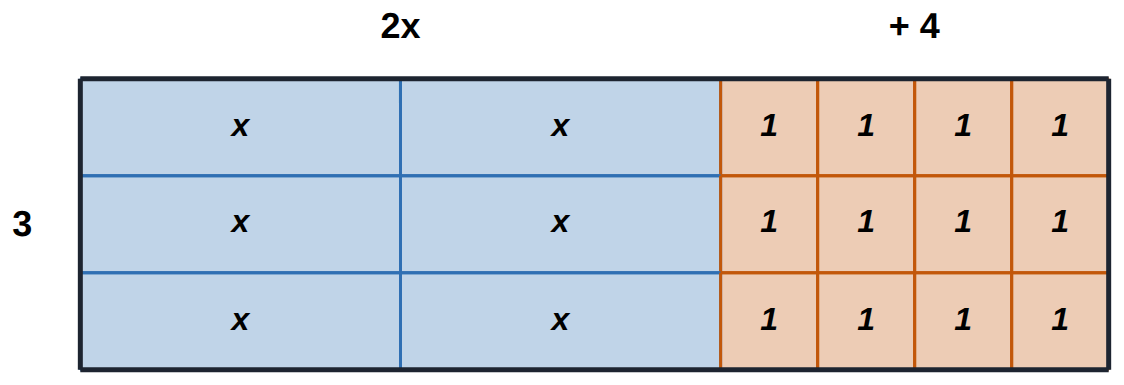
3(2x + 4): 3 rows of 2x + 4 make 6x + 12.
3(2x+4)3(2x + 4): 3 rows of 2x+42x + 4 make 6x+126x + 12.
The number outside multiplies every term inside · Sound on for the voiceover
Open the lesson →

11. Factorising

Try firstFactorise 14x − 21 fully, then check by expanding.

Check your answer

7(2x − 3). Check: 7 × 2x = 14x and 7 × (−3) = −21.

Factorising is expanding backwards. Find a number that goes into every term, divide every term by it, and put it outside the bracket.

$6x + 9$: 3 goes into 6 and 9, so $6x + 9 = 3(2x + 3)$. Take out the highest common factor: $12x - 8 = 4(3x - 2)$, not $2(6x - 4)$, which still shares a 2. A letter can be common too: $2x^2 + 4x = 2x(x + 2)$.

Check by expanding: you should get back to where you started.

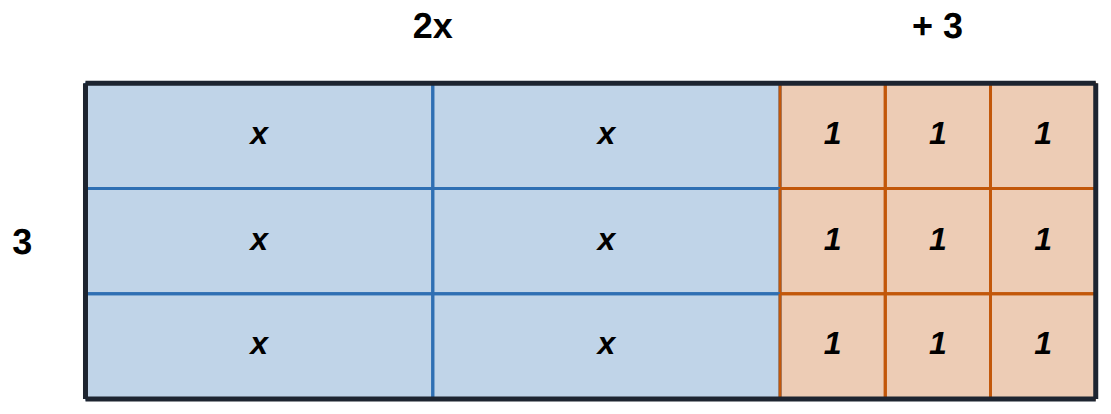
6x + 9 shared into 3 equal rows: each row is 2x + 3, so 6x + 9 = 3(2x + 3).
6x+96x + 9 shared into 3 equal rows: each row is 2x+32x + 3, so 6x+9=3(2x+3)6x + 9 = 3(2x + 3).
Share the tiles into equal rows · Sound on for the voiceover
Open the lesson →

12. Changing the subject

Try firstMake x the subject of y = 6x − 2, then check it with x = 3.

Check your answer

x = (y + 2)/6. Check: x = 3 gives y = 16, and (16 + 2)/6 = 3.

To change the subject, undo what was done to the letter you want, last step first, doing the same to the whole of both sides.

$y = 3x + 5$: $x$ was multiplied by 3, then 5 was added. Take 5 away: $y - 5 = 3x$. Divide by 3: $x = \dfrac{y - 5}{3}$.

Check by putting in numbers: $x = 2$ gives $y = 11$, and $\dfrac{11 - 5}{3} = 2$.

P = 2l + 2w rearranged: w = (P - 2l) \div 2. With P = 20 and l = 6: w = (20 - 12) \div 2 = 4.
P=2l+2wP = 2l + 2w rearranged: w=(P−2l)÷2w = (P - 2l) \div 2. With P=20P = 20 and l=6l = 6: w=(20−12)÷2=4w = (20 - 12) \div 2 = 4.
Turn the formula around · Sound on for the voiceover
Open the lesson →

Equations and inequalities

13. Solving harder equations

Try firstSolve 4(x − 1) = 2x + 6 and check.

Check your answer

4x − 4 = 2x + 6, 2x = 10, x = 5. Check: 16 = 16.

To solve an equation, do the same to both sides until $x$ is on its own:

  1. Expand any brackets.
  2. Take the smaller $x$ term from both sides, so $x$ is on one side only.
  3. Undo the numbers with the inverse operation (add to undo $-$, subtract to undo $+$).
  4. Divide (or multiply) to get $x$.

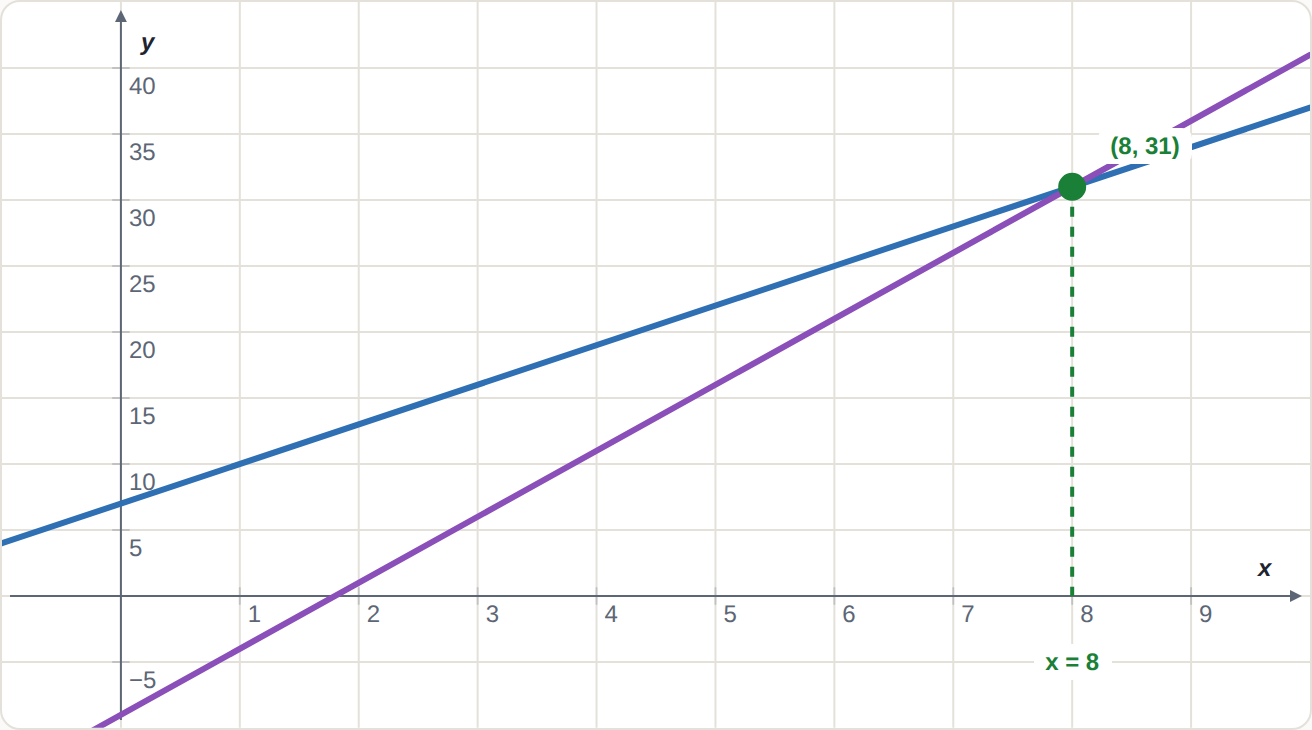
$3x + 7 = 5x - 9 \to 7 = 2x - 9 \to 16 = 2x \to x = 8$. Check: $3(8) + 7 = 31$ and $5(8) - 9 = 31$. On a graph, $x = 8$ is where the two sides meet.

y = 3x + 7 and y = 5x - 9 meet at (8, 31): both sides of 3x + 7 = 5x - 9 equal 31 when x = 8.
y=3x+7y = 3x + 7 and y=5x−9y = 5x - 9 meet at (8,31)(8, 31): both sides of 3x+7=5x−93x + 7 = 5x - 9 equal 31 when x=8x = 8.
Same to both sides, then check · Sound on for the voiceover
Open the lesson →

14. Inequalities

Try firstSolve 7 − 2x ≥ 1 and show it on a number line.

Check your answer

−2x ≥ −6, x ≤ 3 (reversed): closed circle at 3, shaded left. Check x = 0: 7 ≥ 1.

Solve an inequality like an equation, doing the same to both sides. Adding, subtracting, and multiplying or dividing by a positive keep the inequality sign. Multiplying or dividing by a negative reverses it: $-2x > 6$ gives $x < -3$ (because $2 < 5$ but $-2 > -5$).

On a number line: an open circle for $<$ and $>$ (the end is not included), closed for $\le$ and $\ge$, shaded towards the solutions. Check by trying a value: $x = -4$ gives $8 > 6$. ✓

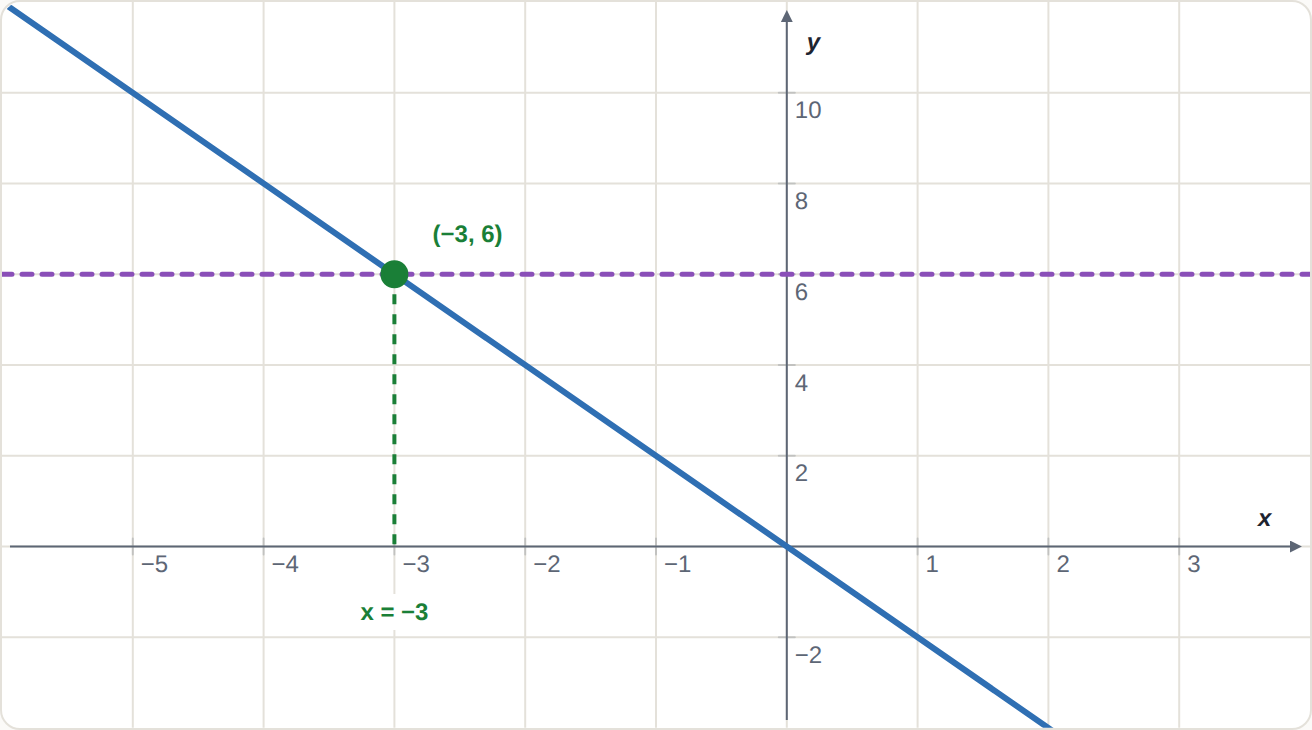
-2x is more than 6 (the line above the dashed one) to the left of x = -3: the solution of -2x > 6 is x < -3.
−2x-2x is more than 6 (the line above the dashed one) to the left of x=−3x = -3: the solution of −2x>6-2x > 6 is x<−3x < -3.
Dividing by a negative turns it round · Sound on for the voiceover
Open the lesson →